Showing posts with label Critical Analysis. Show all posts

Thursday, April 13, 2017

Collection Review: Maiden Rose--and Thoughts on Understanding a Genre

Delve into a genre--romance, mystery, country music, possibly even literary fiction--and what appears monolithic from the outside (All fantasy is the same!) appears far more variable from the inside (No, it isn't!).

Not all comic books/graphic novels/manga are the same.

Delving, however, takes effort. It means actually reading (and discarding) different works by different artists within the genre. It means developing an inner criteria or standard about what makes something bad or good. (Teachers should also do this: develop a personal theory or ideology about teaching; I have always enjoyed taking classes from teachers who have developed their own theory/style--even if I disagreed with their ideological perspective--more than from teachers who teach-from-the-book or teach-lesson-plans-developed-by-someone-else.)

I mentioned in a previous post that delving with yaoi is somewhat more difficult than with shojo--simply because yaoi is less accessible. When I started my research, I ordered three yaoi books through Amazon: A Gentleman's Kiss, But You're My Teacher, and Maiden Rose.

At this point, I was batting 1 out of 3.

The short story collection, But You're My Teacher, falls into the category that I discuss in my posts about manga short stories: Only a Premise. It is basically porn and reminded me of the endlessly amusing Provenza quote from The Closer:
Do you know why I hate porn? Guy delivers a pizza, it never gets eaten. Girl's refrigerator breaks, it never gets fixed.
Gentleman's Kiss was my introduction to Ken-doll art and to the problem of a couple that I was given absolutely no reasons to believe should be together. It was my introduction to the problem of relying on stereotypes (rather than archetypes) to sell the characters.

Maiden Rose was--and continues to be--in a class to itself.

The soft sigh or silence before
chaos descends is well-captured
in Maiden Rose.

Maiden Rose was also confirmation that explicitness does not automatically equate to erotica. Neither does it automatically equate to porn.

Maiden Rose is quite remarkably explicit, so much so that I artistically censored it for my own peace of mind (something I have never bothered to do with Black Sun). But it isn't porn. I attempt to tackle why in other posts. Suffice it to say here, the use of sex in any type of fiction to further that fiction's plot is only as salacious as (1) its tone; (2) its effectiveness.

Maiden Rose is nearly impossible to describe adequately. It belongs to high romance. It also belongs to history, being a thinly veiled exploration of Japanese culture and politics between WWI and WWII. It is also incredibly well-written, having strong, memorable characters (not only the main characters but the supporting cast) and quick, insightful, show-don't-tell dialog. The politics is believable and organic, arising naturally from the series' world. Both volumes are impressively well-translated, being possibly the only contemporary works I've read where the word "equites" is used properly and as a pun.

Ultimately, Maiden Rose is a love story. It's high romance love, so despite the relationship's consummation, there is the same ongoing, heart-aching sense of yearning that one experiences from other slice-of-life artistes, such as Makoto Shinkai (Voices of a Distant Star, Garden of Words) and Hayao Miyazaki.

Which brings me to my final point: the art of Maiden Rose is the most impressive out of all the manga I read. The series is in a class of its own.

Wednesday, February 1, 2017

Wish-Fulfillment Is Not Always Wrong

"Yes Yes Yes No No No" scene from Singin' in the Rain
In a prior post, I argue that women do not automatically read romance literature out of wish-fulfillment, i.e. because they see themselves as the heroine of the piece and/or want to be swept away by Darcy or Mel Gibson or, to update myself a little, Josh Hutchinson or (still) Darcy.

Since the belief that women only read romance for this reason is almost always accompanied by a guffaw, smirk, or patronizing tone, I refuted the argument for being patronizing; women readers are as capable as anyone at reading something for other types of reasons, from philosophical to writerly.

In this post, however, I defend the idea of reading for wish-fulfillment. Although it often gets mocked, it is a perfectly respectable reason to read.

I argue in my thesis that many readers engage in a synthesis of "using" and "receiving." I am borrowing C.S. Lewis's terms from An Experiment in Criticism, where he argues that "users" read for the message or the personal application; he is understandably not a fan of "using," and I don't completely disagree. I saw plenty of "using" during my years as a student: people reading great literature in order to find evidence for their socio-politico-economico theories. One doesn't need great literature to do that kind of thing. I can do it with a cereal box.

My contribution to Middle Earth fan fiction: a
continuation of Tolkien's map.
C.S. Lewis uses the second term, "receiving," to refer to readers allowing themselves to be swept away by a poem or short story or novel or play. They don't judge the work until they have fully experienced it.

In my thesis, I suggest a third road that combines "using" and "receiving." My point was/is that humans have a creative instinct or urge (a theory that Steven Johnson defends in his latest book Wonderland: How Play Made the Modern World), even if they aren't "creative" in the painting-pictures-writing-books-spouting-poetry sense. In fact, the desire to "make" can be as basic as "I want to make a good birthday party" or "I want to make a decent filing system." Like Johnson, I suggest that this desire has as much weight (if not more) than power and money. (And is the fundamental reason why theories like Marxism that ignore community involvement and personal investment so grossly misread people and fall short of even stock-market-valid prophetic outcomes.)

The desire to exercise their creative impulses means that while human beings want to get swept away by Middle Earth or Asimov's robots or Ahab's Pequod, they also want to imagine themselves inside those worlds. Or at least imagine that world as a real experience. It's the same reason that shows like 1900 House were so popular yet failed--the capacity for humans to imagine an experience outweighs any reality (show).

When I watched my brothers and their friends play
Dungeons & Dragons, it was the pewter figurines
that enthralled me. The game itself was too much like Risk,
which meant it was boring, not corrupting.
The latter issue is the problem--and the reason that people guffaw at wish-fulfillment. Wanting-to-be-part-of-the-romance immediately conjures up images of women (mostly) and men (too) investing themselves in a world to the point where they cease to pay their bills or feed the dog--or, to put this in social terms, date real people or apply for real jobs.

And sure, that can happen. But people who do that stuff don't need literature, popular or "great", to pull it off. Should they retreat to a created world for escapism or for some other reason, that world is no more likely by itself to engender a negative outcome than Dungeons & Dragons was to produce psychopaths (I grew up around Dungeons & Dragons players--they all turned out fine).

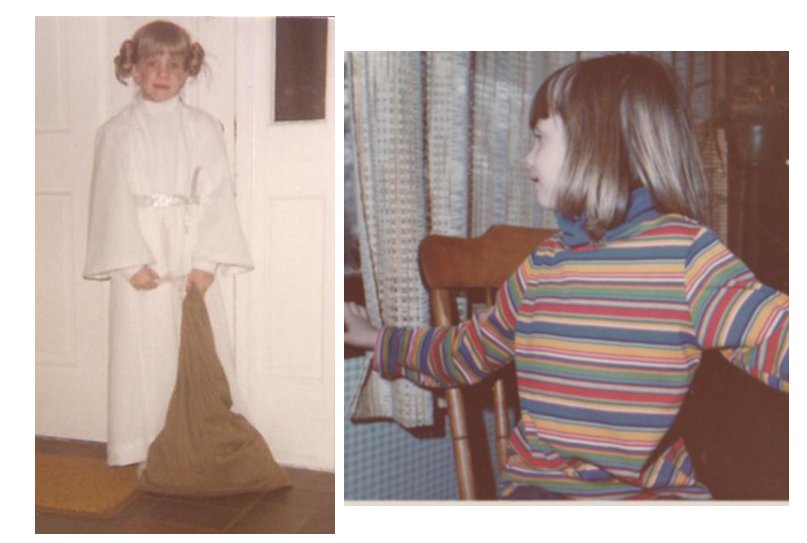
As a kid, I was obsessed with Star Wars and my striped
shirt. Neither did me any damage, although I literally
unraveled the striped shirt--unfortunately.
Besides which, beyond the kind of obsession that involves people locking themselves in a room with a media system that plays Avatar over and over and over...or listening to radio pundits rant about politics over and over and over, a little obsession is by no means an unhealthy, unproductive, or problematic thing.

I think the issue comes down to semantics. The truth is obsessive nitpicking of great literature in order to produce boring socio-politco-economico theories can be just (if not more) limiting than writing fan fiction.

But writing a "treatise" or "exploring the juxtaposition of ideological factors in The Scarlet Letter" sounds better than "I wrote some fan fiction about a character who joins the Fellowship in Lord of the Rings" (see above).

Truth: In the long run, the fan fiction will prove more satisfying and more productive. It is always better to create than destroy.