Showing posts with label Workplace Romance. Show all posts

Sunday, January 5, 2025

Everybody in Romance Needs a Job: Twilight Out of Focus

Twilight Out of Focus is an impressive series precisely because the actual jobs make a difference.

The series revolves around the senior and junior units of a high school film club. The jobs range from camera man to scriptwriter to director to actor to gofer. 

Nearly every volume tackles a particular production. The production isn't simply the container. Like with Semantic Error, the project is directly linked to the lovers' characters. 

One character wasn't sure what he wanted to do with his life. When he gets roped into one of the club's productions, his ability to act leads him to join the drama club. 

A scriptwriter/director argues with his lover over the purpose of a film. Giichi perceives a film in artistic terms. His lover sees it more as a team project, a way to bring people together. And yet they both love film and work very hard on their projects.

The gofer or production assistant or runner is on the set to get a boyfriend. However, he works hard. The film club fits his style since he has the ability to quickly master tasks and subsequently got bored in other clubs. With the film club, he stays long enough to invest himself and build relationships.

Love of the trade seeps through the volumes--it matters what the characters do, to the readers and to the writer.   

Monday, November 18, 2024

Everybody in Romance Should Have a Job: Cops in Fake

On Votaries, I discuss the importance of jobs in fiction, specifically mystery shows, specifically Blue Bloods. 

Job are important in romance too. 

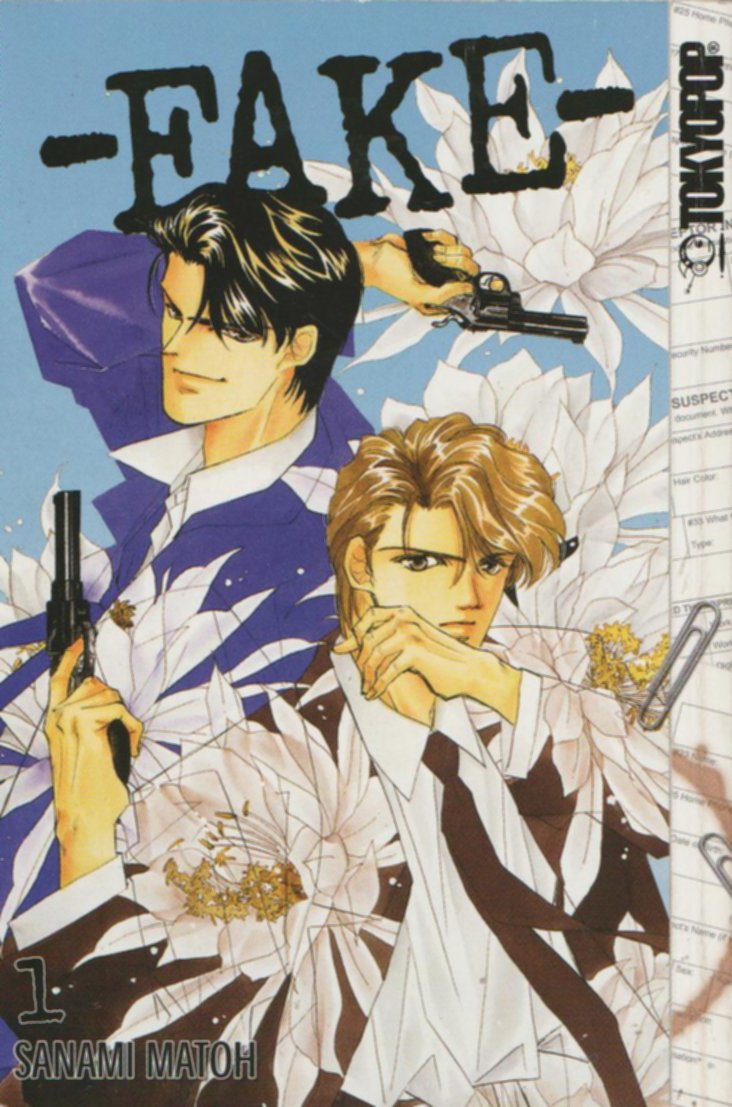
I especially enjoy the cops in Sanami Matoh's Fake.

Fake is the first yaoi series that I read--if one discounts Descendants of Darkness (which many critics do, placing it in the "too complicated to label" genre).

I believe that I read the first volume through the local library system. Memory being what it is, it is possible that I initially Interlibrary-loaned the first 6 volumes (I know I had to order the 7th from Amazon--I then worked backwards to collect them all). 

I was immediately enchanted. I love police procedurals, for one thing (Blue Bloods, The Closer, Law & Order). The series is also exceptionally well-translated; I'm convinced that the translator, Nan Rymer is also a Law & Order fan. The slang, interoffice grumblings, in-office arguments, use of expletives and contemporary allusions are entirely appropriate to the genre and to Law & Order specifically. The series came out in 1994 and was translated in 2003. I have elsewhere compared Dee to Mike Logan from original Law & Order. Ryo, on the other hand, is the archetypal dreamy hero though he is a sharpshooter par excellence!

Dee in Mike Logan-mode

In some ways, Fake was an entirely appropriate introduction to yaoi: the high jinks, ADHD ongoing action, the entire lack of reality despite the realistic setting: everyone in the police department is completely blithe about Dee and J.J.'s sexuality. Eh, so they're bi and gay; hey, who cares?! FYI: The series is set in the late 1990s, not the distant future.

In some ways, reading Fake first was a little misleading. I had no idea until much later that having Dee and Ryo be tall, obviously masculine, and equally aggressive (cop-wise) was in any way unusual for yaoi, especially yaoi in the late 1990s. Dee is the pursuer while Ryo is the pursued--but again, I didn't realize until much later that their seme/uke roles are quite unlike those in much other yaoi. Dee is always trying to kiss Ryo but there is no non-con, and he accepts Ryo's apparent disinterest with grace and surprising maturity (this is Dee we're talking about). As for Ryo, he isn't a straight man falling in love against his will with another guy. He's a gay man coming to terms with being gay.

I had no idea that any of this was outside-the-box. All I cared about, then and now, was the stories and character development. Each volume has several "cases" from a serial bomber to several serial killers to a couple of drug lords. Each case is well-plotted. There's an overarching plot with a sweet resolution.

The character development is aided, of course, by the fact that the romance takes place in the workplace. The characters have jobs

They are cops, so they have cases to discuss (see above), witnesses to interview and protect, clues to track down, fights to end. They also have a blustery Gormley-type boss, a competitive detective who tries to break up their partnership, and--after the station house is blown up--a new office to move into. 

They do all of that while presenting personal character flaws and virtues in a comprehensible context.

The series does end a tad abruptly--though there have been additions. Matoh's art changed slightly later on--I discuss this when I reviewed Until the Full Moon. For now, I will state that Matoh continues to represent for me the powerful enchantment of art-in-motion (see post about Good Manga Art). 


Sunday, October 13, 2024

Everybody in Romance Should Have a Job: Royalty

 Actually--

 I don't think royal jobs are a good idea with romance

Mostly because I think anyone who wants to marry a royal--and isn't Kate Middleton--is an idiot. 

But also because being royal is both more demanding and less demanding than a regular 9-5 job. That is, it imposes more demands in terms of continual "on-stage" performances before the public but...

It isn't exactly like operating on someone or answering the phone or stacking fruit or faxing updated reports. It isn't even like making financial decisions regarding the stock market and hoping they don't flop. Or putting forward an advertising campaign and hoping it doesn't sizzle.  

It involves both more nitpicky audience attention and less "yes, you will actually answer for this particular decision" demands. Royals do answer for things in the court of public opinion. That still isn't the same as the insurance adjuster who forgot to send an important document to the law firm and lost the law firm the case--and got fired. 

True story. 

In addition, the royal "job" entails accepting certain assumptions--such as, yes, you have to answer those dumb questions and look good on camera and pretend not to be tired and annoyed and not beg off because you really don't care about that particular cause. Yes, you have to listen to lectures about not making the crown look bad...

In other words, the characters have to accept a whole bunch of things that most romances fight AGAINST. 

Most romance-the-royal books, in my opinion, try to have their cake and eat it and hate it and extol it all at the same time. Royal life is demanding! But the people love me! And I will do whatever they need! Except I must do what is right for me! I do have to go to meetings! But I will always make time for you! 

Yeah, right. 

The best royal romances, I would argue, are indirectly about royals. Out of fantasy manga, the following stand out: 

  • The Royal Tutor, which is about the royal tutor instilling discipline into the young princes
  • Titan's Bride in which the prince's consort is from another planet
  • Selfish Mr. Mermaid, in which the prince mostly lives in the human world and only goes home when he has to
  • The Other World's Books Depend on the Bean Counter, in which the noble's job is mostly to keep his accountant boyfriend from overworking
  • Barbarities, in which the main characters' jobs are to stay alive during Renaissance-type infighting between royalty, the Church, and other parties

Generally, speaking, it's best if the royals actually have a specific problem to address alongside characters who are not royal themselves.

Sunday, September 15, 2024

The Scarlet Pimpernel: Do Spies Make Good Spouses?

Anthony Andrews' Scarlet Pimpernel is carried to a huge extent by Jane Seymour's vibrant beauty and Anthony Andrews' exceptional skill at bravado and insouciance. Unlike the book, the story starts with the courtship, and the question immediately arises: Why would a sharp-witted actress marry a seemingly shallow idiot, if not for his money?

Without abandoning the character's vapid cover, Anthony Andrews manages to give Sir Percy a hint of something deeper when he is around Marguerite. He is boisterously happy to woo her and lets her believe that there is, in fact, "more" there.
 
When they marry and he comes to believe that she sent a family to the guillotine, he retreats entirely behind his adopted persona. Marguerite rightly perceives him as hiding from her. But the lover is still there.
 
This double or, rather, triple face is only possible because Andrews is that good. He manages to give Percy an aura of sincerity no matter what he is doing. When Marguerite complains that she can't confide in him, he is truly upset. He manages to convey that underneath all the frippery and shifting attitudes, a base personality remains.
 
Generally speaking, however, I don't buy it. The history of spies reads like the history of die-hard grifters. Le Carre's version of spies--and for that matter, Andrew Robinson's Garak in Deep Space Nine--is much closer to the truth. In one episode of Deep Space Nine, Garak keeps telling stories to the doctor, as if he were four or five different people: soldier, friend, traitor, exile. All of them are true. All of them are lies. 
 
The slipperiness of an entire personality being constantly in "code" doesn't bode well for a relationship. Though it may be true that one person can never totally understand another, the sheer bewilderment of a person never being one thing--no base personality--would make it difficult to go forward with that person...
 
Unless, of course, the lover LIKES being in love with a chimera.
 
Loid [using Crunchyroll's spelling] and Yo are exceptions here, of course, since they are decent, family people who just happen (oops!) to be a spy and assassin rather than a spy and assassin who are trying to pretend to be decent people.

Thursday, July 25, 2024

Everybody in Romance Needs a Job: But Not Massage Therapist

"Massage Parlor"

A common trope in romance is the taboo relationship: professor and student, boss and subordinate, step-siblings. They resist and resist and resist...right up until they fall into each other's arms. 

It's a fun trope and can work quite effectively.

The taboo relationship of massage therapist and client never works.

The taboo is that massage therapists are not supposed to sleep with their clients since massage has commonly been associated with "happy endings" and prostitution (see Barney Miller). In much the same way that W.S. Gilbert improved the reputations of actors and actresses by insisting on separate changing rooms in the theater, massage therapy battles a reputation that only discipline and legal standards can overcome.

Consider Phoebe, from Friends, getting fired for kissing a client, who turns out to be a married jerk. Phoebe doesn't protest the firing. She knows she crossed the line. 

The few romances I've read with massage therapists have made token protests about unfair attitudes towards massage therapists...right before the protagonists fall into each other arms on the massage table. In one not-so-awful novella, the front desk administrator does threaten to take legal action, mostly because she doesn't know how to bill the insurance company. 

But it was still rather pointless. The massage therapist has a client and  they shouldn't sleep together and then...they do. So?

Restraint, in this case, would be far more interesting.  

Monday, April 8, 2024

Everybody in Romance Needs a Job: Sales and Executive Positions

In Woman's World, the three candidates for the general manager position come out of sales though Sid (Fred MacMurray) came up from the factory floor while the other two were university graduates.

While discussing salesmanship and leadership at the factory, Sid Burns agrees with everything company owner Ernest Gifford (Clifton Webb) says. Bill Baxter disagrees with the idea that a good salesman has to schmooze a potential buyer by pretending to have the same interests, claiming that technology will sell the product. Jerry Talbot, who eventually gets the job, holds his fire. 

Jerry is right (that's why he gets the job). Technology is a huge part of the equation. But schmooze--the ability to remember names; the ability to take a potential client seriously--is also part of the equation. Malcolm Gladwell points out that a successful seller doesn't make assumptions about anyone...and consequently, makes more contacts and ultimately, more sales. 

I think the scriptwriters could have done with more of these scenes but, then, the movie is Woman's World, not How to Get a Job World

Still, it helps the script that the men are competing for a specific job in a specific company and bringing specific experience to the table. Sid is very good at what he does, and he did pull himself up by smarts, dedication, and willpower. But at the executive level, he has little to offer. Bill is more interested in balancing his family with his work, yet Jerry recognizes that Bill has the intelligence, drive, and even the potential outside-the-box thinking to be general manager. Several scenes imply that the two have become friends, and Bill will become a resource. And Jerry Talbot knows how to track down resources! He is the guy who gathers around him bright people to help him do a job.

The distinctiveness of the men helps sell the distinctiveness of their wives. And vice versa.

Thursday, April 4, 2024

Everybody in Romance Needs a Job: Advertising

In Jun & Jun, Lee Jun goes to work for an advertising agency. He finds himself working for his childhood friend, Choi Jun, now returned to Korea from abroad. 

The romance develops as the two work on various advertising campaigns, one specifically for men's cologne. The show isn't one of my favorite BLs since it involves a love triangle, but it does have some fantastic work scenes that dovetail with the plot. 

Lee wants the campaign to have a specific tone or ambiance. The model working on the campaign--also a friend of Lee's--goes in a different direction. After talking with his colleagues, Lee approaches the model to try to get him to follow his guidance. The advice doesn't go over well. The model leaves the studio floor in a huff.

Lee and Choi consequently confer. Choi points out that sometimes a campaign has to change to meet what is happening with the photos/model. Although he backs Lee's idea, he adds, "But even though it may be better, it's not clear what you meant."

What Lee wants is a softer look, a "boyfriend" look, and he uses Choi to do sample photos. The model is so offended at being replaced, and having his professionalism questioned, he comes back and shows that he can do that "look" as well. 

It's a great moment because it encapsulates a real issue: the gap between the image in one's head, the actual visual, and the result. Anyone who has ever had a client who wanted a whizz-bang website that was simply not possible in reality understands this problem. 

Lee has an image in his head, an entire map of how the campaign should go. Being able to (1) communicate that vision and (2) get those involved to accomplish it...

is why good advertisers get paid so many bucks.

Wednesday, January 31, 2024

Everybody in Romance Should Have a Job: Manager

The boss, Jeng, gets upset when Pat provides
the client with a solution--when asked--
without running it by Jeng first.
Although Step by Step isn't my favorite live-action BL series, it does one thing impressively right. 

The relationship between subordinate and manager, Pat and Jeng, isn't at risk because of taboos, a ploy that I consider increasingly unusable in our modern age. 

The problem is that the manager, Jeng, is a better boyfriend than a manager. 

He isn't a horrible manager and he tries hard, but he is a micro-manager

The personality trait isn't reduced to a romantic problem. That is, he doesn't need to stop micro-managing because it upsets his boyfriend. He needs to stop micro-managing because he is driving his subordinates up the wall. 

At one point, Jeng's best friend--with whom he owns a restaurant--says, "I'm so glad we did this venture together. You're a great business partner. But if I worked for you, I'd quit."

It's an interesting point. I've been in situations where I liked a person but would never, ever, ever in a billion years voluntarily work for that person. 

Eventually, the boyfriends in Step by Step end up in different companies. They stay in the same business (advertising) so they run into each other and eventually get back together. But this is not a couple that can work together in some "oh, if they TRULY loved each other, they would..." fashion.

Sometimes, time apart is healthier.

Sunday, October 29, 2023

Everybody in Romance Needs a Job: Professor & Archaeologist

"HIStory 2: Right or Wrong" is a decent BL series for a number of reasons. 

One reason relates to this post's title. The professor is not some generic professor. He is a professor of archaeology, more specifically, anthropology. He not only is constantly researching, checking sources, preparing notes, the class he gives focuses on life rituals.

And he appears to actually be good at his job--even if he fails occasionally as a father. 

He lectures with confidence. He makes assignments. He demands that his students meet a high standard in a friendly way, without coming across as either rule-obsessed or as playing favorites (difficult since one male student is his nanny and eventually his boyfriend, though they don't become official until the class ends). He is objective. He is also something of a romantic, as befits a man who loves history. (And he likes to tease, but that archetype is a separate post.) 

The professor-student romance has problems. "HIStory 2" pulls it off largely due to the professor inhabiting a very relatable field and demonstrating a believable and layered personality within that field. 

Sunday, September 17, 2023

Everybody in Romance Needs a Job: Programmer

A number of romantic comedies use the workplace as the "container." A number also use programming as the underlying issue, including Senpai, This Can't Be Love and Semantic Error

Semantic Error stands above the rest, including Senpai, This Can't Be Love, for the very good reason that the programming actually matters.

That is, the programming problem not only lends its title to the series, it also informs the behavior, opportunities, experiences, and choices of the romantic leads. 

Jaeyeong is the designer and Sangwoo likes his work from the start, even as he finds the other man extremely exasperating. Their initial meetings come about because Sangwoo is looking for a designer for a game he is programming.  

They are enemies-to-friends, of course, since Sangwoo has also refused to give credit to his virtual peer group for leaving him to finish a project alone. He "outs" the group members, including Jaeyeong. He does so using a PowerPoint that designer Jaeyeong  finds more deplorable than the "outing"--because it was just sooo bad in appearance. 

The enemies' aspect of the relationship changes when a venture capitalist maven--who obviously takes advantage of young talent--comes to campus. Sangwoo--clear-headed, literal, and unimpressed by empty promises--offends the maven by demanding a contract. Jaeyeong backs him. 

Jaeyeong goes to Sangwoo for help when his computer dies. He takes a programming class that is somewhat above his head because Sangwoo is in the course (the distinction here regarding specialties is impressive and shows up in Numb3rs). The two ultimately work on a project with great potential that perfectly meshes their professional-grade talents. The project operates as a catalyst for the aforementioned exasperation, the relationship, and show-don't-tell personality growth.

Their work doesn't merely provide opportunities for various romantic events--arguments, photo opportunities, rivals, late nights, overseas job opportunities. 

Their work IS their personalities, a reflection of what they care about and how they function.  

Quite appropriately, Sangwoo's personal epiphany--his realization that he wants to reboot or reset his relationship with Jaeyeong rather than delete it entirely--uses a computer analogy. And he uses Internet terminology to discuss giving a relationship with Jaeyeong a "2-week trial."

Brilliant writing! Excellent use of a profession!

Saturday, July 15, 2023

Romance Writing Problem: Squandering Power Imbalances

Separating the couple in a romance is nearly a given. The reason for the separation varies. One common reason is a power imbalance. Boss and intern. Boss and employee. King and courtier. Professor and student. Homeowner and handy man. And so on.

In many cases, despite some initial hesitation, the power gap can be ignored or easily overcome, in large part (most of the time) because the relationship is accepted by society (to a degree). 42% of people have dated a co-worker while 16% of couples met each other at work. Likewise, though far more negatively viewed these days, a college professor and student is fairly common fodder. And hey, for king and courtier, there's always Elizabeth I and Robert Dudley. 

I recently encountered such a relationship in a novel that I just couldn't defend. The relationship was a parolee and the equivalent of a parole officer--actually, the supervisor of an early release program. 

IT working relationship--quite believable!
The same writer created a similar earlier book with a relationship that I could endorse, namely, the parolee was sent to the ranch to work but the immediate parolee's supervisor was not running the program.

With the more recent book, however, I kept thinking, "Man, they are so going to lose their funding." 

The program gets state money, and no one at the state level is going to fund a program where the person in charge slept with one of the parolees before the program ended. Absolutely, no way

The writer makes a fundamental mistake, which I address elsewhere, including here. Because we readers see inside the protagonists' heads, we know that there is no power imbalance, nobody is taking advantage, and everybody truly loves everybody else. Consequently, when one of the other parolees makes a sarcastic remark about the relationship, the reader is supposed to view the sarcasm as misplaced--an obstacle for the lovers rather than a red flag. 

Nope. It's a red flag. No way would anyone in the program be able to trust the supervisor from that point on--any more than students can trust teachers who play favorites or sleep with students in the same program/course (which is why that relationship, though relatively more common, still raises eyebrows). 

And no way would the state--the bureaucrats who require documentation for everything--ever fold in the face of "but we feel so strongly!" reasoning. I have an image of completely unimpressed inspectors nodding away sympathetically right before they walk off with all the money and equipment. 

Basic professional behavior is expected, folks. The money can go elsewhere.

The sad thing to me is that the writer respecting boundaries here would have created more tension. In our increasingly democratic age (whatever doomsdayers like to believe), it is more and more difficult to create external barriers for lovers. In the charming Thai series, The Boss and the Babe, the barrier of boss and intern is little more than a temporary snag. The greater barrier, intelligently, is Cher's tendency to take the weight of the world on his shoulders while showing a smiling face to the people around him. Psychology has to be the fall-back position.

Which means that if an actual barrier exists, don't squander it! Use it in some way. 

In the aforementioned book, the parolee could leave the program, then return as a civilian. The supervisor could step down. The parolee could move to a different team. They could both wait until the program ends. Ramp up sexual tension and solve the problem creatively! 


Sunday, June 11, 2023

Everybody in Romance Needs a Job: Architect

I mention in a prior post that the best characters have jobs. 

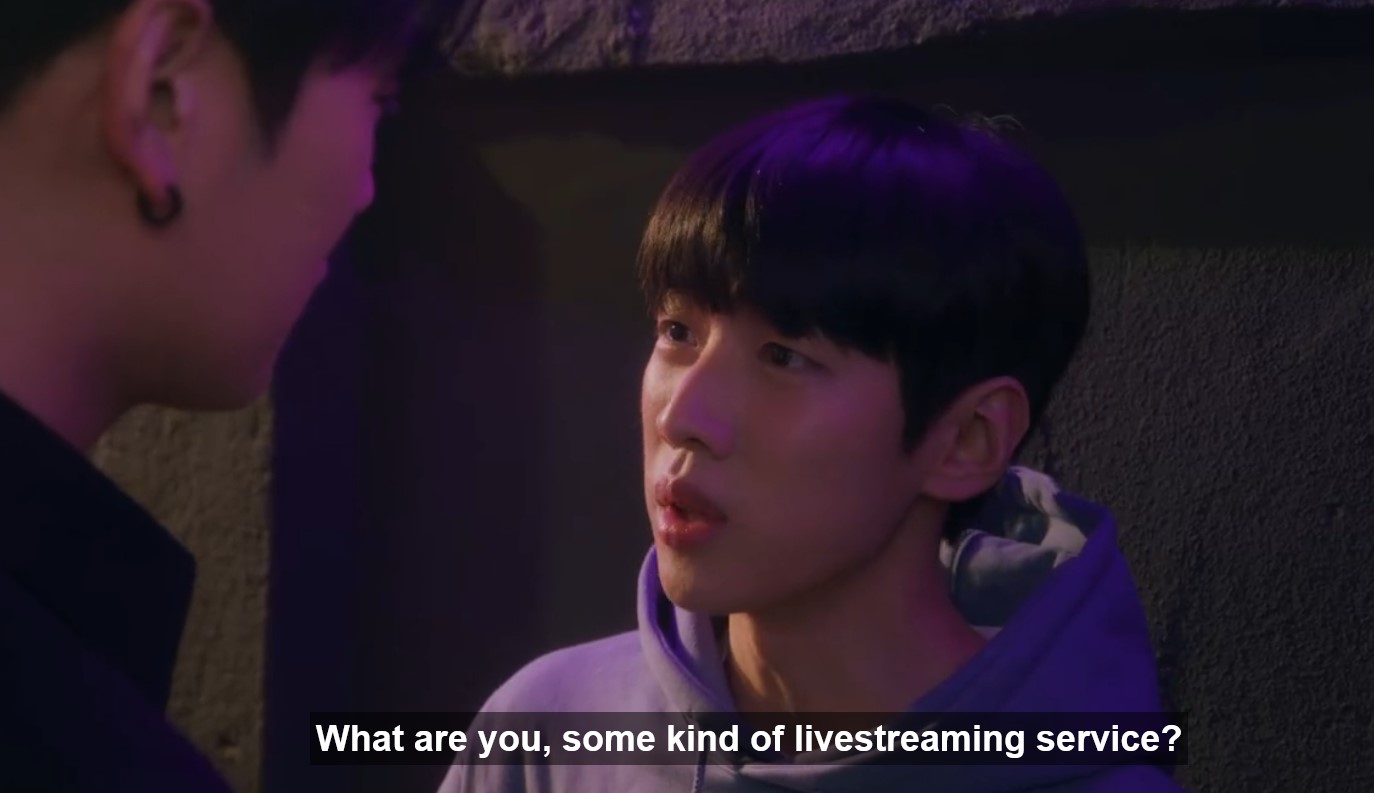
Love in the Air has numerous writing problems, mostly at the end. However, one writing choice that is spot-on is that the two male leads (who are wooed by older men) are college students enrolled in the architecture department or "faculty". 

Consequently, when they need to show their long-term commitment to the relationship by doing well in school (a common trope in Asian romance), they complete actual projects that involve actual work. 

In fact, I suspect that the writers either did research or knew something about the program/projects. 

The writing-choice re: jobs extends beyond the above trope. When Rain misses a deadline, he is told in no uncertain terms by his professor and his lover that he better learn now to cope with deadlines because the real world isn't any nicer (his lover is also an architect). 

In addition, several scenes show the students grouped around drafting boards and, at one point, in a fellow student's dorm room as they prepare for their presentations. The conversations do not, as they so often do in Thai dramas, revert entirely to discussions of food and drink. The students have a grounded topic to discuss and debate.

Good writing choice--and an interesting one!  

Monday, September 2, 2019

Candy Color Paradox Review

Candy Color Paradox is the latest yaoi series form Isaku Natsume. I recently read Volume 1, and it is fairly standard fare--with a welcome difference.

One of Natsume's strengths is that she gives her characters jobs. In a prior series, False Memories, the main characters work for a toy company and its marketing firm/distributor. In Candy Color Paradox, the main characters work for a weekly magazine (the equivalent, as far as I can tell from the description, of People magazine: serious news alongside gossip stories).

I've said it before--I'll say it again: giving characters jobs strengthens their characterizations.

In this case, the two characters, Onoe and Kaburagi, while investigating a gossip story, stumble across a yakuza story--or at least, ties between yakuza and the entertainment industry. Although Onoe, the writer, comes across as more impulsive and inexperienced, he is the one who spots the possible yakuza in the corner of one of Kaburagi's pictures. He may be prone to overreactions; he is still good at his job. His strength is his memory and research.

On the other hand, Kaburagi, the photographer, is the one who came up with the initial leads through his networks and his willingness to obfuscate in order to get information. His strength is his adaptability.

One can see why the bosses put them together. One can even see why a relationship might work. Their strengths complement each other.

Very smart writing.  

Tuesday, February 6, 2018

Romance and Jobs (Again)

Contrary to some silly Jane Austen-tributes, being a landowner
(like Darcy) was a job. Hence, the grandfather's shame in
Little Lord Fauntleroy for not improving his tenants' cottages.
There are a number of well-written paperback romances out there ("paperback romances" being my term for what used-to-be called "Harlequins"--though they are now published by many different companies--in which the plot focuses on male/female protagonists).

What amazes me in my reading of M/M romances is not only how many of them are also well-written but how many of them are philosophically dense as well.

I'm not saying they rival Dostoevsky, but hey, I never got through Crime & Punishment anyway. Frankly, I like my stories stream-lined with strong characters, a seamless plot, and no "shoe shopping"  tangents. Tell me a story! Keep me entertained! And give me a little meat.

Good M/M romances deliver a surprising amount of meat.

I've determined that part of the reason comes down to something I've mentioned with manga: it helps if characters have jobs.

In historical paperback romances, the female leads sometimes have jobs (more on this later) but rather too often their (understandable and comprehensible) goal is to (1) get married; (2) not get married; (3) figure out who to live with if they don't get married; (4) avoid getting married, etc.

I'm being a tad sardonic; the truth is, these were real and valid issues for woman of the past, especially Jane Austen's time period, and novels that deal with those issues are doing justice to real concerns.

Still, there's something to say for books where everybody has to have an outside job/career, whether as a landowner (see above) or an accountant or a novelist or a sailor or an attorney or a professor or a bookseller or a bureaucrat--to name a few male characters' jobs from novels by Cat Sebastian, KJ Charles, Alex Beecroft, Joanna Chambers, and Charlie Cochrane. By necessity, the characters' jobs bring other forces, problems, and realities into play.

This may explain why so many women enjoy writing historical M/M.

It explains too why the paperback-romances-with-jobs stories often are the best within that sub-genre. Nobody did "the occupation of getting married" better than Jane Austen. Still, it's nice to read something like Romancing Mr. Bridgerton by Julia Quinn where the heroine's job as a gossip rag columnist arouses both concern and jealousy in her suitor's breast. He is worried about her reputation if the truth comes out (a lady, she writes under a pseudonym); as a fellow writer, he is also jealous of her success, no matter how hidden from the world. His jealousy surprises and alarms him--and causes him to rethink his own long-term goals.

Marriage and the relationship is one concern. Other issues--what constitutes a life? how does one measure success? what kind of work is worth doing? what does it mean to do something 'well'? whose needs and desires should a person's purpose in life satisfy? when does a job becomes a kind of slavery? what is the line between private achievement and outside obligation?--lend the characters depth.

To put it simply: because they are interested in something else, the characters become interesting.

Saturday, July 22, 2017

The Couple on an Island

Although I generally praise the couple-who-works-through-problems-within-society rather than the-couple-who-retreats-to-an-island, there is something to be said for the couple-that-is-an-island-unto-itself. These couples almost always occur in a society that is so corrupt that turning to each other is the only refuge (the theme of Baz Luhrmann's Romeo & Juliet).

John Howe's definition of Tauriel and Kili is a good guide here:
The relationship between Tauriel and Kili is like one of those love stories where people think they are falling in love when, in fact, they are actually falling out of love with everything else around them, and the only sympathetic face is someone who they would never choose in any other circumstances...
In manga, this couple is most commonly found in the world of the yakuza.

Twittering Birds Never Fly by Kou
Yoneda has a similar feel to Intense
although it is somewhat more layered.
One of the most remarkable yaoi series in this regard is the Korean mangwa Intense by Kyungha Yi. Jiwoon works for a mob boss; he perceives his life as locked into this one small corner of the world. Soohan does odd-jobs for mobsters but entirely by choice and without investment; he retains his independence. To him, the world is big enough to allow for escape. So why not do it?

The result is . . . intense--the kind of stuff that can lead to tragedy as easily as comedy. It belongs, consequently, to the high romance side of romantic literature. I generally prefer the slice-of-life moments of ordinary people leading ordinary lives but high romance has its place. Well-done high romance can impress--at the same time one thinks, "Wow, not having to worry about much more than feeding my cats is . . . kind of nice."*

*Intense ends with the interesting point that going from high romance to ordinary life might prove as troubling for the characters as for the readers. Sure, Lancelot and Guinevere brought down a kingdom, but could they have managed on a fixed income with chores, pets that need to be walked, and one television remote? 

Sunday, March 5, 2017

Workplaces and Plot

I comment in a prior post that manga (really, all fiction) works best when the main characters have jobs (one likely reason that Buffy went downhill after Buffy graduated high school was her character was far too realistic as a waffling, non-employed 19-year-old, and waffling, non-employed 19-year-olds are not exceptionally interesting).

Manga use workplaces in a variety of ways. 

The Workplace as a Useful Way for the Protagonists to Meet
Much yaoi and shojo revolves around salary(wo)men and their problems. The office environment becomes a useful source of obstacles but also a useful excuse for the protagonists to meet (followed by the useful obstacles).

However, as mentioned in the previous post, a vague office environment is not nearly as effective as a specific one. 
False Memories by Isaku Natsume uses the setting of a toy company and its contractor (the company that will make the toys). One protagonist, Nakano, belongs to the toy company. The other protagonist, Tsuda, belongs to the contractor. They know each other but haven't met in many years.

In classic networking business style, once their respective bosses realize they knew each other in high school, the bosses stick them together as the respective point men for their teams. So they have to meet a lot and talk, no matter how much Nakano (says he) doesn't want to. Useful, believable context that creates masses of ongoing tension.
The Workplace as a Useful Source of Conversation
Even a couple that doesn't work together needs something to talk about. No matter how much they love each other, ordinary life must still be dealt with--and ordinary life includes work.
In What Did You Eat Yesterday? by Fumi Yoshinaga, Shiro and Kenji work as a hairdresser and a civil lawyer. They discuss their friends, their families, food (of course), and their jobs. Even when they don't discuss their work directly, what occurs at work affects their attitudes and conversations at home. In the image, Shiro realizes with a shame-faced shake of his head that he finds it easier to listen to his clients' problems at work than to Kenji's far less complicated problems at home.
Everybody's Getting Married by Izumi Miyazono: This screwball-like shojo comedic manga revolves around a young career woman who wants to get married and her boyfriend, a young newscaster/host for entertainment shows who doesn't. But they love each other anyway.

They can't talk about not getting married ALL the time. The rest of the time they discuss their jobs, mostly his, including the tension he feels having to host a live televised show and how he handles his critical boss. 
The Workplace as a Useful Source of Plot
And sometimes the job is the plot. Toko Kawai's In the Walnut and Loveholic are both excellent examples of work supplying the main problems. Character development is linked directly to how the protagonists handle these problems. 
In the Walnut is the title of a 2-volume series and of the art gallery around which the series revolves. In the Walnut is owned by Hideo Tanazaki. His boyfriend, Sohei Nakai--a film student graduate who works for independent (starving) directors--often visits, only to get embroiled in slightly shady transactions. Sometimes, these transactions involve condoning a forgery; sometimes, they involve uncovering a theft; sometimes, they involve outbidding bad guys at auctions. In fact, the manga is a kind of mystery series in which Tanazaki solves art problems by moral though not always legal means.
Note: "In the walnut" refers to Hamlet's speech in Act 2, Scene 2: "I could be bounded in a nutshell, and count myself a king of infinite space, were it not that I have bad dreams." ("Nutshell" is sometimes translated as "walnut.")

The protagonists of Loveholic are an independent photographer and a manager from an advertising agency. Problems at work often spill over into their personal lives. When Daisuke Matsukawa's jealous co-workers sabotage his marketing campaign by stealing his ideas, Kentaro Nishioka agrees to supply him with new shots and even delivers them to the office. He also agrees to enlarge prints for Matsukawa at the last minute; in revenge for the unexpected request, he includes a silly picture of himself which sends Matsukawa into fits. The silly picture becomes a recurring motif throughout the manga.

On a more somber note, the issue of work and family leads Nishioka to decide to relocate. He has gotten as much as he can out of living in Tokyo. He is ready to move back to Osaka and give back to his community there. Naturally, the issue, Do I ask you to go with me? arises.
Whenever I'm reading a book with vaguely defined characters, the first fix that comes to mind is always, What do these people want to do with their lives? Work-wise?

The next question is, What books do they read!?

Tuesday, December 27, 2016

Character Archetypes in Manga, Part II: Dee and Ryo

In the prior post, I discuss the power of archetypes. I end by admitting that stereotypes--as opposed to archetypes--often fall flat. I've read romance novels and manga where the characters were little more than their labels--dominating hero, sweet heroine; seme, uke . . .

So what is the difference between an archetype and a stereotype, literarily speaking?

The archetype, as opposed to the stereotype, is all of a piece.

My positive example couple for this blog is Ryo and Dee from the series Fake (my non-manga back-up example can be found on Votaries). Ryo is the supposedly steadier, quieter member of the duo. He is good at paperwork, actually saves his money, and appears more reasonable/rational in conversation. He is also an excellent sharpshooter.

Dee is the Mike Logan of the two (the series is set in NYC; Ryo and Dee are cops). He is impulsive, romantic, seemingly boastful (but yeah, it's mostly talk), shrewd, and street-smart. He is an excellent detective.

As one might suppose, Ryo comes from a wealthier, more stable background: two loving parents (who are killed, propelling a young man who would typically have gone into business or civil law to go into criminal justice instead--think Jamey from Blue Bloods) and a large extended family.
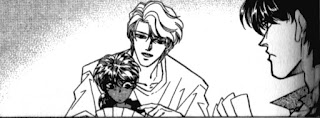
True to type, Ryo is also good with kids--though
Dee can be perceptive about their behavior
when it reminds him of himself.

Dee, on the other hand, was raised in a Catholic orphanage. Although he never knew his parents, he has a strong filial relationship with the woman who runs the orphanage. He could have gone "either way" as a teen and seems to have chosen the justice side from an innate distaste for the sleaziness of the criminal lifestyle.

The archetypes--Ryo as patient, soft-spoken steady partner to Dee as brash, impulsive partner--is set by the middle of the first volume. What keeps it working is that the writer/illustrator doesn't forget what her characters are and pushes each archetype to include all their behavior, including how the characters respond to new events.

Ryo's reasonableness extends to him not believing in ghosts, something more romantic (despite being more shrewd) Dee does: "Yup, that how it always works, isn't it?" Dee complains. "It's always the sensitive guys you'd expect to believe in things like ghosts that are the uber-realists."

Ryo's reasonableness is also of a different brand than Dee's practicality, especially when it comes to holding a grudge. Ryo is the type to mull on something for years; Dee is the type to blow up at someone, then shrug his shoulders and move on.

Ryo's tendency to ruminate makes him apparently more dreamy (though infinitely more skeptical) than Dee. As Dee says to Binky, "He may look flighty but he's actually quite reliable" to which Binky responds, "I think he looks reliable but is not all there." Dee, the supposedly more irresponsible partner, never fails to follow through. Once he's on your side, he's on your side forever.

The variations within Ryo and Dee's responses give them ballast while keeping them consistent to their archetypes. It is utterly believable that Ryo would keep information about his parents' killers to himself while Dee would dash off to confront a villain. It is also believable that Ryo would feel a little weepy on Christmas (near the time his parents were killed) while Dee would burst into his apartment, carrying presents and a teeny-tiny tree (love that teeny-tiny tree.)

In other words, assigning archetypes doesn't start and end with a single event or adhere only to the characters' personal relationship. It washes through all aspects of their lives and dovetails with prior behavior/events. Stereotypes, on the other hand, tend to remain consistent only so long as a character needs to be DOMINANT or TRUSTING or PUSHY or . . . whatever.

Goh and Taki of Yellow comprise similar archetypes to
Ryo and Dee; yet, they are specific characters
with specific backgrounds.
Because they remain whole and consistent, characters based on archetypes--Persephone, Luke Skywalker, Westley & Buttercup--remain memorable. More importantly, the psychology of their behavior makes sense. They don't do things because, hey, it's time for the MENTOR to give a speech, the VILLAIN to act threatening, and the SEME to demand a kiss while the UKE gets nervous. Dee's pursuit of Ryo is rooted in his desire to have a family; he is fundamentally better off in a relationship than outside one. Ryo's initial reluctance regarding the relationship is rooted in his uncertainty about his path in life which uncertainty is rooted in his personality: he's a "I need to think about this A LOT" kind of guy.

Stereotypes, on the other hand, never move beyond the annoying assumption that the reader will accept the behavior because, well, that's what a mentor or villain or seme or uke does. The archetype, on the other hand, becomes the character becomes the behavior which confirms the archetype.

And archetypes are powerful! Well-crafted archetypes create interesting characters who capture their fans' hearts. They become more real than any amount of "well-roundedness" could possibly manage.