Showing posts with label Reference to Jane Austen. Show all posts

Tuesday, August 25, 2026

Assumptions as Disguise; Revelation as True Knowledge

In romance, a lovely version of disguise based on assumptions is when assumptions are set aside and the couple make a connection. Darcy and Elizabeth, of course, are a classic example. Elizabeth especially--since so much of the novel is told from her perspective--sets aside her assumptions about Darcy (based on her own ideas and Wickham's insidious suggestions) to figure out the guy as he is, from his housekeeper, no less! 

In yaoi/MM romance, Winterbourne and Wataya are two great examples. In Joanna Chambers' Introducing Winterbourne, the secondary hero, Adam, realizes that his host for the day, Lysander Winterbourne, is not like his father. His blond good looks and careful tact are not the looks and actions of a self-entitled brainless profligate yuppie (the 19th century equivalent) but those of an insightful and kindly man who would rather be looking after an estate than meeting people in parlors. 

In Cherry Magic, Tsuge originally sees Wataya as a "punk." His magic allows him to see that Wataya is actually a pretty responsible and straightforward guy--who likes cats! 

The "reveal"--the disguise tossed off--happens mentally. It is just as satisfying as a cloak being removed.  

Sunday, May 31, 2026

Shakespeare's Couples: Romeo & Juliet, Part II

Alex Beecroft's M/M Shining in the Sun is a good example of a Romeo & Juliet (or, in this case, Romeo & Romeo) tale working. The main characters, Alec and Darren, come from different social classes. How do they overcome internal and external pressures to part?

Beecroft's answer is for Alec and Darren to acknowledge the stressful differences. When Darren has to meet Alec's well-to-do, Lady Catherine-like mama, he resents being "put on display" as well as the subtle ways in which the mama and the waiters at the fancy restaurant make him feel uncouth. Likewise, when Alec goes to meet Darren's grandmother, he is appalled by the woman's poverty.

The latter scene is fairly brilliant. Darren wants Alec to meet his grandmother; Darren himself has always been impressed by how clean she keeps her tiny house; how hard she works to wear matching slacks and pullovers. Then he sees his grandmother through Alec's eyes. The house is clean but shabby (and lacking in basic amenities). His grandmother's dress is presentable yet threadbare (and Walmart cheap, not haute couture). He resents Alec for this new perspective.

A Juliet and Romeo who seem to 

know what they signed up for.

Both Alec and Darren have to overcome their judgments and resentments in order to move forward. 

Without an acknowledgement of their differences, Romeo & Romeo or Romeo & Juliet or Juliet & Juliet (and so on and so forth) will stall and disintegrate, leaving the reader with the awful instinctual knowledge, "This relationship is doomed--even if nobody dies."


Saturday, May 30, 2026

Shakespeare's Couples: When Romeo & Juliet Work, Part I

Despite generations of heart-sick teenagers taking Romeo & Juliet as a blueprint for "success," Shakespeare likely meant it as a cautionary tale--directed more at the parents than the teens.

The Romeo & Juliet trope rests on the premise that two people from opposite sides of the tracks meet and fall in love. Maybe their families are enemies. Maybe one is a liberal and one is a conservative. Maybe one is poor and the other is rich. Maybe one is royalty and the other is an obscure non-royal (Cinderella). Maybe one is a spy or con-artist and the other is the mark.

The tension arises from (1) outside forces stating, "You must not be together." And (2) inner forces stating, "I don't really get you."

Sometimes the tensions are resolved in accordance with the tale's most celebrated example: lots of death. Sometimes it ends with sacrifice and acceptance (Casablanca). Sometimes it ends with an utter lack of realism. And sometimes, if handled correctly, it ends with a sweet, romantic resolution.

The first two are not the focus of this post (despite Casablanca being a great movie). The focus is the last two: what separates the positive romantic unbelievable ending from the positive romantic believable ending.

The difference lies in acknowledgement of the accompanying problems.

In Frasier, Niles meets Daphne's lay-about
brothers and still wants to marry her.
Unrealistic Romeo & Juliet tales focus only on (1) the external forces rather than accepting that (2) internal qualms will have impact.

Internal qualms count because people cannot be magically stripped of their familial/cultural/monetary expectations. There is a reason that most people do, in fact, marry within their "class" (even in America). One reason Austen is so popular even now is that she verbalizes issues that have become taboo in our own culture (every culture has, as Tom Wolfe argued, its own Victorian Gent).

Truth: money and background impact relationships.

Elizabeth can argue fiercely with Lady Catherine de Bourgh that she equates to Darcy since she is a gentleman's daughter. Yet Austen never allows any of her heroines to contemplate marrying a farmhand or a minor clerk in an office. Love conquers all within a specific social milieu.

Austen was not being naive or prejudiced; she was being realistic. Money, where people want to live, how people want to live, their friends, their families, their social settings: all these things are factors in a relationship. To pretend they are not is to leave the door open for worse problems.

Austen perfectly encapsulates these "worse problems" in Sense & Sensibility. At the end of the book, Willoughby--who married for money--regrets that he didn't marry for love. Elinor wisely reflects that if Willoughby had married her sister, he would have ended up resenting their mutual poverty.

So how does a Romeo & Juliet tale end without the couple, in the long run, hating each other's guts because "you estranged me from my family...you buried me in poverty...you forced me to live in a horrible city/country/town...you prevented me from accomplishing what I could have accomplished..."?

Romeo & Juliet Part II

Thursday, May 14, 2026

The Omniscient Lover: Bad Writing However Desirable

On Votaries, I comment on the problems caused by omniscient detectives.

Omniscient lovers cause equal problems. The best romances, though they may involve rescues, provide lovers who improve. Darcy learns to communicate outside of his man-cave. Elizabeth learns that she may--despite her quickness of thought--misjudge situations. They come to an understanding.

The omniscient lover overrides all that. This lover may sometimes express doubt, may occasionally--after knowing exactly what the significant other wants, borderline stalking the significant other, arranging the significant other's life--say, "But if you don't want to--"

But such token "I guess you have free will" statements don't suggest a personality in need of transformation or adaptation. Such lovers are rather dull.

However, I do understand the creation of the omniscient lover better than the creation of the omniscient detective--why it is such an attractive proposition. I believe that at the back of original sin or the natural man--the stuff that leads people to behave stupidly and meanly--is a desire for ease, for guarantees, for absolute and all-encompassing answers.

Life is just so hard! And people often wish it could be simpler. Label the bad guys. Force the perfect utopia on people. Go with the latest peer pressure/trend.

Dorothy Sayers called this behavior "snatch." And it's understandable--even if wrong (and explains the number of people who have convinced themselves that Chat GPT "borrowing" other people's work for their benefit isn't lazy, short-sighted, and unethical: what will humans do when the work becomes one mass of circular reasoning?)

In romance, searching and dating and breaking up and searching and dating and trying to make a relationship work is hard. It's exhausting. It's understandable that people sometimes fall back on a trope where the desired partner simply makes it happen.

Of course, few people truly want that "simple" solution when it does appear.

Saturday, May 24, 2025

The Problem of Ross & Rachel: Why It Still Doesn't Work

Julia Roberts shows up, Friends, Season 2

I discuss the rival-character on Votaries. I was reminded of Ross & Rachel whose entirely dysfunctional relationship relied to a degree on jealousy over rivals. 

Here is a repost from 2017. 

* * *

I recently rewatched most seasons of Friends (with self-censoring). It is a remarkably well-written and well-cast show, especially for its time period, 1994-2004. Friends slightly precedes the years when television became the massive money-maker it is now. This may sound odd to the younger generation, but when Michael J. Fox (intelligently) returned to television to star in Spin City in 1996, his decision was still considered rather daring. A television star who made it to the movies going BACK to television?! (That he'd been diagnosed with Parkinson's was not known by the general public until 1998.)

Now, no one thinks anything of Fox's courageous choice. So Friends--with its Hollywood guest stars--was oddly and impressively prescient, and was from Season 1. The network obviously decided to do what all shows wish the network would do for them: back it to the hilt.

David Schwimmer as the Holiday Armadillo
Having said that, I find it almost impossible (still) to watch Ross & Rachel together. Jennifer Aniston is a fine comedienne and David Schwimmer is surprisingly willing to be the Don Knotts of the show--although Don Knotts is more charming.

As a couple, they grate. I self-censored nearly every one of the "fighting" episodes--and a number of the "wondering if we should be a couple" ones as well.

Why? As Eugene points out, failure to mature is the main reason. On an episode to episode basis, what becomes increasingly unbearable re: Ross and Rachel is the ridiculous business of both characters waiting for some special lightning bolt from the blue to decide "we are in love."

They date. They're friends. They care for each other. They sleep together. They have a baby. They live in the same apartment for a number of months. But they can't marry because "it doesn't feel right"?

It's a level of emotional self-indulgence that makes the brain melt. What exactly are they waiting for? As far I can tell, they are waiting for a single subjective moment that writes "I feel it! I feel it!" on their souls--which makes me doubt that the (final) marriage will last more than two seconds. After all, subjective feelings are prone to wax and wane. How long will it be before the writing fades?

Elizabeth hearing praises of Darcy
from his housekeeper.
Compare this with Elizabeth, who was likely always attracted to Darcy but acknowledges her feelings when she encounters his good reputation at Pemberley. It isn't his wealth (although Elizabeth herself jokes about that possibility) but his decent behavior that confirms her (subjective) feelings. Her respect for him grows until she can answer her father's incredulity ("Let me not have the grief of seeing you unable to respect your partner in life") by "relating her absolute certainty that [Darcy's] affection was not the work of a day, but had stood the test of many months’ suspense, and enumerating with energy all his good qualities."

Compare Rachel & Ross with Booth in Bones who doesn't immediately leave Hannah the moment Bones confesses her feelings to him. The man doesn't substitute a lightning bolt for loyalty and commitment. 

From manga, compare R&R to Fumi Yoshinaga's What Did You Eat Yesterday in which Shiro's desire to keep the relationship growing (partly because he hates the idea of having to start over) leads him to spend extra money on fresh peaches for Kenji (Shiro is a cheapskate so this is a big deal). His later resolution to spend New Year's Eve with Kenji--rather than his parents--is handled with maturity: he invests in his partner.

And from anime, compare R&R to Taeko and Toshio from Only Yesterday who slowly discover similarities as well as differences to admire during Taeko's vacation in Yamagata. In the end, they indicate a willingness to further a relationship of mutual respect.

Love and attraction is part of the equation in all these cases. The difference between them and Ross & Rachel is that the believable relationships don't rest upon some arbitrarily designated moment that may or may not arrive. Initial love/attraction plays a role, but the actual relationship is the result of investment and the additional perception, "I am lucky to have found this person." At the core is (to go old school) high regard, a quality I simply don't believe Rachel and Ross have for each other.

Thursday, January 16, 2025

Defending the Indefensible Relationship: Austen's Mrs. Clay & Mr. Elliot; Richardson's Mr. B & Pamela

On Votaries, I discuss unliked characters who end up with their own books. 

Unliked relationships are a little less likely to be defended. P.D. James did defend Withers in her Death at Pemberley but not because his relationship with Lydia had substantially altered. 

I defend two classic relationships, one negative in the original text; one negative according to later critics.

In Persuadable, Mrs. Clay pursues and married Mr. Elliot. I basically make them low-key grifters who recognize each other's nature. They are attracted to each other, mostly because the people around them are so comparatively boring. 

Interestingly enough, although Jane Austen quite often ruthlessly goes after opportunists, she lets Mrs. Clay do whatever Mrs. Clay does. There's an entirely unspoken acknowledgement that women who marry for money or position or protection are, in fact, saving their skins. She treats Charlotte from Pride & Prejudice coldly but with understanding. 

The second relationship is Mr. B and Pamela in Mr. B Speaks! When Samuel Richardson's book was published, this couple was...think Brad & Jennifer, Taylor & Burton, the Twilight stuff. HUGE. Real churches rang real bells in celebration of the marriage. Sure, Henry Fielding mocked Pamela with Shamela, but most people were totally on-board. Mr. B and Pamelay WERE the eighteenth century's favorite couple.

Now-a-days, we look askance. Mr. B appears to stalk Pamela; he kidnaps her, harasses her, nearly (but doesn't) rape her, plans to fool her with a fake clergyman, and then, finally, marries her. 

However, I think that Richardson is a great example of a guy who thought he was writing one book but got too interested in something else. He gets too interested in the debate/repartee between Mr. B and Pamela. 

Those conversations, when shorn of their eighteenth century verbiage, strike me as something one hears on The Thin Man

So I set out to explain and justify that relationship. 

(Persuadable & Mr. B Speaks! will be republished by Aurora & Bob Press in 2025.)

Tuesday, December 24, 2024

Romance Archetype: The One That Got Away

The one that got away is a common archetype in romance. In many ways, it is rather lovely and reminiscent of the parable of the lost sheep. There is something incredibly attractive to human beings that missed chances/opportunities/beloveds are still within reach. 

And it quite honestly isn't one of my favorite tropes. 

My problems with the trope in romance are two-fold:

1. Regret is a waste of time. 

In Sense & Sensibility, Willoughby regrets his choice to marry for money rather than love. Eleanor reflects that he would have regretted marrying for love if he'd actually done so. His regrets are the regrets of people who create utopias: the idea or expectation that life choices can be moved around a person's life like pieces on a chessboard rather than as organic events that arise from experience and lead to the next experience. 

Joe versus The Volcano is the reality: "It's a long, crooked road that brought me here to you." People can make new choices but they can't unwind the road. They go forward from where they are.

2. People do move on. 

There's a rather unexpected NCIS episode in which a woman comes to the United States to track down her husband. She is absolutely sure that he is still waiting, unmarried, endlessly hopeful of their reunion. 

When the team find him, he is married. He isn't a bad guy (and the writers give him the excuse that he thought the wife was dead). It's been several years. He moved on. 

Despite my problems with the trope in romance, I am a fan of the implicit grace of the trope. Combine religion and romance and one gets the fantastic ending of Babette's Feast. It isn't so much that one gets to rewind. In the end, everything is granted one. We don't have to bargain with God.


Tuesday, November 26, 2024

A-Z Romance! Drake

I picked up Olivia Drake's The Duke I Once Knew. Although I found the main character engaging, and I appreciated her desire to head out on her own, I found the premise somewhat unappealing:

She goes to work as a governess for the sister of a man with whom she lost contact years earlier. They blame each other for the ceased contact, and she never wants to see him again!

Yet she goes to work for his sister...

Right.

I think Elizabeth Bennet visiting Pemberley is allowable because (1) it is one day; (2) she is honestly curious about Darcy. She is shocked to encounter Darcy but accepts his appearance as an acceptable possibility. They use the encounter to reach a friendly peace, before Darcy determines to court her again.

But going to stay on an estate owned by a man whom one supposedly loathes because he broke one's heart--with the excuse that he won't ever visit--makes me roll my eyes. Even though the main character has limited options and is afraid her family will change her mind if she doesn't move rapidly (one of her more believable motivations), she does have other options.

Take Jane Eyre:

Jane spends eight years at Lowood as a student where she "had the means of an excellent education" and two as a teacher. However, once Miss Temple leaves, she finds she is tired of the "uniform" life.

I desired liberty; for liberty I gasped; for liberty I uttered a prayer; it seemed scattered on the wind then faintly blowing. I abandoned it and framed a humbler supplication; for change, stimulus: that petition, too, seemed swept off into vague space: “Then,” I cried, half desperate, “grant me at least a new servitude!”

So she places an advertisement in the paper.

"A young lady accustomed to tuition is desirous of meeting with a situation in a private family where the children are under fourteen. She is qualified to teach the usual branches of a good English education, together with French, Drawing, and Music.”

She only receives one reply--from Mrs. Fairfax--but here is a young lady at the age of eighteen showing more careful thought and activity about her future than a character who is near thirty. She later uses her education to help at St. Rivers' school. 

I don't much care for female characters who treat every encounter as an opportunity to argue; however, I do rather like them to use their heads. I don't care for heroines who are maneuvered into situations they would never have brought upon themselves: oh, my, how did that happen? 

Elizabeth and Jane comes across as more modern than some contemporarily written historical characters.  

The issue of lovers who previously fell out beginning over--see Austen's Persuasion--will crop up again.

Tuesday, October 29, 2024

Sir Walter Plays the Lothario

Sir Walter at Home; Mrs. Clay is to the left.
In Jane Austen's Persuasion, Mrs. Clay is trying to snare Sir Walter. When that doesn't work, she snares Mr. Elliot.

Penelope Clay's hopes for this engagement have precedence. Gentlemen--members of the gentry and the aristocracy--did occasionally marry "down." There are even cases of peers marrying courtesans, actresses, and servants. Although Pamela's marriage to Mr. B shocked Richardson's contemporaries, it didn't surprise them. It was improbable, not impossible.

Penelope is certainly not as low down the hierarchy as a servant, but she isn't as high up the hierarchy as, even, Elizabeth is to Darcy. Elizabeth argues, correctly, that since both she and Darcy are products of the gentry, there can be no objection to a marriage between them. (Note, however, that she does not argue, "Darcy can marry whomever he wants!")

Like the wife that warmed King David's bed in old age, Penelope Clay's hope (for most of Persuasion and my tribute Persuadable) has been to catch Sir Walter's interest when he is feeling his age or, more specifically, when Sir Walter is feeling abandoned.

It may seem odd that Sir Walter would experience the empty nest syndrome when his eldest daughters are nearing thirty (rather than going through it earlier), but during the Regency era, people stayed home until they married. This interesting trend has begun to reassert itself in recent years ("reassert" since children staying at home until marriage has been more common throughout history than single people living on their own).

With only one single daughter left, Sir Walter will surely wonder who is going to cosset him in his remaining years. Anne and Will Elliot both correctly foresee how Sir Walter's vulnerability might make him susceptible to the suggestion of marriage; this is not a man who manages well on his own.

If he doesn't marry, and Elizabeth does, he will probably try to move in with one of his daughters.Unfortunately, the daughter he understands the least would likely be the most willing. But Captain Wentworth would no doubt put his foot down.

Excerpt from my tribute Persuadable:

[Penelope and Sir Walter meet in the Camden Crescent residence.] 
“Ah, my dear Mrs. Clay,” he said and gave her his roguish look that made him look about as dangerous as a starling. “You’ve heard our latest news, no doubt. My daughter Anne is engaged to Captain Wentworth.”

She joined him at the head of the stairs and coyly tilted her head. “It is difficult to believe that you, Sir Walter, could have any daughter about to be married.”

She conveniently failed to mention Mary, and Sir Walter blustered in a pleased fashion. He took Penelope’s hand and patted it.

“What will I do when I lose Anne’s comforting support?” he said as if he’d ever shown a preference for Anne’s company.

Anne found her own source of comfort, Penelope thought and felt an unexpected surge of jealousy.

She had never desired the middle Elliot daughter’s life with its self-effacement and mildness in the service of others. But she wished now for Anne’s freedom—to be satisfied and respectable and secure. I have such small desires. Can't I have any of them? 

Sir Walter was still patting her hand. He looked genuinely disheartened; Penelope could guess his thoughts. He might have no interest in Anne, but before her engagement she had been available—a spare daughter to look after her father’s needs. Now there was only Elizabeth, and Sir Walter believed firmly in Elizabeth’s ability to marry well.

He was afraid of being alone.

Now’s the time. Penelope should lean in, cover his hand with hers, say, “Oh, Sir Walter, think how much more frightening life is for an unattached woman.”

He would comfort her. She’d put her head on his shoulder. He’d start thinking about his future, about how she could ease his cares.

I’m not a lady, but he’ll convince himself that the merit of his title precludes my lack of one. Sir Walter would put his desire for security above all else.

Doesn’t everybody?

She loosed her hand. She said, “I’m sure your new son-in-law will never place his needs before a father’s.”

She didn’t believe that for a moment. Captain Wentworth was definitely the type to keep his wife by his side. But Sir Walter cheered up and continued on to his bedchamber.

Penelope went to hers, shut the door, and slid to the floor, arms around her knees. From that position, all she could see through the small, square window was blazing blue sky. She might be in any room in any city. She might be in London with Will.

She smiled ruefully. I never thought I’d be such a fool to give up the opportunity to secure a baronet. She knew what happened to women who thought with their hearts.

And yet, Penelope was not like other women. She’d survived a tedious marriage and had two intelligent sons (foisted onto her parents) to show for it. She’d survived interfering neighbors, pushy creditors, and leering landlords. She’d survived Sir Walter and his family.

She could survive anything.

Friday, October 25, 2024

A-Z Romance: Berne & Groundhog Day

Lisa Berne's The Redemption of Philip Thane is...Groundhog Day!

It IS Groundhog Day (even to the point of a runaway carriage ride) The rake, Philip Thane, has been sent to Whittlesey in January by his aunt to give a Plough Day speech, during which he introduces the Straw Bear. He encounters a bright young woman fascinated by folklore. He stays at a local inn. When he tries to leave the next day, a storm sends him back to Whittlesey. When he wakes the next morning, he is back in Plough Day. He goes through confusion, despair, acceptance...and so on. The lovely folklore scholar and he eventually fall in love.
 
The book is well-written. I skimmed most of it.
 
Here's the thing: I don't care that much for the repeat-a-day trope.
 
I don't mind it as a once-a-series episode. Star Trek did it. Stargate did it. And Groundhog Day is a clever and funny movie.
 
I don't find it specifically romantic.

I wondered at first if my issue was the idea of trying to change the past, an idea I philosophically dislike since OCD rehashes, if-onlys, and what-ifs are not even remotely helpful or character-forming. 
 
Quantum Leap doesn't bother me. However, in Quantum Leap, Sam isn't repeating his own life. He is living out other people's lives, and each choice leads to the next. In addition, Al remains a consistent and ongoing part of Sam's life. Sam learns more about Al and himself from episode to episode.
 
Likewise, regarding classic literature, although Scrooge goes back to his past, he doesn't change it. He learns from it and moves forward. 
 
And Back to the Future--where changing the past ends up changing Marty's future--is more about the adventure than about fixing everything. 
 
The problem with the repeat-a-day trope is not necessarily about revisiting the past. The problem with the trope, however fun, is the Love Boat problem.
 
That is, the idea behind repeat-a-day is that the main character undergoes growth or a fundamental shift in character apparently in 24-hours as a result of making constant improvements to the same order of events (rewriting an essay a hundred times until it gets an "A"). 
 
But change needs somewhere to go. I hate to reduce life to the somewhat reductionist idea of being sent to Earth to endure trials, proving whether we are good or bad. Rather, to borrow from C.S. Lewis, 
 
"[A] dangerous world [is] a world in which moral issues really come to the point. [C]ourage is not simply one of the virtues, but the form of every virtue at the testing point, which means, at the point of highest reality. A chastity or honesty, or mercy which yields to danger will be chaste or honest or merciful only on conditions. Pilate was merciful till it became risky."
 
In other words, once the couple leaves the "island" (boat), will the relationship retain the qualities that made is so attractive in the first place? (I don't take Love Boat seriously, so I'm okay with that question.)
 
Will Philip Thane remain reformed when faced with options elsewhere? (Will he be able to write ANOTHER essay, using what he has learned?)
 
That is, I like my romantic couples to build on what happened to them an hour before, day before, week before. Will they remain loyal when life DOES change?
 
With my favorite couples, yes: Elizabeth makes mistakes about Darcy and then learns the truth and questions herself. Darcy acts like a jerk and makes assumptions and then reviews his behavior. Jane grows up in fairly miserable circumstances, battens down her passion, and goes to work for Rochester, where she learns more about him. Rochester bumbles around with his life, meets Jane and finds a focus. Jane leaves, stands up to her nutty cousin, and returns.
 
Trajectory.

Again--repeat-a-day is a decent trope. But it doesn't have the romantic power of a person stumbling forward step-by-step and seeing/hoping/testing if each new choice will work in the future.

For those who love Groundhog Day and enjoy the trope, The Redemption of Philip Thane does give insight into the main character's growth.

Monday, July 29, 2024

Popular Romance Trope: The Interfering Third Party

A popular romance trope is when a third party arrives to bring the fighting/shy/arguing romance couple together. 

Austen played with this idea in one draft of Persuasion. She dropped it for the fantastic letter-writing scene instead. The Amanda Root movie combines both endings. 

Pride & Prejudice 1940 uses this trope. Lady Catherine does not visit Elizabeth out of spite but, rather, to test her resolve at Darcy's request. 

Such scenes can be gratifying in the "paying off the character" sense. Viewers are delighted that Lady Catherine actually likes Elizabeth. 

However, I'm not a fan. The specter of "enabling" hovers. If the couple need this much help, what will happen in the future? And will the interfering 3rd party ever back off? (Would any sane couple want to owe Lady Catherine for their happiness?)

A modern variation is slightly more acceptable but still off-putting. The couple argue. Each runs to his or her corner. Each then confers with a best friend, who gives good advice, such good advice, the protagonists run back and apologize to each other. 

I prefer the disinterested best friend.
The difference, of course, is the interfering 3rd party doesn't get directly involved. But it still raises the issue of, Wow, what on earth will this couple do when a friend gives them BAD advice? (an issue that Austen bravely raises in Persuasion) and Wow, what on earth will this couple do when a friend refuses to get involved? 

The variation on the variation is the well-meaning, inclusive, adorable parental figure (see Lady Catherine) who keeps nudging the couple. This variation simply makes my skin crawl. I am apparently not the only one since some romance novels involve telling this parental figure, in loving terms, to take a hike. (In fact, a few novels have the protagonists intelligently point out that the constant nudging put off the protagonists making a decision since they had to make sure they were making the decision themselves and for the right reasons--with unclouded minds.)

From a visual standpoint, discussion with a third party precludes the need for a voice-over. However, once again, the  Firth-Ehle version of Pride & Prejudice manages to convey through behavior and facial expressions the need for each protagonist to struggle alone. Elizabeth and Darcy must make peace with themselves as individuals. No third party can make it happen.

Monday, July 1, 2024

Personal Objectivity in Austen--Not About Emotional Self-Indulgence

My version: the narrator is
very objective.
Re-post

I recently read [2011] a "re-imagined" version of Persuasion in which Anne bemoans she dropped Captain Wentworth when she was younger out of weak-mindedness; she should have dared all and married him anyway!

This is completely and utterly out of keeping with Anne's personality, not to mention Austen's theme.

What Anne actually says at the end of the novel is that while Lady Russell's advice to Anne when she was nineteen was wrong, Anne was not wrong to follow it. Having taught numerous nineteen-year-olds, I can attest to this. Being persuadable regarding certain issues--Hey, drop that druggy boyfriend and go back to college to get a degree in nursing--is a WONDERFUL attribute for a 19-year-old young woman to have.

Not that Captain Wentworth was a druggy boyfriend type of dude--and Lady Russell never gave him the chance to prove otherwise--but he so easily could have been. And Anne never blames Lady Russell. She went to her for advice, but the decision was Anne's.

She doesn't beat herself up for making it. She regrets it but not because she turned to someone with more experience due to her lack of experience. 

Austen's focus here indicates that although Persuasion is a very different novel from P& P, her themes/attitudes remain consistent: her narrator rarely thinks highly of characters who just do whatever comes to them on the spur of the moment (sweet-natured Bingley is a rare exception, and Bingley is never destructive).

It isn't that Austen is opposed (as Bronte thought she was) to "sensibility," an emotional reaction based on strong feeling. But she isn't a big fan of "because I've had this emotional reaction, it is now more important than anything else, including other people's well-being, social stability, not to mention my own future and health."

What Austen emphasizes with her heroes and heroines is their thoughtfulness. Anne's decision to marry Wentworth at the end of Persuasion provokes some social/familial hostility, though less than it would have eight years earlier, but now she knows what she is getting into. She is prepared to bear the consequences. She is also much more able to weigh the real costs to her family against their imagined costs. And she is better able to assess the strengths and weaknesses of her mother figure, Lady Russell.

These are all things she couldn't have done at nineteen although the marriage would likely have weathered her (and Wentworth's) learning curve. But Austen (and Bronte too actually) saw greater nobility in a decision based on self-knowledge and self-revelation than a decision based on "but this is what I want at the moment" (what Sayers in Gaudy Night calls "snatching").

Returning to Pride & Prejudice, the characters who behave without thought (Mr. Collins, Wickham, Lydia, Mr. Bennet) are punished (sort of) in the end. "Sort of" because although Lydia has married a wastrel, she'll spend the rest of her life flirting with officers, so she won't be particularly miserable (Wickham might be, but I think even Wickham does better out of the marriage than he could have hoped for). Mr. Collins has a far better wife than he deserves and a GREAT employer (from his perspective). And although Mr. Bennet is a crappy disciplinarian and not the best husband in the world, he is a reasonably nice guy and will continue to have a reasonably nice life. 

The narrator of my Northanger Abbey, like
Austen's, is more objective than the young lovers.

However, Austen reserves her true approbation, her happy endings, her love for those characters who demonstrate not only goodness and mutual affection but also intelligent objectivity and honesty. 

I think, to a degree, this is one reason Austen remains so beloved. We all want the sentimental romance, but underneath, we also want it to be real. Jane Austen keeps it real.

Tuesday, June 11, 2024

Darcy & Babies: He was NOT Repressed

In the last chapter of my tribute to Austen, A Man of Few Words,  Darcy figures out that Elizabeth is pregnant before she does. The scene can be read below.

It is unlikely that Elizabeth wouldn't know she was pregnant. However, I wrote this ending in response to Austen tributes that I feel completely misinterpret Austen and her time period (likewise, the final chapter of Persuadable is a response to the 2007 movie).

Because Austen deliberately left out hot & heavy romance scenes as well as direct discussions of topics like reproduction (there are plenty of indirect discussions), many readers assume (1) that Austen belonged to the Victorian era; (2) that Austen, the spinster, was repressed/scared of sex, etc.

Setting aside that Victorians were far more earthy and cognizant of basic human functions than many modern people seem to be and also setting aside that Austen was not actually a Victorian but belonged to the earthy, sometimes bawdy, Regency era and setting aside that Austen was surrounded by all kinds of sex-related scandals and could have written the equivalent of salacious porn if she'd wanted (and writers of that era did), Austen deserves to be treated as what she was: a serious writer.

She didn't write what she did because she was a poor little woman with no experience; she wrote what she did from choice. Everything that is excised from Austen is excised by the author's careful craftsmanship.

So when I read Austen tributes that paint Darcy as some kind of stuck-up Victorian prig whose introversion has been translated into sexual repression, I want to scream.

Part of the problem, I believe is that many American (and some British) authors translate Darcy's wealth into American terms; they think the Darcys are the equivalent of the Vanderbilts and Rockefellers, families whose wealth originated in industrialization and who used that wealth to create ostentatious and decadent lifestyles in places like Newport, Rhode Island.

But Darcy grew up on a farm! His wealth is based on land, crops, weather, and other such earthy considerations. He would be fully cognizant of the ways of reproduction; he would likely have seen newborn babies; he would more than likely have seen tenants' wives breastfeeding (remember, Darcy rode his horse all over Pemberley when he was a youth). 

Colin Firth's Darcy likewise--and correctly--has a very easy manner with his servants. All parties take for granted that Darcy is in charge. He also interacts with them as people whom he works next to every day, not invisible entities that need to stand in corners while the upperclass indulge in frivolities (a far later custom, belonging to the late Victorian and Edwardian eras). They like him because he is a good manager. 

We moderns like to believe that we are so much more aware of things than people of the past, but the truth is, Austen doesn't talk about a lot of stuff in her writing precisely because she wouldn't have considered it quite so shocking and astonishing and hush-hush as us.

Excerpt from "Darcy Betrays a Thorough Understanding of Human Biology"--

“Maybe you’re starting a baby,” Darcy said and headed towards the door.

He was halfway across the room when Lizzy said, “Will!” and he turned back. She sat on the divan, staring at him, her face pale, eyes large.

“I think you’re right,” she said, slightly stunned.

Darcy shook his head. Why was she surprised? Her mother was fertile—she had given birth to five healthy daughters and survived.

He went back and kissed the top of his wife’s head. He was pleased, though babies at this stage always seemed rather remote to Darcy. He usually visited them in his tenants’ cottages after their births, bestowing coins, best wishes, and the occasional sapling.

Of course, this baby—his and Elizabeth’s baby—would garner far more attention and resources than Darcy had ever marshaled before. But Darcy rather liked the idea of introducing a new relation to the delights of Pemberley.

“I’ve never had a baby,” Lizzy said to his shirt, which made Darcy laugh. She grimaced up at him. “I’ve taken care of children, but this—”

“Lizzy,” Darcy said, still amused, “you can do anything.”

She laughed then and pushed him away: “Get along, you.”

Darcy went out to find the castile soap. As clever as his wife was, he thought as he ran down the stairs, there were times when she could be downright obtuse.

Saturday, May 18, 2024

Great Epiphany: The Fall at Lyme

Charlotte Bronte was notoriously at odds with Austen. I personally don't feel I must choose between the two. I also consider that they have more in common with each other than many other authors, coming out of similar traditions and promoting similar types of heroines. 

However, it is true that Bronte was far more likely than Austen to use bold and dramatic moments to highlight a character's personal epiphany: a tree being struck by lightening; near death while running away from a confusing situation; a possibly supernatural whisper from a lover; a jump from a roof. 

Austen relied on somewhat quieter moments: letters, a face-to-face encounter at a ball; a sister's illness; a fall at Lyme...

In Persuasion, Louisa's fall at Lyme changes the entire momentum of the story. The 1995 film does a good job portraying this event. In some of the movies, it is far too quick and Wentworth's culpability is passed over. But the 1995 film demonstrates how Louisa's waywardness--that Wentworth has encouraged--leads to profoundly negative repercussions.

I think that too many script writers feel, secretly, that Louisa is in right--that Louisa's impetuous nature is the way to go about things, that Anne must learn to be like Louisa, not the other way around.

But as the 1995 film illustrates, impulse (what Dorothy Sayers in Gaudy Night calls, "The Doctrine of Snatch") is not a terribly good approach to major life events. Louisa's impulsive leap in Lyme is not an anomaly; rather, it is symptomatic of her philosophy: a ME-GET-THIS-NOW id-approach to the world around her.

In my tribute Persuadable, Mrs. Clay criticizes Anne for not being direct enough with Captain Wentworth, but she also recognizes in Anne, as in herself, the need to tread carefully and consider all angles. A woman's lot is not easy, and poverty ain't fun, and being a poor dead naval officer's wife is even less fun. 

Both Anne and Mrs. Clay would be more than capable of supporting themselves in the modern world--I see Mrs. Clay as a real estate broker and Anne as the person who cleans out people's houses and appraises their antiques--maybe even a forensic accountant!

However, as members of the early nineteenth century, the two women have limited options. They have to maintain positions which will enable them to snag a man while remaining unsullied and respectable. And this position has its own risks (property becomes the husband's; respectability doesn't automatically entail wealth or security).

From this perspective, Anne's wariness at marrying Captain Wentworth seven years earlier and Mrs. Clay's careful assessment of Mr. Elliot's potential become mirrors to each other. 

Captain Wentworth's epiphany at Lyme is (1) he still loves Anne; (2) that however much her restraint in the past upset him, he admires it more than Lydia's impulsiveness.

The following excerpt from Persuadable takes place when Mr. Elliot comes to Camden Place to dine. The incident at Lyme is discussed. 

“I never put down the Elliot name!” Mr. Elliot exclaimed in answer to a querulous remark from Sir Walter. “I have ever boasted of being an Elliot.” (What he had said was, “Thank God I’m an Elliot with sense.” And he’d only mocked Sir Walter to his wife’s friends when his Kellynch cousins were mentioned—which was hardly at all.)

Mrs. Clay’s mouth twitched. Will put down his utensils and gazed at her, bringing the others’ attention to her side of the table.

She said, the twitch utterly wiped out, “Of course you did, Mr. Elliot, for who would not be proud of such a connection?!”

He nearly glared at her except Sir Walter had refocused on him, uttering harrumphs of approval.

Returning to the drawing room, Will said pointedly to Elizabeth, “Your sisters will keep you company this winter?”

“Anne is coming soon with Lady Russell. I don’t know if Mary will visit.” Mary was the youngest sister. “There’s been an accident with one of our in-laws.”

“Mary’s husband’s sister, Louisa, had a bad fall,” Mrs. Clay said softly. “She struck her head, and they are still unsure if she will regain her wits.”

“Yes,” Elizabeth said. “Anne wrote something about it. She was there when it happened.”

Will barely managed to restrain his surprise. His wife Sally had been aggravating in the extreme but when her best friend was killed by a racing carriage, Will had held her while she cried. He hadn’t been so awful a husband that he couldn’t sympathize with unexpected terror and pain.

Elizabeth behaved as though Anne had witnessed a minor brawl at a local fair.

For a moment, Will’s eyes met Mrs. Clay’s. A faint wryness touched the corners of her mouth, then she leaned forward solicitously to ask Sir Walter if he was comfortable.

Will broke in: “Where did this accident occur?”

“In Lyme.”

Will had passed through Lyme on his way from Sidmouth. A collection of pretty women and soldierly-looking men had stayed at Will’s inn. No doubt, the unmarried Elliot daughter had been among them.

I should have introduced myself. I might have met the other unmarried daughter—

Will shrugged mentally. Reintroducing himself to anyone in the family but Sir Walter would have gravely offended the man. He must tread carefully, for Mrs. Clay—patting a pillow for Sir Walter, assuring him that a man of his well-maintained posture deserved a bolster—was a more subtle threat than Will had initially anticipated.

Saturday, April 20, 2024

The Trope of the Forced Relationship

 
A common trope in Regency romances is the couple who must marry because they were caught in a compromising situation.
 
Imagine that Elizabeth and Darcy have met again at Pemberley--no longer actively antagonistic but still wary with some of the same family hindrances--but they are caught making out by, say, one of the Bingleys, and the rumors start to fly and to protect Elizabeth's honor, the two must marry.
 
Basically, Lydia and Wickham blended with Elizabeth and Darcy.
 
It isn't a completely horrible plot. The very funny The Viscount Who Loves Me by Julia Quinn is partly based on this approach. It can work.
 
But it suffers from immediately catapulting the plot into "oh, no, we only married because we had to" angst, which can get a tad tiresome. It isn't that the conflict has zero teeth, but it's not clear where it is expected to go. Unless the book becomes all about dysfunctional people who hate each other (which plot can also be rather tedious), the only plot left is for the characters to adjust.
 
Adjustment plots can offer some substance. With A Civil Contract, Heyer produced a book in which the young high-status hero marries the daughter of a middle class financier (of rather crass manners), all in order to save his estate--and the people who live on his estate. He gives up, he thinks, a great romance with a young woman of his own class who tends to swoon in dramatic moments.
 
Over a year later after the birth of his first child, he finds that he likes his wife and is far more interested in innovations to his estate than enacting melodramatic scenes with the ex-girlfriend, who is married now to someone else anyway.
 
The book is not everyone's favorite Heyer--it's never been one of mine--but it is one of the better versions of the "they had to marry--do they even love each other" plots since Heyer allows the couple to grow naturally together over time.
 
Still, one can shake the "Uh, what else were they supposed to do? Hate each other and be miserable? Who wants to read that?" sense of inevitability.
 
Granted: part of the attraction of romance is HOW a couple works things out. But if one is writing narrative arcs, it is best to preserve some point of change or active choice...rather than to say, "Well, yeah, of course everybody trundled along okay. They are reasonably civilized people, after all." And since the point of change or choice for a "forced marriage" with a HEA (Happily Ever After) is to not have an affair, not commit murder, not wallow in self-pity, not build a separate staircase to one's study (Thomas Hardy), not write blistering letters to each other for public consumption (Bryon and...everybody)...
 
I'm not sure I see the point. Oh, thank goodness, nobody acted like a total jerk is not the most satisfying pay-off. If, on the other hand, the ultimate point is that the marriage won't work out, unless the book is a murder mystery, a non-fiction tome about the dissolution of modern marriages will achieve the same goal. 

Overall, I think Austen was wise to keep her sights trained on how the couple work things out before the wedding. The married couples in her fiction, no matter what, simply manage. Mrs. Tilney may not have had the best marriage with General Tilney, but, eh, it worked well enough. Mr. and Mrs. Bennet may be on completely different wavelengths--but they have five girls and they both care about them, if in very different ways. Other couples--such as the Crofts--are wonderful together!
 
Austen understood marriages--she was quite observant. But she was writing narratives, not self-help manuals.

Tuesday, April 16, 2024

Notes from the Past: Breach of Promise Suits

Embarrassed Mr. Bennet at the Netherfield Ball.
I'll start with Darcy's interference in Bingley's life in Austen's Pride & Prejudice. Darcy is so appalled by the Bennet Family's behavior at the Netherfield ball that he maneuvers Bingley into staying away from Jane Bennet. Bingley leaves for London the next morning.

On the one hand, Darcy assuming that Jane will not be hurt by Bingley's abandonment and encouraging his friend to leave so quickly is as officious and rude as anything Emma might do.

On the other hand, Darcy is trying to save Bingley from a breach of promise suit. 

For Frasier fans, Donny Douglas--Daphne's fiance--threatens to bring a breach of promise suit when she leaves him at the altar for Niles. Breach of promise suits are not that common in our modern age although they can be filed in some states.
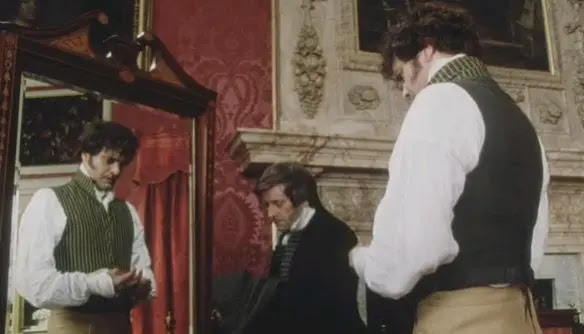
The problem for Bingley is that what constitutes a "promise" from him is far more subtle than what constitutes a promise from men (and women) now-a-days. In Trollope's book The American Senator (1875), the femme fatale Amanda desperately attempts to maneuver Lord Rufford into making a single compromising statement, anything that will enable her to say, "But you said you would marry me!" He is never trapped, partly because he is rather clueless and partly because he is well-protected by friends like Darcy.

Bingley is a much nicer bloke than Lord Rufford, and Jane certainly never goes as far as Amanda. But Darcy would still worry that Bingley's actions could be misinterpreted, especially after Mrs. Bennet actually claims that an engagement exists! In other words, Bingley simply paying more attention to Jane than to the other single women at the ball practically implies a proposal.

Darcy also knows his friend. Unlike Lord Rufford, Bingley would agree to an engagement--even if none existed--rather than hurt anyone's feelings. And Darcy honestly believes that Jane isn't interested in Bingley. Although Darcy never says so directly in Austen's account, he likely compares Jane unfavorably to Elizabeth. Why would Bingley want to marry this cold, seemingly passionless person when he could have lively, enchanting Elizabeth?! (And if Darcy is going to give up Elizabeth, surely Bingley can give up another one of his so-called infatuations.)

Victorian Divorce Court

Moreover, although marriage is always a big deal--then and now--a bad marriage based on a mistake was not something that anyone in the nineteenth century would be walking away from. As detailed in the fascinating book Mrs. Robinson's Disgrace by Kate Summerscale, "easy" divorce did not become possible in Britain until the mid-1800s. 

"Easy" means that while a man could get a divorce based on his wife's proven infidelity, a wife could only get a divorce for infidelity and another form of abuse. The two-fold consequences of these requirements were (1) divorce court news became an instant hit with Victorians; (2) historical romance novelists who claim that the Divorce Act was a feminist triumph should keep in mind that far more men sought divorces and got them than women. (On the other hand, not a few of the Court of Divorce judges were remarkably even-handed in their judgments.) 

Overall, Darcy is trying to protect Bingley. He is wrong in his methods and possibly wrong in his interpretation of events. But someone needs to protect Bingley. 

And Darcy eventually fixes his mistakes.