Showing posts with label Manga. Show all posts

Monday, September 14, 2026

Twelve Kingdoms: Interview with the Translator, Children & Teenagers

On Votaries, I discuss youth heroes who save the world. I suggest that they are more interesting if they take action (with the implication that they will make mistakes) rather than merely inspiring people with their innocence. 

In keeping with these ideas, I am reposting one of my interviews with the translator. 

* * *  

Kate: Shadow of the Moon ruthlessly dismantles the worldview of a rather ordinary teenager who wafts through life expecting to be catered to and understood.

Do the Japanese have any patience with "snowflakes"? Or is the whole American obsession with teenagers kind of a bemusing oddity? Does Japanese Twitter ever reach the heights of American Twitter in terms of pure angry self-absorption?

Eugene: Of course, manga and anime focus a lot of attention on the teenage experience, but not typically the kind of attention that sets them at odds with the greater society. Love, Chunibyo & Other Delusions sets up the classic conflict between conformity and being "true to yourself," but makes compelling arguments on both sides and doesn't attempt to universalize the conclusions.

A comparison of old adages makes for an interesting exercise in sociolinguistics. In Japan, the nail that sticks out gets hammered down, while in the west, the squeaky wheel gets the grease. They sound similar but are opposite concepts. As illustrated in Rascal does not Dream of Bunny Girl Senpai, the online culture in Japan wields that hammer just as ruthlessly as elsewhere.

The nail that sticks out gets hammered down and the snowflake gets the blowtorch. For good or ill, this is very much a product of gaman culture. You're supposed to get with the program, try hard, persevere, and fit in. A funny example of this is One Punch Man. The most powerful superhero in the universe gets no respect until he gets with the program (including the paperwork) and fits in.

To be sure, trendy activism is alive and well in Japan, ready to be discovered by western journalists, but is not nearly as influential (if at all) beyond the fringes. NHK World, for example, which caters to western audiences, tends to give the latest and greatest woke issues a degree of attention that suggests a prominence inside Japan that simply does not exist outside of select enclaves.

At the end of his "Why You Should Move to Japan" video, Nobita from Japan cites Japan's reluctance to adopt the woke politics of the west as a reason.

Clownfish TV explores the subject in depth here. 

Kate: I'm sure that someone somewhere has written a massive intellectual treatise on the plethora of children in Japanese manga/anime. From a popular culture perspective, what accounts for it? Why do children show up so much in anime/manga/light novels in adult situations? Or as long-lived children? Like in C.S. Lewis, these children experience very little adult hand-holding. Their youth is part of their attraction, not an excuse for their behavior.

Any thoughts? Are wise-beyond-their-years children a trope in Japanese literature, specific to certain authors, part of the cultural mindset?

Are Westerners the outliers, being squeamish (and more committed to the Victorian ideal of innocent childhood)?

Eugene: The most obvious answer is marketing. The editorial content of the numerous manga periodicals and imprints are designed by publishers to target specific demographics. Because consumers of manga and anime outside Japan tend to be older, they often overlook material aimed at younger audiences.

Several of the most popular and long-running anime on Japanese television are practically unknown in North America. Chibi Maruko-chan (over 1200 episodes to date) is a lighthearted melodrama about a traditional Japanese family in the 1970s. The POV character is a nine-year-old girl, so we see that world through her eyes.

There are a lot of authorized videos on YouTube. They're not localized, but it's worth watching an episode or two just to hear Tarako Isono as Maruko.

Delving more deeply into the social psychology of the matter, helicopter parenting simply hasn't become a thing in Japan. Basically, the kind of hands-off approach that kids enjoyed growing up in the American suburbs fifty years ago remains alive and well.

Elementary school students walk to school. By themselves. This expectation that young children can handle such responsibilities is taken as a given. The video at this link above is from a reality show in which little kids are given fairly complex tasks to accomplish by themselves.

In Non Non Biyori, once school is out, there is barely an adult in sight, also true of the elementary school kids in the more urban Den-noh Coil. At the end of Super Cub, three high school girls ride their scooters all the way to the southern tip of Kyushu. By themselves. And then there is the whole school government thing.

All this means that kids in Japan are not only allowed to do more interesting things, but it is easy to push the boundaries a bit and have them do really interesting things. Frankly, the spelunking expedition at the end of The Phantom Doctor strikes even me as crazy dangerous, but it would have been hugely appealing to Edogawa's readers.

In other words, Japanese not only expect more of (and grant greater latitude to) real children, but fictional children as well. It is the freest time of their lives, after all, and should not be wasted. (The girls in Super Cub go on their adventure during the spring break before their senior year, because that's when the fun pretty much ends.)

Kate: I previously taught a course about working women in America. The impact of biology—the reality of bearing children, giving birth and raising children—greatly influenced women’s work (when, how, what) historically and now.

Ono seems far more aware of the connection between work and childbearing than many Westerners. Many laws in the United States directly address many of these issues, but the reality of childbirth—perhaps as it loses its inherent risks—seems to be admitted with a shrug rather than an appraisal of its impact.

Does is that awareness inherent to Japanese culture? Due to its inherent conservatism?

Eugene: There are several long-standing aspects of Japanese culture that do address the inherent problems here in unique ways. First of all, especially among the aristocracy, well into the 20th century, legitimacy was readily conferred upon the offspring of mistresses. The current imperial line descends from one of Emperor Meiji's concubines, not his legal wife (Meiji was the last emperor to have concubines). 

The second is muko-iri marriage, according to which the husband is adopted into the wife's family. This is still relatively common today. "You can't choose your sons but you can choose your sons-in-law." In some cases, sans any children, a family business will adopt a loyal employee to keep the family name alive. The connection between work and childbearing thus becomes a negotiable arrangement.

Japan's current low birth rate and high female employment rate (above the OECD average) suggests that working and childbearing continue to be seen in mutually exclusive terms.Though it should also be pointed out that helicopter parenting is not a thing in Japan, which shifts the burdens of childrearing around. Nobody freaks out about unattended kids out and about in public.
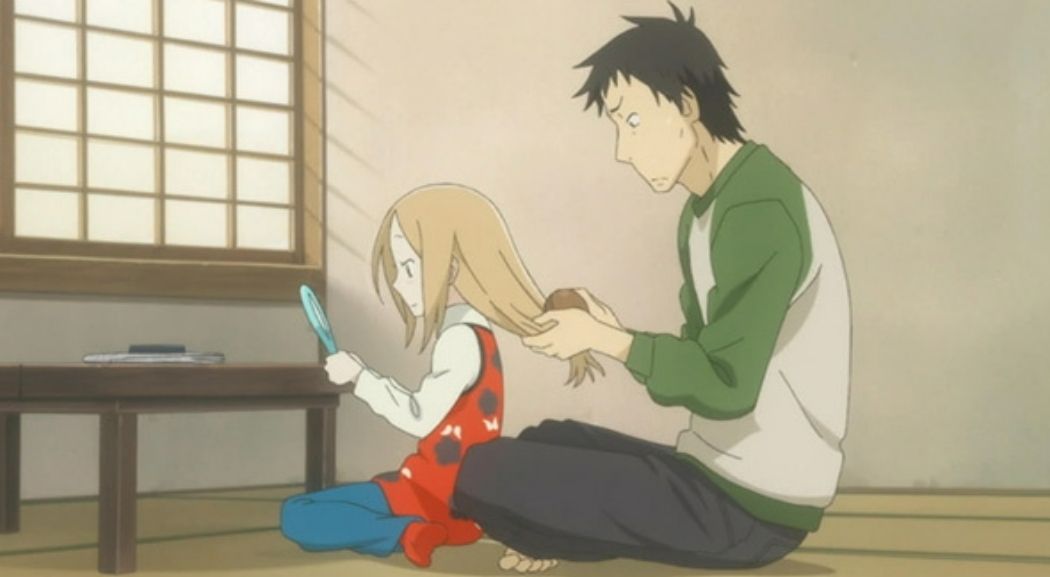
So while contemporary Japanese society has evolved more slowly away from "traditional marriage" as the ideal model for organizing society, the real world is a lot more complicated, and the fictional world has taken full advantage. The working mother and the single mother in melodrama and comedy are ubiquitous at this point, and the single dad has become of late a favored protagonist.

After the Rain features the teenage daughter of a single mom and a divorced dad. The Way of the Househusband is about a stay-at-home dad (who happens to be a former yakuza). No children yet. Speaking of which, Ryuji in Toradora often gets mistaken for a yakuza (like his father), but he's a good kid who looks after his single mom (who works in a nightclub) more than she looks after him.

The responsible kid with the irresponsible single mom (who nonetheless has a heart of gold) is an established trope. Hanasaku Iroha begins with Ohana's mom sending her to her grandmother's country inn while she runs off with her latest boyfriend. In Beyond the Boundary, Akihito would prefer that his mom stay out of his life as she's a demon (not a terrifying demon, a total goofball of a demon).

Of course, you can count on manga and anime to push a concept to its logical extreme, so the preternaturally competent Kotaru in Kotaru Lives Alone is all of five years old.

At least in the fictional realm, raising independent children who can raise themselves is one sort-of solution.

Thursday, September 10, 2026

Appearance & Identity in Manga and Other Works

In the manga series, His Favorite by Suzuki Tanaka, Sato was once a short, fat kid who got mocked by his peers (and defended by Yoshida). After time abroad, he returns tall, svelte, and handsome. 

Tanaka captures a basic truth with Sato (which Bronte also captures with Rochester). Whatever his appearance, he still thinks of himself as THAT kid. In fact, as far as Sato is concerned, he IS that kid. 

Sharyn McCrumb explains the psychology here in Missing Susan. Elizabeth MacPherson is on a tour with a woman, Susan, who had a great deal of cosmetic surgery and physical therapy. Susan is entirely exasperating (and is repeatedly nearly murdered). Fellow tour members explain why to Elizabeth:

"I don't think she's used to interacting socially," says one.

Another states, "She hasn't learned how to stop acting like a wallflower. She's only pretty on the outside; she doesn't believe it yet." 

Years ago, a reality show on television had people get plastic surgery. The plastic surgery was inevitably accompanied by therapy. And truth was, people really didn't change. In one episode, 3 sisters had plastic surgery to remove a genetic inheritance, what the sisters themselves referred to as turkey neck. After, the sisters went on a cruise.

And the one sister who was already straight-forward and confident behaved straight-forward and confident. And the other sisters, who were far less confident acted...exactly the same as they did before. 

With Sato, Tanaka captures a true inner issue: self-esteem honestly has little to do with appearance...unless appearance has been incorporated into a person's identity at a much earlier age. Yoshida is a short kid in high school, but he was the tallest in elementary school and still retains those leadership qualities.     

Sunday, August 9, 2026

Girl Disguised as Boy: Hana-Kimi Manga and 2007 TV Series

On Votaries, I just tackled Girls Disguised as Boys. Hana-Kimi is one of the seminal manga works to use this trope, so I am reposting a prior review with added notes.  

Hana-Kimi by Hisaya Nakajo is one of the first shojo series I read. I was helped in part by the local library having the complete set! 

The series is delightful. The premise: Mizuki pretends to be a boy, so she can attend a boys' school in Japan and meet her idol, Izumi Sano, a high-jumper. A few people learn her secret, including the school's gay doctor, Dr. Umeda. In fact, the idol, Sano, discovers she is a girl early on (they are roommates) but keeps her secret from others and the fact that he knows the secret from her.

One of my favorite realistic scenes--hey, I learned
English grammar from studying French.

The plots run the gamut from plausible (issues over cheating; the school contest where the "prize" is a bunch of boring pencils) to totally implausible (the local photographer decides to turn Mizuki and her friends into fashion celebrities) to cute to silly to occasionally spooky (there are a few ghost vignettes). The reliable thread is the behavior of the students--they talk and behave like teenagers.

The series is very "G"--but Dr. Umeda 
is allowed to ask the risque questions.
Yup, he smokes.

Regarding Dr. Umeda, my first reaction was that Nakajo-sensei made him gay to prevent him becoming a love interest. He is almost perfectly suited to be Mizuki's love interest since he is the one she confides in. He is also good-looking, sarcastic, and mildly insulting, making him a typical shojo/yaoi hero. And his age isn't a problem. Shojo/yaoi romances often have up to a 15-year age difference between the protagonists.

Keeping Dr. Umeda a confidant may be one reason for identifying him as gay but the series is full of operatic farce related to cross-dressing plus gender and sexual identify confusion, so his frank identification as gay makes sense (characters will occasionally break the fourth wall and inform readers that this is a SHOJO manga, not a yaoi one). I use "operatic" deliberately. The series is rather like one of those operas where men or women fall in love with boys, with boys who are actually girls, and with boys who dress up as girls who dress up as boys.

Forthright, bleached-blond 
Nakatsu is from Osaka.

The relationship between Mizuki and Sano is the touchstone for everyday reality and commonsense. And since the manga is set in (20th century) contemporary Japan, the food, settings, and references are entirely realistic. I learned a great deal about Japanese culture (which I later verified) from reading Hana-Kimi! For one thing Osaka appears to = Jersey Shore.

Note: The Japanese TV series, available on Viki, is a HOOT. It is any high school musical...on speed. It captures the high-jinks, the over-the-top scenarios, and the interpersonal conflicts. Despite the leads all being 19-25, they act like high schoolers and retain those relationships. Unlike other versions of Hana-Kimi (there are many!), Mizuki's membership in the social order is the overriding point, not merely her attachment to Sano. 

As mentioned on Votaries, there is a certain suspension of belief/disbelief with Mizuki. However, Maki Horikita does a fantastic job at adopting the posture of young males. In one scene, she sits with Nakatsu on a bench and for a moment, I thought she was one of the male characters. That is impressive! 


Wednesday, July 8, 2026

Sato: Transformation to Normal Teen

One of the most fascinating transformations in manga is Sato in His Favorite. 

Sato starts out as a not atypical manga/yaoi/shojo figure: the tall, handsome, aloof, sarcastic, slightly sadistic, intelligent guy who finds ordinary mortals somewhat perplexing. House, MD--but younger. He starts out, in fact, as a kind of non-changing Sherlock Holmes. 

He doesn't stay that way. As he dates Yoshida, he becomes more and more teenager-ish. He gets enthralled by the school trip. He enjoys fireworks. He gets upset and jealous over everyday spats. His peers begin to interact with him more naturally, so that at one point, they defend Yoshida when Sato tries to tease him! Sato even has his own "clique" in which he comes across less as the "pretty boy" and more as a gangling, normally awkward guy who gets invested in the group's various ups and downs and interests. 

The transformation here isn't a mistake. Although His Favorite is one of the funniest ongoing pastiches and spoofs of teenage manga tropes, Sato's transformation from a somewhat nihilistic, indifferent young man to a regular teenage boy is applauded by Yoshida and the author. At one point, the teenage girls bemoan that Sato has lost his superior edge, the "suave" behavior that made him so initially attractive. Sato is disconcerted--but his transformation is already too far gone. He can't go back.

No longer a budding sociopath but a teenage boy with a "favorite," Sato--due to honest, say-it-like-it-is, down-to-earth Yoshida (with whom he has normal fights)--has joined humanity.

Sunday, July 5, 2026

Maturity in What Did You Eat Yesterday

On Votaries, my latest A-Z list tackles characters who transform, often carefully and slowly over time. 

One of my favorite slice-of-life examples of this type of change comes from What Did You Eat Yesterday?, namely Shiro's relationship with his parents.

At the beginning of the series, Shiro and Kenji have been together for about 3 years. Shiro has a normal age-40ish fond-but-exasperated relationship with his parents, specifically with his mom. He loves them but...

Consequently, he complains to Kenji about going home for New Year's (which in the U.S. is rather like complaining about going home for Thanksgiving PLUS Christmas).

To Shiro's surprise, Kenji is miffed (see panel). Startled (since Kenji is normally a happy-go-lucky kind-of guy), Shiro agrees to "go be good to his folks." This one-time agreement turns into several years of Shiro spending New Year's at his parents' rebuilding their semi-aloof relationship (they were never estranged, simply not close).

When a later New Year's visit to his parents with Kenji doesn't go well (Shiro's parents request Shiro not to bring Kenji the next year), Shiro decides that he needs to commit more to Kenji--he should be spending his New Year's with his long-term partner. He should invest (see post on Ross and Rachel) in the relationship that will probably see him into old age.

He informs his parents in a calm manner of his decision. He is blunt but not angry or blaming, and he assures them that he will still visit to help them with cleaning, hospital stays, and such.

Here's where Fumi Yoshinaga truly excels: although Shiro apologizes to Kenji for leaving him alone for so many New Year's, Shiro was not in fact ready at the beginning of the series to make the decision that he ends up making. His "I don't want to spend New Year's with my parents" at that time was childish (as Kenji recognized). His decision several years later is thought-out and mature.

The outcome might be the same but the thought process, the growth, is completely different. It is a remarkable instance of character building and proves, moreover, that non-melodramatic character growth can be as profound and interesting in its own way as a million soap operatic moments.

Thursday, June 18, 2026

Aquariums in Manga and Live Action BL

It is becoming standard to send characters in manga and live action to aquariums.

It happens with such regulatory in Thai BL, I suspect that a particular aquarium is rather like a house in my grandmother's neighborhood in Pasadena. Though it may have burnt down since, the house was one of the places our family would walk past when we visited in my childhood. Someone was nearly always filming there, usually scenes that were supposed to take place in New England (the house has/had that look) complete with fake snow on the ground.

Interestingly, this use has passed from "hey, the aquarium lets us film on their premises!" to a standard date for BL characters, even in manga. That is, the aquarium date has become a trope, much like amusement rides and haunted houses! In the Japanese BL series, Stay by My Side After the Rain, the characters visit an aquarium for their first date after they meet again (since high school).

There is something quite inviting about fish. And the set-up is perfect for action-while-talking. Sitting in a theater is too static. Dancing is too noisy. The aquarium is perfect!

The below is from one of my favorite short manga stories: "Lover's Pledge" by Kae Maurya. The nervous main character and alpha Darcy-like character get to know each other on "innocent" dates.


Wednesday, June 10, 2026

Extroverted Dogs in Manga

The idea that dogs are extroverts shows up quite often in manga. 

I'm not referring to manga with animal spouses or shapeshifters or beasts as alphas. I read those manga too! 

Rather I'm referring to entirely contemporary manga in contemporary settings with entirely non-magical elements and yet...

Quite abruptly, while reading, one of the characters will gain a wagging tail.  

Like "golf" and "black coffee" the tail is an almost short-hand indicator of personality. 

How extroverted and friendly and people-oriented is this guy or gal? 

Just check out the tail!  

Friday, March 27, 2026

Transformation and Disguise in Palace of the Omega

Ilia, an omega, is sent to Hanu to marry the young king, Khalid. The young king is 10 years old but forms a friendship with Ilia and determines to eventually make him his consort. 

The plans are derailed when the king's brother Zayn carries out a coup. Both Khalid and Ilia are presumed dead after one is supposedly killed on a journey and the other jumps from a cliff.  

They find each other 8 years later and they have naturally undergone changes. Khalid's fundamental serious and charismatic character hasn't altered, but he is older and much taller. 

Ilia undergoes a change not in personality--he is still somewhat sarcastic and a bundle of concentrated intent--but in attitude. Though he starts out cynical and indifferent, he grows attached to Khalid for his youthful and innocent earnestness, for his devotion to Hanu, and for his total acceptance of Ilia as his consort and equal. Ilia becomes a believer in something. 

The character development is quite believable since it takes place over time and after personal interactions. 

The series also includes a disguise--namely, Khalid becomes the leader of the rebels without telling others his identity...except they aren't that surprised when he reveals himself...which amuses Ilia to no end. 

Good couple in a story with decent external and internal arcs! The transformations--quite a lot of them--make sense, and the characterizations remain consistent.  


Friday, February 27, 2026

Frenemies as Lovers

Black Sun's protagonists start as as enemies. In fact, Leonard is the prisoner of Jamal, a trope that many publishers and readers shy from. I find it at least more honest than some frenemy arrangements, in which the "hostage"-taking is purely emotional (one member of the couple feels indebted to the other). 

However, this type of frenemy relationship works best in historical romances. The current trend of plots where modern-day protagonists form relationships with sociopaths, I admittedly find a tad nihilistic. 

I prefer my frenemies to be rooted not in emotional enthrallment but in personality differences. Leonard and Jamal are different but complementary. In a more modern setting, so are Minato and Shizuma from Therapy Game Restart. 

Minato in the "tacky" shirt
Shizuma bought.
Minato is smart, sharp-tongued, wary, self-aware, uncertain, quick-tempered, and dogged in his commitment. Shizuma is mellow, easy-going (despite being a hard-working and dedicated veterinarian), understanding, and easily romantic. 

Although their relationship is far more fraught with ups and downs than the brothers' relationship (Minato's brother is dating Shizuma's brother), it has grit--and believability. 

Frenemies in romance is best not as a state of continual uncertainty--but as a state of continual negotiations.

Monday, February 23, 2026

Uki Ogasawara's Black Sun

I am reviewing romance "paperbacks"--that is, romance books that do not fall into the "acceptably literary" tradition. 

I love Austen and Heyer and Bronte. 

But I also love romances that don't necessarily fall into the category of so-called Great Literature.

I've reached "U" authors, and I admit to being somewhat stymied. Not many "U" authors at all, let alone in romance! 

I gave myself permission to go with first names as well as last names and to go to manga (which generally speaking, I have been reviewing separately). 

Black Sun by Uki Ogasawara is one of my favorite yaoi manga. One reason is that the characters have distinct personalities and retain those personalities through the 2 volumes. (One problem I note with romance is when characters become instantly "cute"--and follow a script--the moment they fall in love.) 

Below is character analysis from one of my earliest posts on this blog:


Jamal and Leonard's seemingly unlikely compatibility in Black Sun is highlighted by their easy physical "banter."

Character development plays a role here. Despite his spiritual and idealistic nature, Leonard is more than capable of keeping up with Jamal physically. Leonard may have a sweet and ethereal disposition; his desire for touch, for affection, has been a fundamental aspect of his personality from childhood. 

Jamal's larger-than-life persona at first evokes hero-worship from Leonard. But Jamal doesn't want to be set on a pedestal (it's so boring). He provides Leonard with a down-to-earth reality that Leonard never anticipated and finds incredibly restful.

At the end of Black Sun, Leonard still retains his quiet, Gilly-like nature. But he has learned to gently and cleverly tease Jamal back.  

Wednesday, January 7, 2026

The Disguise of Enaga in Punks Triangle

My latest A-Z List on Votaries looks at character who transform, either internally (they change into better people) or externally (they adopt or shed disguises). The character of Enaga or Ai in Punks Triangle is a great example of the external change.

The trope of external change carries with it loads of problems--in particular, will the disguise truly fool anyone? There's a hilarious scene in Lois & Clark where Tempus teases Lois by mimicking Clark and taking his glasses on and off. How galactically dumb was she?  

The "disguise" of Enaga or Ai, however, rests on something that Agatha Christie uses and that I find quite valid: 

  • First, human beings are actually quite awful at recognizing faces. 
  • Second, the disguise here is that Enaga not only gives off a different persona in his non-model persona--he is in a different location and behaving in a different way.

Enaga
Chiaki is so sure that his idol exists at a distance that he doesn't see what may seem obvious until it is obvious. 

The manga is quite enchanting, in part because it falls into the same category as Metalhead, a manga about vocations or hobbies. While I don't mind the enormous number of "romance in the office" manga out there, a change in setting is nice!  

Ai


Tuesday, December 30, 2025

Trips to Shrines in Romance Manga

Trips to local shrines on New Year's are more common events in manga than couples spending Christmas together. Many times, couples do both. 

The shrine trip is less romantically charged than Christmas. Like with Hallmark movies, the Christmas moment carries a strong expectation of something outside of everyday life. In comparison, the shrine trips are more likely to evoke complaints about the weather, the crowds, the time of day as well as, with certain manga, worries about school. They are more likely, too, to supply jokes. The romance slides in unexpectedly as part of everyday life. 

While I enjoy some sentimentality, a little goes a long way. Ultimately, I find the everyday life romance somewhat more enchanting. I will grant that part of that enchantment could be the cultural uniqueness (for me). 

But even there, I rather like how cultural uniqueness is treated as "Hey, this is life!" 


Friday, December 26, 2025

What Makes This Manga Different From Others: Snow Fairy

It's the season for snow in the Northeast! 

Below is a review of a manga that celebrates this time of year in Japan.

* * * 

On the surface, Snow Fairy by Tomo Serizawa is a classic romance plot without frills. It offers an uncomplicated story (which adjective isn't a negative) without frills. 

Despite the simplicity, once read, the manga stays with the reader. It is memorable for several reasons:

1. It takes place in the boondocks, specifically Hakkaido, a nice change from the usual setting of Tokyo. 

Tokyo is to Japan what London is to Britain, which means, there's a very good reason so many stories take place around Tokyo. Still, the boondocks, specifically the boondocks with snow, is a great variation. The characters get snowed in at one point!

The main character's parents died in a car accident. Some extended family members think he should leave the area, but he feels entirely connected to his community. As he states to his lover, "In such a small town, even one person's absence can be a burden."

2. The characters don't automatically assume that separation means a lack of love. 

I recently watched the Thai drama, The Boss and the Babe, which I enjoyed, but I got irritated by the idea that a few weeks--even months--separation somehow meant that the characters didn't really love each other or that other people were unfairly separating them or whatever. Just wait until the internship is over! 

I went along with the premise since it was intelligently tied to other factors, including Cher's deep-rooted tendency to put on a "clown's" face for others rather than to admit to any negative feelings. 

But. Still. 

The wonderful aspect of Snow Fairy is that Narumi and Haruki's relationship will not falter should Narumi take another journey for his photography. They both have lives that absorb them. They can survive separation, especially since Haruki offers a home base. 

A grown-up relationship!

3. The outdoor/indoor scenes are lovely. 

Growing up, one of my favorite experiences was drying off/warming up after being outside: swimming in a pond during the summer or playing in the snow during the winter. Of course, one had to go outside to come back in and dry off/warm up, so going outside was pleasurable too. 

Snow Fairy captures that sensation: the wonder of being out in crisp, cold air surrounded by heaps of snow and the coziness of coming inside to a warm room and lots of blankets. 

Monday, December 22, 2025

Christmas Together in Manga Romance

A very common trope in Romance Manga is the couple spending Christmas together. New Year's, of course, is the bigger holiday. However, New Year's is rather like Thanksgiving and July 4th and family camping trips rolled into one. 

Christmas has a more private, one-on-one connotation. A kind of optional extra. So the "will we spend Christmas together?" question comes up more than once with couples. 

In Yamada's No One Loves Me, reserved Katushiro takes a leap in his relationship with Masafumi when he brings Christmas chicken. 

In Fake, Dee shows up to Ryo's apartment with his teeny tiny tree! 

In The Metalhead Next Door, baker Soshi invites Kento to share a yule log with him. 

In 10 Things I Want to Do Before I Turn 40, the male protagonists have an actual lovely run-to-each-other moment (but not in an airport!) when they decide to spend December 24th together.  

Romance is all about fragile hope--appropriate for the season, which is so often associated with a single birth, a winter solstice, a candle in the window, a space of warmth in snowfall.

Thursday, December 18, 2025

The Snow Queen in Manga

On Votaries, I discuss fairy tale characters that change--or don't change (such as Cinderella). 

One fantastic fairy tale retelling in manga is Allure by Yuri Ebihara, based on Hans Christian Andersen's "The Snow Queen." What makes it especially effective is that main character, Dr. Hizuki, undergoes an internal transformation. 

At first, Dr. Hizuki seems to be the Snow Queen figure who lures away Kay or Kai to Norway. In the original tale, the Snow Queen is a constant, a force. She doesn't change because she isn't meant to change. 

Dr. Hizuki starts out as cold and aloof since he is still suffering from the death of a lover a number of months earlier. After he performs eye surgery on Kai, Kai falls for him. Eventually, Kai follows Hizuki to Norway. A sweet-natured, extroverted, confident young man, Kai is undemanding yet also unapologetic in his motives. He is there to keep Hizuki company!

Kai's ex-fiancĂ©e, Miharu, supposedly the Gerda figure, shows up to fetch Kai home. 

Here is where the manga turns the tale on its head. For Miharu may appear to be the Gerda figure but her reasoning is more like the Snow Queen's--she wants an unchanging, seamless (like a blanket of snow) existence. Kai must return to his designated role as her fiancĂ©. If he does, everyone will pretend he didn't behave so oddly, breaking his engagement and running off the way he did. He needs to abide by an unbreakable order. 

Even Hizuki is temporarily convinced by Miharu's argument. In a world where lovers don't die in car accidents and love is impervious and methodical, the boy would marry the girl who nursed him and of whom his family approves. Isn't that the proper, perfect ending? Hizuki should give Kai up to the correct tidy (non-messy) resolution. 

Until Hizuki remembers a passage Kai read from "The Snow Queen" about "an ice-puzzle for the understanding" or a "mirror of reason." In the original story, Kay keeps trying to rearrange the puzzle pieces to create the word "Eternity." He can never arrange the pieces correctly--until Gerda comes and warms him. The pieces of a broken mirror fall from his heart and his eyes and form the word he could not create on his own. 

Hizuki takes the passage as a sign. He runs after Kai and brings him back. He is even willing to make a non-seamless messy "spectacle" of himself to convince Kai he is serious.

In this way, Hizuki becomes the Gerda character--but also the Kay figure who needs to be warmed. 

In Allure, Andersen's thematic resolution is turned on its head while also honored. In the original story, the shards of broken mirror corrupt human's sight. But in the manga, the shards--related to the surgical "cuts" by Dr. Hikuzi--challenge Kai's assumptions. They are not all that different from the irritating "monkey conscience" in Shadow of the Moon. 

That is, when Kai regains his sight, due to Hizuki, he comes to realize how much Miharu and his family have controlled his appearance, his wardrobe and perhaps, even, his thoughts. He doesn't entirely recognize himself until he sees Dr. Hizuki.

The shards consequently could also be the (entirely unintentional) "corruption" of Kai's true self by family and friends when he was blind--in which case, once again, Miharu becomes the Snow Queen, trying to lure Kai back to a time when his sight was damaged, first through social pressure and then through freezing contempt. 

Allure is a emotionally resilient rendering of "The Snow Queen" and also a retelling or re-imagining. Heroines become villains. Heroes take on double roles. 

A product of his time, Andersen may have been alarmed by a couple that echoed his own feelings--or he may have appreciated the sentiment. In any case, "The Snow Queen" clearly crosses borders! 

In connection to the new A-Z list on Votaries, Dr. Hizuki is a fantastic character who transforms (warms) steadily yet surely over time. 

Wednesday, December 10, 2025

Hobbies in Manga: Heavy Metal

A common container for romantic manga is hobbies. The romantic partners in yaoi bond over various non-academic, non-work-related interests. 

One of the most delightful is The Metalhead Next Door by Mamita. Two neighbors meet when Kento's apartment heater breaks down. Soshi takes him in and feeds him. 

They bond when the more extroverted young man, Kento, learns that Soshi loves metal music. They don't share the interest, but Kento embraces Soshi's interest and learns more about Soshi through his interest. 

The hobby here is perfect for several reasons:

(1) The metal music loving neighbor, Soshi, is quite shy and diffident. He isn't loud and crass and drug-using. That is, he isn't the cliche. In fact, he struggles to communicate, thinking at one point, "I'm not acting. I'm really bad at expressing my thoughts through words."

(2) The manga exhibits knowledge of sub-cultures within metal music, including the Heavy Metal Knitting Competition, which I am not making up! 

The sub-cultures also address that there are different forms of metal music, which I knew from watching Bones. As I will say about classical music and romances and mysteries and, well, everything: the further one gets into a genre, the more differences and strongly held stances one will find. Two people WITHIN a field will have louder arguments than an insider with an outsider.  

 (3) Most of the main sequences take place in winter, which I find quite captivating. Many of my favorite manga, including Snow Fairy, take place in a winter environment. Kento and Soshi get to know each other over three winters. Primary scenes take place during cold weather, in snowfalls, at the tail end of winter. The emphasis is on indoor scenes with a few seminal outdoor moments, and the atmosphere is quite lovely. 


Thursday, November 20, 2025

What Makes This Manga Different From the Others: Dashing Zaddy and Icy Protege

Dashing Zaddy and Icy Protege is one of those series I picked up at Books-a-Million. I visit Books-a-Million for its stunning and expanding manga section. And I have been pleasantly surprised by a few volumes I chanced across (rather than volumes I went to BAM on purpose to find). Dashing Zaddy is one of them. 

I like it for several reasons: 

(1) The older "December" Zaddy character actually looks older. So many times with manga, the only reason I know one character is older than the other is because the "script" tells me (similar to BL Thai series on Viki, in which the "older" character is almost always taller despite the character looking much younger). 

But Takanashi of Dashing Zaddy actually looks older--while still being charismatic and attractive. He has a kind of Elvin quality that makes him sparkle on the page. In many ways, his age enhances this otherworldly quality: he is a lively 40-year-old and appears that way. 

(2) The characters have a background. Quite often with manga series in office environments, the characters MIGHT have a background from high school (where they were rivals) but there's no substance to the background. But Hiwatari from Dashing Zaddy has an entire foundation of memories which fuel his affection and attraction for Takanashi. 

(3) The characters are different from each other. As I have mentioned multiple times on this blog, the best romances bring together complementary characters, and they retain their differences throughout the romance. 

They don't have to be the odd-couple: the slob and neat freak come with a separate set of issues. But they are more enchanting if they work off of each other rather than mirroring each other. 

Takanashi is an extrovert, a people-person manager. In contrast, Hiwatari has a "straight-arrow," somewhat blunt personality that masks a deeply romantic nature. In fact, the underlying mindsets here are quite clever. Takanashi, while being more people-aware, is more relationship-cautious. He's the kind of guy who has to figure out whom he loves. Hiwatari is the kind of guy who knows whom he loves and needs to bring the knowledge out of the clouds and into reality. A dreamer-realist and a realist-romantic: those combinations are more common than you might think!  

(4) Because the characters are different and reasonably complex, the story is not just about the relationship. There's nothing wrong with the relationship being the primary focus but endless pages of people being cutesy can get rather dull (one reason I love romance-mysteries so much is that the couple solve crimes: the focus is the couple, but the couple actually gets to do stuff). 

In Dashing Zaddy, the workplace is more than a staging area for dates and sex. The characters have to function in society: might as well show them carrying out those functions! (The underlying politics of New Employee/New Recruit also come to mind.)  

Dashing Zaddy and Icy Protege is a wonderful series that I am still enjoying!