Showing posts with label Anime. Show all posts

Monday, September 14, 2026

Twelve Kingdoms: Interview with the Translator, Children & Teenagers

On Votaries, I discuss youth heroes who save the world. I suggest that they are more interesting if they take action (with the implication that they will make mistakes) rather than merely inspiring people with their innocence. 

In keeping with these ideas, I am reposting one of my interviews with the translator. 

* * *  

Kate: Shadow of the Moon ruthlessly dismantles the worldview of a rather ordinary teenager who wafts through life expecting to be catered to and understood.

Do the Japanese have any patience with "snowflakes"? Or is the whole American obsession with teenagers kind of a bemusing oddity? Does Japanese Twitter ever reach the heights of American Twitter in terms of pure angry self-absorption?

Eugene: Of course, manga and anime focus a lot of attention on the teenage experience, but not typically the kind of attention that sets them at odds with the greater society. Love, Chunibyo & Other Delusions sets up the classic conflict between conformity and being "true to yourself," but makes compelling arguments on both sides and doesn't attempt to universalize the conclusions.

A comparison of old adages makes for an interesting exercise in sociolinguistics. In Japan, the nail that sticks out gets hammered down, while in the west, the squeaky wheel gets the grease. They sound similar but are opposite concepts. As illustrated in Rascal does not Dream of Bunny Girl Senpai, the online culture in Japan wields that hammer just as ruthlessly as elsewhere.

The nail that sticks out gets hammered down and the snowflake gets the blowtorch. For good or ill, this is very much a product of gaman culture. You're supposed to get with the program, try hard, persevere, and fit in. A funny example of this is One Punch Man. The most powerful superhero in the universe gets no respect until he gets with the program (including the paperwork) and fits in.

To be sure, trendy activism is alive and well in Japan, ready to be discovered by western journalists, but is not nearly as influential (if at all) beyond the fringes. NHK World, for example, which caters to western audiences, tends to give the latest and greatest woke issues a degree of attention that suggests a prominence inside Japan that simply does not exist outside of select enclaves.

At the end of his "Why You Should Move to Japan" video, Nobita from Japan cites Japan's reluctance to adopt the woke politics of the west as a reason.

Clownfish TV explores the subject in depth here. 

Kate: I'm sure that someone somewhere has written a massive intellectual treatise on the plethora of children in Japanese manga/anime. From a popular culture perspective, what accounts for it? Why do children show up so much in anime/manga/light novels in adult situations? Or as long-lived children? Like in C.S. Lewis, these children experience very little adult hand-holding. Their youth is part of their attraction, not an excuse for their behavior.

Any thoughts? Are wise-beyond-their-years children a trope in Japanese literature, specific to certain authors, part of the cultural mindset?

Are Westerners the outliers, being squeamish (and more committed to the Victorian ideal of innocent childhood)?

Eugene: The most obvious answer is marketing. The editorial content of the numerous manga periodicals and imprints are designed by publishers to target specific demographics. Because consumers of manga and anime outside Japan tend to be older, they often overlook material aimed at younger audiences.

Several of the most popular and long-running anime on Japanese television are practically unknown in North America. Chibi Maruko-chan (over 1200 episodes to date) is a lighthearted melodrama about a traditional Japanese family in the 1970s. The POV character is a nine-year-old girl, so we see that world through her eyes.

There are a lot of authorized videos on YouTube. They're not localized, but it's worth watching an episode or two just to hear Tarako Isono as Maruko.

Delving more deeply into the social psychology of the matter, helicopter parenting simply hasn't become a thing in Japan. Basically, the kind of hands-off approach that kids enjoyed growing up in the American suburbs fifty years ago remains alive and well.

Elementary school students walk to school. By themselves. This expectation that young children can handle such responsibilities is taken as a given. The video at this link above is from a reality show in which little kids are given fairly complex tasks to accomplish by themselves.

In Non Non Biyori, once school is out, there is barely an adult in sight, also true of the elementary school kids in the more urban Den-noh Coil. At the end of Super Cub, three high school girls ride their scooters all the way to the southern tip of Kyushu. By themselves. And then there is the whole school government thing.

All this means that kids in Japan are not only allowed to do more interesting things, but it is easy to push the boundaries a bit and have them do really interesting things. Frankly, the spelunking expedition at the end of The Phantom Doctor strikes even me as crazy dangerous, but it would have been hugely appealing to Edogawa's readers.

In other words, Japanese not only expect more of (and grant greater latitude to) real children, but fictional children as well. It is the freest time of their lives, after all, and should not be wasted. (The girls in Super Cub go on their adventure during the spring break before their senior year, because that's when the fun pretty much ends.)

Kate: I previously taught a course about working women in America. The impact of biology—the reality of bearing children, giving birth and raising children—greatly influenced women’s work (when, how, what) historically and now.

Ono seems far more aware of the connection between work and childbearing than many Westerners. Many laws in the United States directly address many of these issues, but the reality of childbirth—perhaps as it loses its inherent risks—seems to be admitted with a shrug rather than an appraisal of its impact.

Does is that awareness inherent to Japanese culture? Due to its inherent conservatism?

Eugene: There are several long-standing aspects of Japanese culture that do address the inherent problems here in unique ways. First of all, especially among the aristocracy, well into the 20th century, legitimacy was readily conferred upon the offspring of mistresses. The current imperial line descends from one of Emperor Meiji's concubines, not his legal wife (Meiji was the last emperor to have concubines). 

The second is muko-iri marriage, according to which the husband is adopted into the wife's family. This is still relatively common today. "You can't choose your sons but you can choose your sons-in-law." In some cases, sans any children, a family business will adopt a loyal employee to keep the family name alive. The connection between work and childbearing thus becomes a negotiable arrangement.

Japan's current low birth rate and high female employment rate (above the OECD average) suggests that working and childbearing continue to be seen in mutually exclusive terms.Though it should also be pointed out that helicopter parenting is not a thing in Japan, which shifts the burdens of childrearing around. Nobody freaks out about unattended kids out and about in public.
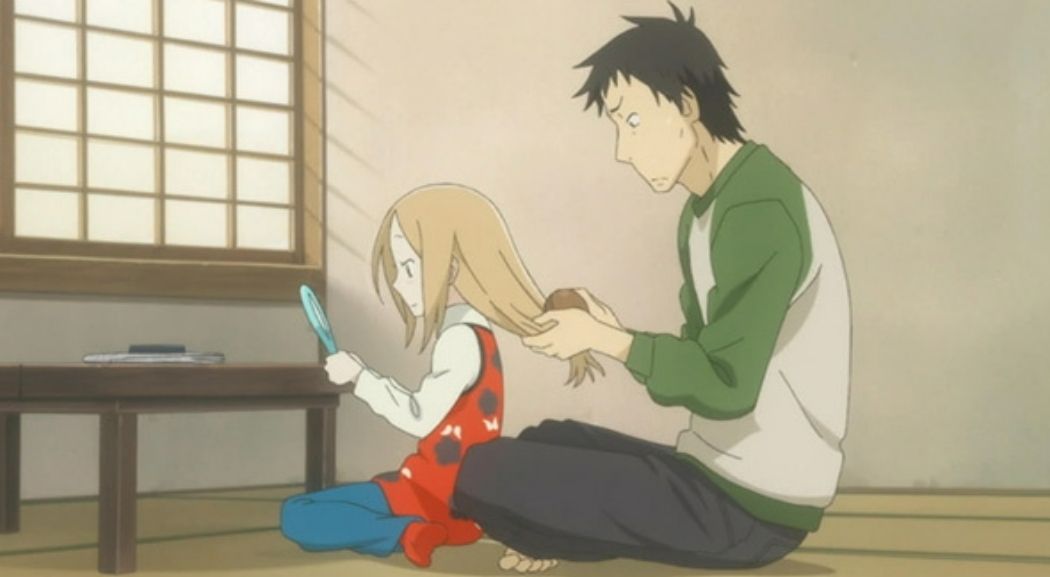
So while contemporary Japanese society has evolved more slowly away from "traditional marriage" as the ideal model for organizing society, the real world is a lot more complicated, and the fictional world has taken full advantage. The working mother and the single mother in melodrama and comedy are ubiquitous at this point, and the single dad has become of late a favored protagonist.

After the Rain features the teenage daughter of a single mom and a divorced dad. The Way of the Househusband is about a stay-at-home dad (who happens to be a former yakuza). No children yet. Speaking of which, Ryuji in Toradora often gets mistaken for a yakuza (like his father), but he's a good kid who looks after his single mom (who works in a nightclub) more than she looks after him.

The responsible kid with the irresponsible single mom (who nonetheless has a heart of gold) is an established trope. Hanasaku Iroha begins with Ohana's mom sending her to her grandmother's country inn while she runs off with her latest boyfriend. In Beyond the Boundary, Akihito would prefer that his mom stay out of his life as she's a demon (not a terrifying demon, a total goofball of a demon).

Of course, you can count on manga and anime to push a concept to its logical extreme, so the preternaturally competent Kotaru in Kotaru Lives Alone is all of five years old.

At least in the fictional realm, raising independent children who can raise themselves is one sort-of solution.

Friday, November 28, 2025

The Sad and Lovely Ache: Sweet Moments in Romance

I recently posted on Votaries about mono no aware, a concept in Japan that often shows up in slice-of-life. Below is a repost about that concept in romance.

* * *  

I am a fan of romance from manga to paperbacks, from classical literature to movies. Generally speaking, I prefer my romances to end on a positive note, which by my definition means "conclusively." So, are they married or what?!

Every now and again, I will encounter a captivating film that ends somewhat inconclusively. Such films leave behind a gentle, sweet sadness or acceptance--mono no aware in Japanese. And that's okay. It isn't the equivalent of some dreadful French drama where I'm asked to acquiescence in the futility of life. Rather, instead, I'm being asked to accept the fleeting beauty and kindness of life.

The two films that come to mind are both the product of Japanese artists (slight spoilers):

Only Yesterday: From Studio Ghibli, Only Yesterday ends romantically (if not entirely conclusively). The romance is either the entire point or it is entirely incidental: I'm not quite sure. What brings an ache to the heart is not necessarily Taeko and Toshio meeting on the road but Taeko's decision to leave the train. And what turns that ache into a shout of joy are the children from Taeko's past. They crowd about her, encouraging her, egging her on while they engage in high energy, hilarious romps.

The entire sequence is accompanied by a gorgeous rendition of Amanda McBroom's "The Rose" sung by a Japanese singer. It sounds sappy. It surprisingly isn't. Rather, the song evokes a nostalgia that transcends mealy-mouth nostalgia. Taeko is not remembering her childhood fondly or wishfully, the way people think back to their "glory" days in high school. She is recapturing her youth in order to move forward.

Voices of a Distant Star: One of my all-time favorites, Voices of a Distant Star ends, possibly, with the lovers separated. There are Blade Runner-type hints--especially in the manga--that time and space may collapse, but as with Only Yesterday, that is hardly the point. They have already transcended time and space through the  email messages that eek through what Star Trek fans would call the space-time continuum and what Cat from Red Dwarf would call magic.

In this case, Cat is the closest because the result is magical.
"It's like a miracle to hear from her after all this time."

"Maybe thoughts can overcome time and distance."

"One thought. What would it be?"

"It would be--"
I am here.

Thursday, June 5, 2025

Frenemies: Competitive Lovers


Gilbert and Anne not only get into various arguments and scraps. They compete academically. This type of competition shows up in several manga/BL stories. 

In Fake Fact Lips by Machi Suehiro, Ryo and Zen have been competing since high school. Ryo feels pressure by his father. Zen is trying to make his mark after growing up in his older brother's shadow. Zen is belligerent and self-conscious but his achievements are honestly pursued. Without realizing the impact of his words, Zen encourages Ryo to compete for the same reason. Rather than trying to satisfy a father who can never be satisfied, why not make Zen his rival? 

Ryo does, especially after he realizes that competition is a form of communication with Zen.

I have my doubts about competitive lovers. When does the competition cross the line into dysfunction, as in the CSI episode where the boyfriend causes his girlfriend's death when he redraws her hiking map? When does competition simply become too wearisome? 

Fake Fact Lips works for several reasons: Ryo and Zen are honest with each other; the competition continues to be a language of connection and flirtation; the competition is healthy in the sense that it involves achievement (constructive results) rather than negation (destructive or absent results). 

The healthy form of competition here is quite common in manga. In Yuri on Ice, competition inspires the two lovers as well as binding them together. In Free, which has no romance, competition inspires the somewhat drifting Haruka Nanase to connect to his future.

Like with all frenemies, however, the competition could go sour. As long as it doesn't...it works! 

Saturday, May 24, 2025

The Problem of Ross & Rachel: Why It Still Doesn't Work

Julia Roberts shows up, Friends, Season 2

I discuss the rival-character on Votaries. I was reminded of Ross & Rachel whose entirely dysfunctional relationship relied to a degree on jealousy over rivals. 

Here is a repost from 2017. 

* * *

I recently rewatched most seasons of Friends (with self-censoring). It is a remarkably well-written and well-cast show, especially for its time period, 1994-2004. Friends slightly precedes the years when television became the massive money-maker it is now. This may sound odd to the younger generation, but when Michael J. Fox (intelligently) returned to television to star in Spin City in 1996, his decision was still considered rather daring. A television star who made it to the movies going BACK to television?! (That he'd been diagnosed with Parkinson's was not known by the general public until 1998.)

Now, no one thinks anything of Fox's courageous choice. So Friends--with its Hollywood guest stars--was oddly and impressively prescient, and was from Season 1. The network obviously decided to do what all shows wish the network would do for them: back it to the hilt.

David Schwimmer as the Holiday Armadillo
Having said that, I find it almost impossible (still) to watch Ross & Rachel together. Jennifer Aniston is a fine comedienne and David Schwimmer is surprisingly willing to be the Don Knotts of the show--although Don Knotts is more charming.

As a couple, they grate. I self-censored nearly every one of the "fighting" episodes--and a number of the "wondering if we should be a couple" ones as well.

Why? As Eugene points out, failure to mature is the main reason. On an episode to episode basis, what becomes increasingly unbearable re: Ross and Rachel is the ridiculous business of both characters waiting for some special lightning bolt from the blue to decide "we are in love."

They date. They're friends. They care for each other. They sleep together. They have a baby. They live in the same apartment for a number of months. But they can't marry because "it doesn't feel right"?

It's a level of emotional self-indulgence that makes the brain melt. What exactly are they waiting for? As far I can tell, they are waiting for a single subjective moment that writes "I feel it! I feel it!" on their souls--which makes me doubt that the (final) marriage will last more than two seconds. After all, subjective feelings are prone to wax and wane. How long will it be before the writing fades?

Elizabeth hearing praises of Darcy
from his housekeeper.
Compare this with Elizabeth, who was likely always attracted to Darcy but acknowledges her feelings when she encounters his good reputation at Pemberley. It isn't his wealth (although Elizabeth herself jokes about that possibility) but his decent behavior that confirms her (subjective) feelings. Her respect for him grows until she can answer her father's incredulity ("Let me not have the grief of seeing you unable to respect your partner in life") by "relating her absolute certainty that [Darcy's] affection was not the work of a day, but had stood the test of many months’ suspense, and enumerating with energy all his good qualities."

Compare Rachel & Ross with Booth in Bones who doesn't immediately leave Hannah the moment Bones confesses her feelings to him. The man doesn't substitute a lightning bolt for loyalty and commitment. 

From manga, compare R&R to Fumi Yoshinaga's What Did You Eat Yesterday in which Shiro's desire to keep the relationship growing (partly because he hates the idea of having to start over) leads him to spend extra money on fresh peaches for Kenji (Shiro is a cheapskate so this is a big deal). His later resolution to spend New Year's Eve with Kenji--rather than his parents--is handled with maturity: he invests in his partner.

And from anime, compare R&R to Taeko and Toshio from Only Yesterday who slowly discover similarities as well as differences to admire during Taeko's vacation in Yamagata. In the end, they indicate a willingness to further a relationship of mutual respect.

Love and attraction is part of the equation in all these cases. The difference between them and Ross & Rachel is that the believable relationships don't rest upon some arbitrarily designated moment that may or may not arrive. Initial love/attraction plays a role, but the actual relationship is the result of investment and the additional perception, "I am lucky to have found this person." At the core is (to go old school) high regard, a quality I simply don't believe Rachel and Ross have for each other.

Thursday, January 9, 2025

The Fun and Fallible Female Love Interest

In Lloyd Alexander's The Chronicles of Prydain, Taran falls in love with the sharp-tempered, adorable, outspoken and somewhat out-of-her-depth (at least initially) heroine.

In general, manga and anime do this character type better than Hollywood. With Hollywood, the "I'm too independent for you" aspect begins to wear thin. Even Eilonwy, Taran's love interest, grates some. She is funny with a few great lines. But she always seems to be right, even when she truly shouldn't be (gatecrashing a military action), and she is regularly dismissive of Taran, even if she does it defensively. (I don't remember my reaction to the character when I was younger; I was more enthralled by Taran and by Gwydion than by Eilonwy. I do remember that I liked her in the third book the best.)

In comparison, manga and anime present this same character as hapless AND effective at the same time. Check out Kasahara from Library Wars, who is somewhat spastic and committed to her career and brave and rather innocent.

And then there's Sophie in Howl's Moving Castle: tough and whimsical and unsure and efficient and passionate. Wry and adorable and real all at the same time. (And it occurs to me that Miyazaki would have done a beautiful job with Alexander's series. Perhaps his studio still could.)

Anne of Green Gables, of course, is the Western answer--in both the books and Sullivan's first series. And Anne is wonderful. But she is difficult to replicate. Off the top of my head, one exception I thought of is Amanda Bynes in the Shakespeare-inspired She's the Man. She is a decent comedian and willing to do physical comedy where she falls over her own feet. 

Another exception, surprisingly enough, is Ziva of NCIS who has a somewhat similar--if much more inherently violent--personality to the anime/manga female characters. She also has a notable internal arc.

That sense of whimsy makes all the difference. And a great actress. And having a storyteller--Bellisario--at the initial helm.


Wednesday, April 24, 2024

Another Laid-Back Action Hero: Yuri from Yuri on Ice!!

A variation on the relaxed tough guy that is quite common in Japanese popular culture is the nervous, self-conscious, unsure character who comes through in a crisis. 

It's a VERY popular archetype. Manga and anime are flooded with characters who just aren't positive if they can...ace that test, take that new job, propose to that person...and do anyway. 

Yuri from Yuri on Ice!!! is a great example. He is shy (except when he is drinking), gets nervous, doubts himself and doesn't live up to his potential. 

However, hints that Yuri is tougher than he thinks are there from the beginning; they aren't tacked on to allow for a great moment. His friends tell Victor, his coach and partner, that Yuri is a "sore loser." In the context, they are confirming for Victor that Yuri doesn't like to lose--and the fact is, nobody makes it to "Nationals" in the skating world without being competitive.

Yuri doesn't want to give up, no matter how often he berates himself. His personality being what it is, he needs someone to skate FOR, and Victor supplies that motivation. But his decision to throw himself completely into a routine is all Yuri. At one point, Victor--who is taking a break from skating to be a coach and is not entirely sure how to distill confidence in his skater--tries a kind of reverse psychology to shake Yuri up. It works, but only because Yuri thinks Victor is behaving like a flake. The inherent toughness of Yuri, which has always been there, comes to the fore. He pushes himself on the ice and excels. 

All the skaters, of course, are very, very good (I remember watching the Olympics once where a male runner trailed in several seconds behind everyone else--and I realized that by anyone else's reckoning, that male runner was still faster than most people). The series does an excellent job underscoring the desire to get ahead even within placid, good-humored skaters. Yuri is not as inherently talented as Yurio, his rival (his rival from Yurio's point of view, at least), but he is talented, has tremendous stamina and the ability to persevere. He also has the maturity to pull together his act, a fact that Yurio recognizes early on. 

Yuri may come off as adorably self-effacing. He knows what he wants.

Other laid-back action heroes:

Saturday, January 27, 2024

Laid Back Hero: Itami from Gate

Like Karasuma from Assassination Classroom and Justin from Secret of Nimh and Sam Gillespie from Sister Boniface and Lieutenant Tao from Major Crimes, Itami from Gate is a laid-back hero who nevertheless comes off as totally cool. 

When Karasuma takes out several different bad-guys, Justin fights the community's arch-nemesis, Sam gets fed up and takes a confused man's gun away from him, and Lieutenant Tao barks at an obnoxious guy to cut it out, they go from buttoned-up or mellow to action-man! It is as fun as the come-from-behind win in a dozen sports movies. 

Better in many way because the characters often revert to their original personas immediately afterwards and don't see what the big deal is. 

Itami in Gate is a mellow, friendly fan-boy (American for otaku) reinstated soldier (due to events in the first episode) who comes across as a total slacker yet has the equivalent of Navy SEAL expertise.  

What makes him so entirely cool are two aspects:

1. In a crisis, he acts quickly and decisively. He is an outside-the-box thinker and inspires others to do the same. 

2. He doesn't mistake action for...anything really. Itami wouldn't be saying, "I'll be back!" He'd been saying, "No, I won't, but since I am here..." That is, Itami doesn't do extreme, bigger-than-life things for the sake of doing them. He does such things because they have to be done. (He wouldn't climb Mallory's mountain just because it was there!)

Consequently, though he does incredibly brave things--and incredibly brave things on the fly--he rarely does incredibly dumb brave things. If he IS going to do them...might as well go in with a plan.

Tuesday, October 17, 2023

Cats in Manga and Anime: One-Punch Man

Cats show up all over manga and anime, sometimes on purpose, sometimes almost as an aside.

Cats even show up in One-Punch Man! 

Without getting too "out there" analysis-wise, a cat is a perfect representation of Saitama's personality. Despite living in a city that is slowly being taken over my monsters, Saitama and the cat maintain their cool. 

"Hey, I'm just out for a stroll..." 

Tuesday, August 8, 2023

Romantic Feelings Between Rivals in Manga and Anime Sports

On Votaries, I discuss the psychology of sports anime and manga. 

Here I discuss the romanticism in these stories, which frankly resembles Victorian and Edwardian romanticism in its intensity as well as its manifestation of strong attraction under restraint.

That is, the relationships unapologetically linked physical existence (you are here) to excellence and discipline. The characters pursue an emotional high that far outclasses a thousand platitude-heavy "go-get-em" posters. They fight to win. That fight spills over into the relationship.

The sports romances here are not (necessarily) BL. For the male-male characters, the closer term is shonen.  

In Yuri on Ice! Yuri K. and Victor do kiss and exchange rings, but the relationship is so focused on the skater-coach-potential-rival factors--being all-in-one to someone else day-in and day-out--the sexual component would be there whether or not a kiss existed.

In fact, again and again, anime and manga make the point that the rivalry, the push to do better, the high expectations, form a bond that is practically unbreakable and transcend everything else. The bond provokes more than slaps on the back (though those happen too). It provokes intense, unrelenting awareness of the "other."

In Free! Rin lost his mojo when he moved away and could no longer be with Haruka Nanase, the teammate--and rival--he always swam with and against. When the series begins, he returns to Japan and meets Haruka again. Only then can he move forward. 

In fact, rivalry is directly linked to team building. As in Chihayafuru, in Free!, a team is disqualified because it allows a non-team member to participate. In Chihayafuru, Arata joins a team from his past, simply to allow them to play the game they love rather than have to forfeit. In Free! newcomer Rei gives up his place to Rin so he can swim with his prior friends in a relay, which experience helps him get back in touch with what matters to him. 

In the end, Rin returns to his school's team. He will be competing against his friends in the future. That's the point. Likewise, while Yuri cheers for his rivals and Chihaya thanks hers, both work to outclass those same people. Yuri's romantic feelings in particular are linked to proving he is worthy of Victor's coaching. He is the only one who deserves Victor's attention. 

A romantic subplot is more recognizable in Chihayafuru, but it is again subsumed--in this case--by Chihaya's single-mindedness. She is competing for and against Arata as is Taichi. She doesn't attempt to disentangled her longing for Arata from her love for the game, though it is fairly evident to the viewer that she has conflated the two things. 

Why shouldn't she? Everybody else does!

In many ways, the relationships in manga and anime sports are not that dissimilar to the relationship between Bourne & Landy or McClane & Gruber: an intense relationship between antagonist and protagonist that draws them closer to each other than to anyone else.

Wednesday, July 19, 2023

Something Else is Going on...Actually, No, the Something IS the Thing That is Going On: Chihayafuru

In August, I will be posting about sports as therapy in anime and manga--as well as the all-consuming relationships within sports in anime and manga. 

The post here focuses specifically on the Taichi-Chihaya relationship in Chihayafuru. 

In many fairy tales, the character who undergoes the strongest internal arc is the female character. From Cinderella to Snow White, the prince is little more than a cipher, a stand-in for the heroine's triumph. 

Chihayafuru impressively switches these roles. Although the catalyst or action figure is Chihaya--the teenage girl who draws together her elementary school friends and motivates them to remaster the game of karuta--the character who undergoes the most change is Taichi, as he comes to grip with his own ambition and abilities. 

He also comes to grip with his romantic feelings--but those romantic feelings are not divided from the game. The game is not even the container for the romantic feelings. The two are inexorably woven together since Taichi's supposed rival, Arata, Chihaya's inspiration for the game, is also his rival at the game and his friend. The two young men maintain a relationship separate from that with Chihaya. 

At the same time, the three form a trio: their energy, vision, and insight galvanize other characters.

Since it is relatively obvious to an outside viewer that Chihaya has conflated nostalgia, personal ambition, and her passion for the game with Arata--a conflation that would end if Arata lived closer and became more than a memory-on-a-pedestal--the actual relationship between Chihaya and Taiki is allowed to thrive. 

In any case, the use of romance in the series is less about romance and more about the multiple threads of desire--that is, desire to win, to be part of a team, to understand the poetry, to beat one's personal record, to achieve a specific goal, to see one's friends again, to regain the past, to simply play, to learn more, to look cute...everything is woven together.

The same can occur in murder mysteries where romantic disillusionment can become hopelessly entangled with greed, others' goals, and physical needs.

Chihayafuru, of course, handles the entanglement far more positively.

Thursday, September 1, 2022

Interview with the Translator: The Twelve Kingdoms, The Animated Series

Kate: The Animated Series combines a number of characters and plot lines into one. Did the series occur after all the books were written except Silver? Or while they were being written? How does Twelve Kingdoms anime compare to the anime of other series?

Eugene: The NHK series debuted in 2002 after the publication of The Wings of Dreams. The author then took a long break, publishing Hisho's Birds in 2013 and Hills of Silver Ruins in 2019.

Especially these days, the approach NHK took seems more the exception than the rule. Many manga and light novels are episodic enough that a cour of an anime or live action adaptation can stand on its own. But there are cases where the entire run of the manga plots out a single, cohesive story.

The 2003 version of Fullmetal Alchemist was made before the manga was finished. Hiromu Arakawa worked with the studio to create an ending unique to the anime. The anime was then remade in 2009 as Fullmetal Alchemist: Brotherhood, this time faithfully following the manga to the end.

The 2001 release of Fruits Basket ended on a less cordial note, with artistic differences leading Natsuki Takaya to disavow the series. She exerted more creative control in the unabridged 2019 release.

Made in Abyss and Demon Slayer released a cour of the anime, did a theatrical release, then a second cour. Chihayafuru has been periodically going on hiatus until the manga progressed far enough for another season. The manga is finally ending so hopefully the anime will now catch up.

When NHK licensed the Twelve Kingdoms, they must have gotten it into their heads to do everything at once and smush all the books together. Somebody in marketing probably insisted there had to be a teen male lead as well. I think this approach was unfortunate, especially with Shadow of the Moon.

Shadow of the Moon would actually be the easiest of the books to adapt, a straightforward heroic journey and road movie with a single POV and two main characters. It'd be nice if someone could do an unabridged adaptation of the Twelve Kingdoms, at least the first two books in the Youko arc.

Kate: Hills of Silver Ruins will reference an event in the series (such as Taiki not initially choosing Gouysuaa—though I gather one of the books addresses this event) that would frankly have confused me if I hadn’t watched the series. The event is important since Taiki uses this previous event to push himself to pretend to select Asen.

Is Ono relying on previous knowledge by readers? Or is Ono's perspective similar to Jackson's with LOTR: You didn't watch the first film (read the prior books)? Too bad! We're moving on!

Eugene: There are passages in Hills of Silver Ruins that cannot be understood without reading The Demon Child. On top of that, Hills of Silver Ruins picks up right where The Shore in Twilight leaves off. The author is assuming that if you've gotten this far, you've already read the rest of the books.

Kate: In one post, you comment that hopefully Taiki can eventually be reunited with his shirei in the future. My initial reaction was, “Really?! They may be protective but yikes! Sociopaths!” However, after watching the series, I felt the same!

On the other hand, having now seen the entire series (hooray, interlibrary loan!), I’m glad I read the majority of the books first. I think I would have been quite confused otherwise. One (unnecessary) character (Asano) entirely disappears, only to re-merge later in a very odd fashion. Taiki’s story begins, gets rolling…then abruptly cuts off. Youko’s meeting with Suza and Shoukei is far too long, which is regrettable since it is a powerful story and delivers a fantastic climax. The most power-action stories—Shouyuu and Enki’s—are delivered rather late in the series.

Were you influenced by the series at all during your translation process?

Eugene: Although watching the NHK series got me interested in the books, my opinion of the series declined sharply after I started reading the books and it became more of a distraction than a help. To be generous, you could argue that NHK stole a march on the whole isekai boom to come, but it had the effect of diminishing the centrality of Youko's character.

Kate: I recently was able to interlibrary loan Star Blazers, an animated series from my childhood that I remembered despite growing up in a house without a TV. As Wikipedia remarks, “Many fans regard Star Blazers as more ‘adult’ than other cartoons shown in the United States at the time, as personal tragedy, funeral scenes for fallen comrades, and the extinction faced by humanity were left intact. The very Japanese theme of ‘the honorable enemy’ was also a tremendously important aspect of character development”—all this despite the show being somewhat “bowdlerized” by American producers.

The thankful lack of afterschool messaging is what I remembered. Anime and manga appear to have those elements! Twelve Kingdoms is remarkably dark in places. How do other anime compare?

Eugene: Rewatching Demon Slayer: Mugen Train got me thinking that the dream sequences would provide plenty of fodder for Freudian analysis (or maybe it's more Jungian), though they didn't have nearly as much fun with it as they could have.

When it comes to psychoanalysis, practically every character in Fruits Basket needs serious therapy, but of course, that subject never comes up. Aside from the cinematic forensic psychologist, clinical psychiatry gets little respect in Japan, in both fiction and reality.

I don't think there's a single shrink in A Silent Voice. A Hollywood version would have one in every other scene (and audiences would wonder if there weren't any).


Tuesday, June 14, 2022

Interview with the Translator: Twelve Kingdoms, Female Protagonists

Kate:  Shushou’s experience in The Wings of Dreams reminds me of Merlin training Arthur in T.H. White’s The Sword in the Stone. Merlin turns Arthur into multiple animals to train him in different forms of governance. Likewise, Shushou experiences different types of leadership on the Shouzen. She comes to appreciate the efficiencies as well as flaws of different approaches.

Is the trope common in Japanese fantasy? The idea that training entails not just discipline but various types of exposure?

Eugene: The training trope arises out of religious ascetic practices. Hills of Silver Ruins describes the rigors of these training regimens in considerable depth, including their connection to pilgrimages (see chapters 25 and 26 of book 3).

Although strongly associated with Zen, these ascetic practices were formalized during the Heian period by a syncretic sect known as Shugendo. Especially in the martial arts/wuxia genre, the training trope in Japanese fantasy closely tracks Shugendo rituals.

The "waterfall exercise" (滝行) depicted in the sidebar of the Wikipedia article has become the stereotypical Shugendo ritual. (Do an image search on those kanji for many examples.)

Kate: Youko begins Shadow of the Moon desperately wanting to be a good girl who gains approval by not making waves. Rather like Buffy, she is the innocent young woman who inherits a difficult position, not entirely desired (I just want to be a normal girl!). How do the Japanese react to Buffy?

Eugene: Buffy reflects the archetype but I'd call this more an example of convergent evolution. Alas, the best I can tell, only two seasons of the DVD are available in Japan and they're out of print.

Yet there are important distinctions. In the rom-com genre, even with fantasy elements, it is common for one or both of the protagonists to have already reached the top of the high school pecking order (academically too). Yuki in Fruits Basket and Miyuki in Kaguya-sama are student council presidents.

When it comes to fighting demons (Beyond the Boundary) or solving mysteries (Hyouka), the Scooby Gang typically hangs out in their own clubroom away from everybody else. Hiyori in Noragami doesn't appear to give her social life a moment's thought. Being "popular" isn't on the agenda.

Just as common are antisocial characters like Hachiman (a young Gregory House) and Yukino in My Teen Romantic Comedy SNAFU who only interact with their fellow students after considerably arm-twisting.

Kate: In A Thousand Leagues of Wind, Suza and Shoukei both undergo internal changes to their beliefs. In terms of the 7 deadly sins, they are skillfully drawn characters who embody (at first) pride and envy: pride in one’s misfortunes; envy of others’ good fortune. Fuyumi Ono reaches C.S. Lewis’s levels of capturing normal human motivations for bad behavior! 

Pride & envy top the list of bad behavior in both Western and Japanese culture—the Japanese version, however, seems to focus less on power (how my pride damages others) and more on the story one tells oneself (I deserve this). The greatest distaste is reserved for those who don’t act and take responsibility because they imagine they are above it all.

In other words, in Japan, the sin of omission is greater than the sin of commission. Does that distinction seem accurate? How do omission and commission relate?

Eugene: Over the past two centuries, Japan (collectively and in terms of statecraft) moved from a national state of introversion, to a spasm of destructive extraversion following the Meiji Restoration, and since 1952 has struggled to balance the two. However, unlike the United States (as a collective and speaking very generally), the default psychological state for Japan is introversion (and thus the Edo period).

The first half of the twentieth century turned out to be a brutal object lesson in this regard, proving perhaps the best-known proverb in the Japanese language outside Japan: The nail that sticks out gets hammered down. This can be seen in a well-established Japanese business practice like ringi, a consensus-seeking system, according to which everyone has to sign off on a decision before it is implemented.

The problem is that all the efforts made to avoid sins of commission result in sins of omission where decisions don't get made in an expeditious manner and nobody is really responsible for the decisions that eventually do get made. One result is that the whole concept of venture capital, investors betting big in order to win big (and losing those bets 90 percent of the time), has been slow to catch on in Japan.

That may explain why the character arc that takes the protagonist from a passive state to a proactive one carries that much more weight in the Japanese narrative tradition. Despite having every reason to "beweep their outcast states," protagonists as different as Youko in Shadow of the Moon, Natsume in Natsume's Book of Friends and Koguma in Super Cub each rise above their (passive) lots in life by choosing to act.

Therein lies the greater risk, but also the greater reward. Hunkering down and doing nothing is the worse choice.

Kate: Shoukei is interesting in this regard since she (eventually) and others hold her responsible for never trying to find out what her father was actually doing. Maybe she couldn't have stopped him but "I didn't know" is not an excuse! 

However, at the end of Thousand Leagues of Wind, I was somewhat disappointed that Shoukei didn’t retain at least some of her ego and continued on as a kind of reformed Cordelia character. Does Japanese literature have many Cordelias? Granted, there is Shushou, but she is more of a “tell it like it is” character. What about “the queen bee”? Does she have a place in manga/anime?

Eugene: Renko in Hanako and Anne is the archetypal loner Cordelia. When she shows up at Anne's school, haughty and aloof, she really is their social superior, as she is the cousin of the Taisho Emperor (albeit illegitimate). Several scandals later, she gets disowned and ends up a commoner, so she also has the most interesting character arc.

Shinka in Love, Chunibyo & Other Delusions desperately wants to be a Cordelia, and carries it off some of the time. But to her great consternation, she keeps ending up with the geeky Scooby gang she swore she was going to put behind her when she graduated from junior high school.

Yukino Yukinoshita in My Teen Romantic Comedy SNAFU is mightily annoyed that she was passed over as heir to the family corporation. She is so aloof that her homeroom teacher invents a social welfare club (to assist other students with their problems) and makes her and Hachiman Hikigaya (who has the personality of Gregory House) the members.

Kaguya Shinomiya in Kaguya-sama: Love Is War is the student council vice president at Tokyo's most elite high school. She's madly in love with Miyuki, the president, but simply cannot imagine herself confessing first. He's in the same position vis-a-vis her. In terms of social status, she's the Darcy and Miyuki is Elizabeth. Same for Yukino and Hachiman.

Nora in Noragami is an outcast regalia (a kind of familiar to a Shinto or Buddhist god) who goes around looking down her nose at everybody as she wreaks havoc far and wide. Very much an unreformed and unrepentant Cordelia (unless reforming and repenting serves her self-interests).

Outside of the lead role, the queen bee character shows up so often as a romantic foil, it's become a by-the-numbers trope, illustrated in the stereotypical scene where the male lead forcibly intervenes to make it clear he prefers the plain and down-to-earth female protagonist to her. She is usually found in a clique of like-minded girls and is largely relegated to comic relief.