Showing posts with label Forster. Show all posts

Wednesday, June 19, 2024

Forster's Ultimate Ordinary and Middleclass Couple

On Votaries, I comment about E.M. Forster:

The relationships run the range from bohemian to easygoing to proper, passionate to presumptuous to unrequited.

There are also stale, sweet, odd, jealous, and invented relationships.

He was truly an observer of human nature. 

I consider Maurice and Alec from Maurice to be, ultimately, his most everyday, ordinary couple. Their circumstances make them unusual, not their personalities. Although Forster proposed a kind of D.H. Lawrence-fly to the countryside-ending for them in an earlier draft, he was too good a writer to settle for such silliness in the final draft (published after his death).

The characters are themselves, not icons. Maurice is somewhat literal minded, physically passionate, only introspective by the demands of his experiences, loyal, and a reasonably hard worker. Alec is belligerent, somewhat more reflective, creative and quick on the mark, loyal, and a reasonably hard worker. 

Fast-forward forty years and Maurice and Alec are working in a bank and newspaper respectively, living in a house in the suburbs, getting some dogs, and planning vacations. 

Truths that activists and romance lovers should remember: the stigmatized relationship may be stigmatized because of outside forces. Or, because others are using the stigma to their own ends (to shore up status, for instance). In addition, what constitutes stigma changes. 

Stigma, by itself, is not a marker of personality. Nor is it a marker of artistic achievement. Nor an indicator of where a relationship is supposed to end up (two people fighting the system forever).

So when people complain about the lack of kissing between men in a Japanese film, it behooves them to remember: it could be because of stigma. It could be because the culture doesn't go in for kissing in the same way as American television and film. 

Not every choice is feinted with meaning. And some people truly do want the ordinary life.

Monday, December 4, 2017

Mr. Beebe and Contemporary Attitudes Towards Singles

Mr. Beebe belongs to the novel A Room with a View by E.M. Forster. Mr. Beebe of the novel is not exactly the same character as Mr. Beebe of the movie.

Mr. Beebe of the movie is played with sweet wryness by Simon Callow. He is a counterpoint to Mr. Eager, the other clergyman in Rome, and to the supposedly prudish Charlotte. His role is mostly commentary and humor.

In the book, however, Mr. Beebe plays a slightly more complex role, indicating Forster's understanding of human nature. Initially, Mr. Beebe seems to be on Lucy's side. He defends the Emersons' desire to give up their room to Lucy and Charlotte. And he approves of Lucy's piano playing, stating, "If Miss Honeychurch ever takes to live as she plays, it will be very exciting both for us and for her." 

There is nothing especially sinister in his statement except it evokes the slight unease which arises when one person attempts to pigeonhole or quantify another person.

In the movie, Mr. Beebe's statement is made objectively, even kindly; it is also somewhat prescient. In the book, it has an underlying meaning, which Forster expands on later. Mr. Beebe is surprisingly non-supportive of Lucy's engagements, especially her last (which leads to a happy marriage).

Basically, Mr. Beebe thinks Lucy should transcend her ordinary destiny as a woman who marries and has children. He doesn't think, "Hey, she should become a nun!" (He's an Anglican.) And he is not personally invested in what happens to Lucy. Fundamentally, however, he is not too different from Jane Eyre's St. John Rivers, who thinks that Jane Eyre's future entails becoming a missionary under the aegis of a stern husband, i.e. him.

That is, Mr. Beebe has mapped out a role for Lucy, and he is irritated when she fails to live up to it.

Forster's insight is that he recognizes that this assignment of roles goes beyond marriage. It is customary for us members of the twentieth and twentieth-first centuries to see the past solely in such terms: "Oh, yes, back then, everybody expected young women to get married and have kids! Oh, the chauvinism!"

And yes, there was a great deal of chauvinism embedded in these expectations. But the extension and expectation of roles touched on those who did not marry as well as those who did. It extended--as Forster well knew--to singles, who were expected to develop certain characteristics, be grateful in certain ways, and adopt certain relationships with others.


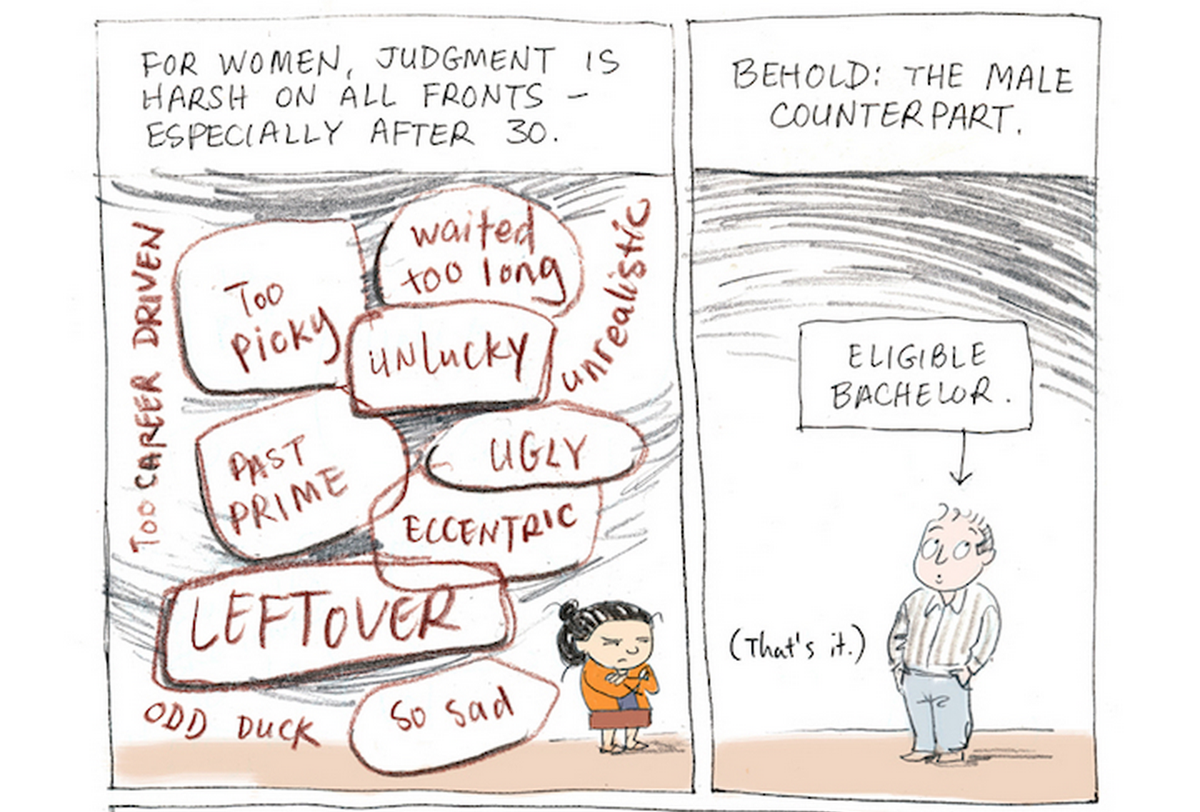
The expectations have changed somewhat but they still exist today. Truthfully, everyone has to contend with roles, from mothers to doctors to politicians to department stores clerks. Single women specifically have to deal with roles that are entirely dated (singles--not merely unmarried people but people who live alone--are growing in numbers).

Expectations for single women remain consistently negative. (Male singles have a separate set of expectations; I don't doubt the the role of single male carries with it its own negative stereotypes; even the role of "bonhomous, high-living bachelor" can be tiresome and difficult-to-live-up-to. The male, however, can always fall back on stoicism as an acceptable alternative.)

That is, single women are expected to be depressed, bitter, angst-filled, finger-pointing, self-blaming, and desperate. If a single woman doesn't act depressed, bitter, angst-filled, finger-pointing, or self-blaming, she must be selfish, self-centered, picky, and cold.

Those who search for these characteristics in single women have a role for themselves in mind: She whines and complains, and then I tell her to forget about guys and live her life! 

A laudable goal.
What happens when the single woman already lives her own life?

Believe it or not, the reaction to a single woman who doesn't fulfill her role of "ohmygosh, I hate myself for being single" is often . . . anger: How dare she not be unhappy about not being married?! How dare she not beat herself up more? How dare she not be running around like a madwoman, desperately clinging to any man?! I was going to TELL her not to do those things, and she went and stopped doing it anyway. How dare she?!

Forster is the only English writer who wholly understands this (okay, maybe Jane Austen as well): that people can be as upset when someone refuses to fulfill a negative role as when that person refuses to fulfill as a positive one. 

Friday, November 10, 2017

Story versus Plot: Titanic versus Voyager

Webster's Duchess of Malfi: Lots of weird things
happen, then everyone dies and goes crazy is story.
In Aspects of the Novel, E.M. Forster distinguishes between story and plot--story is a series of events: this happens, then this happens, then this happens...

Shaggy dog stories fall into this category: one thing happens, then another, then another. Great fun even if the series of events leads nowhere other than the final scene.

Forster considered story the most basic and uninteresting of fiction elements, however necessary. In a rather funny--though typically  pompous--definition, he accuses story of relying on mere curiosity, "the lowest of the human faculties." A story's entire goal is "of making the audience want to know what happens next." He presents the image of "Neanderthal man [listening] to stories...the primitive audience...gaping round the campfire, fatigued with contending against the mammoth or the woolly rhinoceros, and only kept awake by suspense. What would happen next? The novelist droned on, and as soon as the audience guessed what happened next, they neither fell asleep or killed him."
Hamlet: Why and how should I act on the
ghost's instructions? is plot. There's a reason
Shakespeare outclasses Webster.

Plot, on the other hand, includes mystery, which Forster rates higher than curiosity.

Forster writes, "'The king died, and then the queen died' is a story. 'The king died, and then the queen died of grief' is a plot...'The queen died, no one knew why, until it was discovered that it was through grief at the death of the king'...is a plot with a mystery in it."

Story versus plot is ultimately the difference between Titanic and Star Trek's Voyager.

Both works use an underlying structure to keep the narrative running--if the narrative takes place on the Titanic, then the story runs as follows: this happened, then this happened, then everybody died (except maybe one person). It is surprisingly useful, but only to a point. Going with the "hate-at-first-sight" trope, a story on Titanic goes as follows:
An enemy queen meets an enemy king on the boat, which then runs into a iceberg, which then sinks. At some point they decide to get along. And he decides to die for her (unnecessarily since the raft could have held both). Oh, and some people are rescued, but most of them die. 
Season 4: "The Killing Game"
Titanic as story is the reason that so many movies have been made about it and also the reason that so many movies about the Titanic end up being, in the long run, rather forgettable.

The underlying structure of Star Trek Voyager is, as with much episodic television, basically story (but): this happens, then this happens, yet everybody gets home. The "yet" allows for the introduction of plot from the characters' points of view, not only within each episode (which have arcs) but within the Voyager universe:
A ship gets lost and has to get home; four years in, the crew is taken over by an alien race that forces the crew members to take on new personas; seven years in, the crew is taken over by an alien race that forces the crew members to work on a planet; yet the ship gets home.
Returning to the same trope:
The enemy king and queen get lost on a ship that then prepares to return; four years in, they are placed in a situation that requires them to work together; after that event, they reconsidered their prior behavior; they grow closer followed by total reconciliation at seven years; when they return to "ordinary" life, they must decide whether or not their "fantasy" relationship can continue. 
Season 7: "Workforce" and James Read!

Not terribly profound. Yet it involves mystery and payoffs rather than simply resolving itself on the side of an indifferent geological phenomenon.

Will they get home together? is a story question.
Why and how will they get home as a couple? is a plot question.

No is Titanic's answer to the first question.
Maybe . . .if they can work something out is the answer in Voyager. 

In the long run, human agency/vulnerability is always more interesting than inevitable fate.

At some point, a fan-fiction alien story will follow, using Voyager's underlying plot . . .

Thursday, October 12, 2017

E.M. Forster and His Relationships: A Counter to Wendy Moffat's Biography

I discuss Forster biographies/analyses on Votaries. Specifically, I critique Moffat's well-written biography The Unrecorded History. The problem is not the writing. The problem is that Moffat slides all available evidence into a single pattern. The result is a Forster who is neither as complex nor as interesting as the Forster revealed through P.N. Furbank's biography.

Among the many relationships that Moffat details, she presents two--with Mohammed and with Bob Buckingham--as absolutes. She more often than not "tells" the relationship story without "showing" quotes from either journals or letters. She is the equivalent of the good girlfriend who defends her best friend's relationships, even when he isn't so sure of them himself.

With Mohammed, she cannot withhold a slightly critical voice--but that is entirely due to Forster himself. Forster worried about the gap between him and his "lover" in terms of race, class, and philosophy (although there was a considerable age gap, I don't perceive age as an issue any more than did the men themselves). Forster worried that he was taking advantage and being taken advantage of. He also worried that he and Mohammed did not perceive "relationship" in the same light.

Moffat ignores these doubts, downplaying them whenever they rise to the fore. After Mohammed's death, Forster wrote out their history together. He was typically self-analytical and unswervingly truthful. In one of the most shearingly honest pieces ever written by a human being (other than C.S. Lewis), Forster writes to the dead Mohammed:
I wish I could distinguish more clearly between us, but it was always difficult, and now you are not here to correct me when I think of you not as you are but [as] I should like to think you . . . I am professionally a writer and want to pay you this last honour, although there is much that you will not understand, and some things that you will not agree with . . .
Moffat omits this letter. Whenever Forster questions his relationship with Mohammed, she argues that he is a man tortured by doubts, not a man reflecting honestly on a rather odd affair. While reading Moffat's account of Forster-Mohammed's relationship, I could never shake the uneasy impression that Forster made the entire thing up. Yet while reading Forster's letter (in Furbank's biography), Forster's very doubts led me to conclude, "Yes, this happened. It was real." It is Forster's astringent, self-aware voice that convinced me. In Moffat's hands, Forster turns into someone far more clueless about himself than every person connected with Forster understood him to be.

Moffat extends this same interpretation of Forster to his relationship with Bob Buckingham.

Forster was consistently cagey about Bob Buckingham, who would have had far more to lose than Mohammed if Forster had played out a romance in public (or through letters). Moffat works hard to maintain that the relationship was a great romance because . . . I'm not sure why. I have a feeling that the reason is connected to Moffat's desire to see Forster more as an angsty Heathcliff than an objective Darcy. Or to her need to sell Forster as a man thwarted by society's rules when, in fact, he was the beneficiary of his social class--and knew it. (Forster wasn't the type of man to turn life's imperfections into his raison d'etre and tended to avoid, or to sternly remonstrate with, people who did.) 

Bob Buckingham was a cop who was bisexual or open to any experience that would improve his lot in life or a warm-hearted, physical guy who never thought of himself as Forster's gay partner despite the equivalent of locker-room high jinks. He did marry after meeting Forster and by all accounts had a robust physical relationship with his wife. Although one of Forster's friends attempted to sabotage the Forster-Buckingham relationship by informing the wife, May, that Forster was undermining her marriage (by taking Bob about with him so much), the attempt went nowhere, mostly because May's attitude was that Bob hanging out with another man was better than Bob hanging out with another woman.

In his typically scrupulous manner, Furbank suggests that there may have been no ongoing physical relationship at all. Furbank is not being prissy or inhibited or homophobic. He is honest and non-judgmental about Forster's homosexuality as well as Forster's various relationships throughout his biography's 585 pages. He presents the option because he is a honest historian who cannot ignore the accumulated evidence, the lack of evidence, and Forster's personality.

And the evidence is that no one knows exactly what the relationship was between Forster and Bob Buckingham. Forster was highly self-analytical but also capable, as he admits, at creating scenarios that he wished to be true. He presented himself and Bob as partners to his Bohemian friends but so elliptically that one is left with the impression that Forster wanted his friends to believe that Bob and he were lovers, not that they actually were. (Or, rather, he wanted his friends to believe whatever they wanted to believe without Forster having to say anything at all, which seems most likely.)

Forster had the wonderful capacity to immerse
himself in experiences without judgment--
yet he was a shrewd judge of people and
events: not the kind of man to be conned.
When presented with outside evidence--Forster's wry self-analysis, for instance--that contradicts her pattern, Moffat fudges. When Forster had his first stroke and confessed his feelings to Bob Buckingham, Bob was shocked and denied (1) that he knew Forster was gay; (2) that he and Forster were lovers. Unlike Furbank (who deals with this event upfront), Moffat moves Bob's declaration to a side note at a later period of time, implying that Bob did not make such denials until AFTER Forster's death. But in fact, Bob made this denial several years earlier; six years later, he and his wife would care for Forster during his final days. Yet Moffat accuses both husband and wife of covering up the truth--so much so that they come across as low-life grifters out for Forster's money and prestige.

Those who knew and met the Buckinghams  including Furbank, found the possibility of their deliberately lying to protect themselves highly unlikely. From all accounts, including Forster's willingness to befriend the Buckinghams, they were honest, intelligent, unsophisticated people. Bob especially took things at face value. His wife May was more discerning though more likely to worry about Forster's increasing forgetfulness than his sexual orientation. 

Based on Forster's own droll assessment of himself and his various relationships, intimate and not, I rather think that he and Bob Buckingham did exchange some physical intimacies, the type that a highly physical good-old-boy like Buckingham would never define to himself as "gay" since he did not seem to think that he was. (A reality ignored in Moffat's biography is that people are far more varied in their responses to sex and sexual identity than a label. She also ignores that social expectations/attitudes towards male "bonding" have changed in the last fifty to sixty years; even the language has changed from "friendship" to "homosocial" to "bromance.")
Forster sitting next to May Buckingham

When Forster met Bob Buckingham, he was older, wiser, tired, happy with his circle of friends, happy to have a "consort" of sorts to take around with him when he visited his Bohemian friends (who strike me as far more naive than Buckingham's wife) and may have decided, "Hey, I'm a middle-class Englishman with no desire to be a rebel and a lessening sex drive. This works for me!"

And it did. The Buckinghams invited Forster into their home, and most of Forster's friends accepted the Buckinghams as "good sorts". The Buckinghams cared for Forster through various illnesses and broken bones. May Buckingham specifically was an extremely good friend to Forster. He was godfather to the Buckinghams' son; when the young man died, May and Forster consoled each other. One gets the impression that Forster preferred this middle-middle-class family to his Bohemian and upper-middle-class friends. At heart, the guy really liked the middle-class life, even as he critiqued it.

Forster fell in love; Masood didn't; they remained friends. By
his own assessment, this was one of Forster's most important
relationships--every relationship mattered to him.
There are ways to reconcile or at least explain the perspectives of all those involved. I attempted one reconciliation above. Moffat never tries to do this or allow for it--hers is a-one-size-fits-all pattern. If Forster stated something that fits the pattern, she accepts and reports it; if he later qualified or contradicted previous statements (as humans are wont to do), she ignores or downplays his equivocation. Her treatment extends past Forster to his friends: If what you're saying agrees with Forster having notable, dramatic so-called real romances, you must be speaking the truth. If you doubt or question those romances, you must be afraid of speaking out.

The problem is not that Moffat is selling Forster as a gay man. He was. And it informed his life and literature, as Furbank makes clear. The problem is that she doesn't accept that relationships are more complex than one-winner-takes-all. As mentioned above, after a few chapters with Moffat's book, I felt like I was reading a high school confessional: My best friend luved this guy in high school, and she was soooo into him, so it MUST have been, like, the biggest romance of the century.

People live on continuums, not absolutes. In the long-run, Moffat misses out on the objective, idealistic, sensitive, friendly, self-knowing, and wry E. M. Forster that others understood him to be--in and out of his intimate relationships.

Wednesday, September 6, 2017

Alec and Maurice in Maurice: A Study of a Couple

This summer, I read and watched a fair amount of Forster (Maurice, A Passage to India, and A Room with a View as well as Aspects of a Novel and Forster's guide to Alexandria). I also read a fair amount about Forster, including Furbank's seminal biography as well as a smattering of literary analysis.

Furbank's seminal biography is well-worth the read. The literary analysis reminded me of the problem with literary analysis.

Maurice has a happy ending--in his terminal notes to the manuscript, Forster remarks with typical drollness, "[I]t has made the book more difficult to publish . . . if it ended unhappily, with a lad dangling from a noose or with a suicide pact, all would be well, for there is no pornography or seduction of minors. But the lovers get away unpunished and consequently recommend crime."

Not only is Forster's note a dig against the current laws (circa 1960) in England, it is a dig at Ivory Tower intellectualism (and yes, Forster would have been aware of that), which supposes that a classic cannot be a classic unless everyone at the end is depressed, separated, or dead.

And if you don't believe me, take a look at any high school "classics" list.

Forster's friends who read Maurice in unpublished form almost all liked the happy ending but were uneasy about it. There's a reason for this unease, which I address below. What I had forgotten about literary analysts is how utterly sycophantic and lemming-like they are. This is the acceptable way to think. Thank goodness I didn't mess up and write something different! We must all remember to denigrate Maurice in our analysis and act condescending about the ending.

Maurice does have the slightly sketchy feel of something not written for publication precisely because publication forces one to see a work differently (a point that Furbank, alone among Forster critics, seems to have perceived).

I do not, however, find it necessary to disparage the book. Forster does some fine things with Maurice--from the characterization of Clive to some of the more infinitely subtle/insightful moments, such as the opening chapter, Clive's breakdown and Maurice's reaction, the piano scene, the cricket match, and the museum sequence between Maurice and Alec, which last I consider utterly brilliant.

I also don't consider the ending false.

I am an American woman in her 40's. I am aware of class systems re: money and education but not as an intrinsic force of nature. I intellectually understand the British class system (Richardson to Austen to Forster); I've never lived it. Forster's friends did. As one film analyst--Earl Ingersoll--rightly points out, American audiences may not realize how unusually Maurice behaves towards Alec before they become lovers. My favorite example is when Maurice challenges Alec (referred to by his last name, Scudder, throughout this portion of the novel) for apparently holding out for a larger tip. His tone is harassing and familiar. It is not the tone of a person ticking off a servant; it is the tone of an equal badgering a potential friend or lover. (He later calls Alec out for threatening blackmail also from the position of an equal--he challenges Alec's notion "I'm as good as you" on moral grounds, not class ones.)

Forster's friends immediately picked up on the class issue--their strongest objection was that the gap in class would get in the way of the relationship.

Forster's friends had a point. Unfortunately, contemporary literary critics have taken hold of this objection as a sign of an "unrealistic ending" and argued that Alec and Maurice don't fit personality-wise, which is highly inaccurate. Forster understood human nature better than that:

Alec and Maurice are more like each other than they are like everyone else.

Maurice willingly assisting an ill Clive.
Maurice is a doer, a guy who thinks actions ultimately matter more than words. It is Maurice who wants to push the relationship with Clive to the next level. He accepts the platonic solution because he is (1) romantic; (2) somewhat naive; (3) the kind of guy, like Forster, who prefers to invest in a relationship long-term.

But Maurice, like Alec, is more than willing to run through the rain, take care of someone when he is ill, go see someone off on the boat rather than simply wishing that person well...and so on. That Maurice guesses where Alec is waiting at the end of the book is beautifully romantic and no error in characterization

Maurice and Alec exchanging grins across the aisle.
The scene in the museum illustrates the rapport between the characters excellently. They are both taken with enjoying the lamassu, not interpreting it. They both remark on HOW the thing was made rather than dismissing that side of art as plebeian and low-class. They both get a kick out of the fifth leg.

The entire end of the book was fleshed out by Forster after initial feedback. I suspect the most useful feedback was from Lytton Strachey, who thought Maurice and Alec were acting on "curiosity and lust and would only last six weeks." Prior to revision, Strachey had a point, even if an unpopular one among intellectuals (ironically enough): one contemporary critic castigates those viewers/readers who argue that Mellors and Lady Chatterley from Lady Chatterley's Lover need to have a reason to be together/get along beyond sex. Well . . . since they're going to start a freakin' farm together at the end of the book, my answer would be "yes, they do need a reason."

If Maurice and Alec are going to start a life together, then yes, they need more than sex--though that helps. And Forster more than prepares us for that possibility, especially since Forster himself desired compatibility of temperament, not merely a roll in the sack.
Alec demonstrates that no-holds-barred approach that
resembles Maurice's approach to life--yet he uses a
"gentleman's" tool (a letter) to try to reach Maurice.
Both men are willing to adapt to the other's methods.
He did refrain from including the original "us two living alone in the woods together" epilogue, which he was right to do. Forster was oddly enough too educated and too upper middle-class to perceive an obvious solution to Alec and Maurice. He was right to leave them alone at the end (the book turns to Clive's p.o.v).

My version of where Alec and Maurice end up is this:

World War I (1914) starts soon after Alec and Maurice meet. Alec joins up (it's fairly unimaginable that he wouldn't--the pressure in England to "help" the war effort was tremendous, far greater than the mild, persistent social pressure of Forster's novels: Forster himself helped out during WWI with the Red Cross). I think life is more interesting than death, so Alec survives.

Maurice--who has demonstrated an almost blithe tolerance of disease and illness, teaches boxing, and is quite physically strong (all Forster's characterizations)--volunteers as a medical assistant. In the field, after some fighting, Alec comes down with the flu pandemic and is transferred to a base hospital in Portsmouth. Maurice is either already there or gets himself transferred there. Alec survives (there were survivors of the flu pandemic!), and Maurice eventually moves him away from the hospital to his lodgings.

Alec's attitude towards his job is rather
caustic--and not only due to
his employers' snobbery.
By the time the war ends, the populace is shell-shocked enough that Maurice getting an apartment for himself and Alec (his lodger) in London is not remarked on. As Forster himself knew, an English man could remain an "eccentric" bachelor without causing too much of a stir--so long as he was discrete (I'm not saying this was fair; I'm saying it was better than jail or chemical castration).

Maurice could easily go back to being a stockbroker; his character is less fastidious than Forster, who would have liked more "noble" and "earthy" employment for his characters (the D.H. Lawrence influence).

Alec could become a mechanic or a newspaper writer/photographer (the guy who gets called out to report on fires and murder scenes). One of Forster's most insightful points in Maurice is that Alec's class could be as ambitious, class conscious, and strictly moral (even moreso) as anyone in the upper-classes, a perspective backed up by historians. Alec acts as an undergameskeeper in Maurice because it is a job, not because he loves the soil. I think he would attend the Working Men's College (where Forster actually lectured) after the war and get enough education to do something non-agrarian.

If they HAVE to become woodsmen, they could always go to America and move out West to work as  ranch hands (although even that, if Brokeback Mountain is any indication, required a measure of discretion).

Tuesday, August 29, 2017

Clive in Maurice: A Character Study

Clive Durham of Maurice is one of Forster's most complex characters.

He was based on one of Forster's friends and though less moody, is not dissimilar in his adoption of emotional poses as opposed to physical action. The actual friendship/love affair died out eventually since Forster got fed up with the friend's "you must join me in my pit of despair" insistence coupled with the refusal to move beyond a kind of indifferent homoerotic passion. It wasn't easy to max out Forster's tolerance, and he could live on lack of sex. He couldn't live on lack of affection.

Clive is not as emotionally unpredictable--Maurice focuses more on the secondary reason than the first. Ultimately, Forster uses Clive as the ultimate critique of Ivory Tower blathering coupled with English upper class propriety.

I mention on Votaries the tendency for intellectualism to fall prey to the "mind is everything" trope. The much touted intellectualized American versions of Asian "philosophies," for instance, are often shorn of the wild, physical, and palpable (not quite like the actual systems). Life is all about having the correct mental framework and the correct emotional state as opposed to actually seeing gods or touching bodies. 

Clive and the Oscar Wilde-like Risley, who Forster maintains
was actually based on another friend: "Risley, as Lytton
gleefully detected, was based on Lytton."
Despite being somewhere between an atheist and agnostic, Forster was not a fan of stripping religion or reality of its pragmatic and touchable. Hence, the wryness in his self-analysis. He saw the danger of becoming a Durham and said, in his infinitely polite way, "No, thanks!"

Clive is more unconventional than Maurice--on the surface. At college, he is the one who breaks with Christianity, inspiring Maurice to do the same. He is the one who seemingly rebels against authority. He is also the one who declares himself first. But it is all words. It is Maurice, not Clive, who initiates the first kiss. It is Maurice, not Clive, who accepts being sent down and takes a job in the city. It is Maurice, not Clive, who shrugs off the "indignity" of taking care of a sick man. It is Maurice, not Clive, who shows an utter willingness to walk away from his life.

Book cover inspired by the movie.
Maurice as the doer, not the speaker, is made more interesting by his  inherent lack of introspection. His homosexuality (a term not commonly used in Forster's time) forces him to become introspective; because he isn't a "practicing" intellectual and doesn't have labels to fall back on, his introspection is unique to himself.

The result of that introspection is the novel. But this is no Catcher in the Rye where an angsty voice demands sympathy. Clive would write Catcher (under a different name), not Maurice.

If Maurice was Oscar Wilde, he would have moved to France with Lord Alfred Douglas before the trials--then watched Clive leave him for the same reasons Lord Alfred Douglas abandoned Oscar Wilde.  But Maurice would have accomplished the move, not talked or waffled or postured about it. 

Clive's unwillingness to act, to give up his name, family, estate, and position in society as a budding politician is comprehensible, even defensible: people make choices for reasons other than love. Where Forster truly excels is when he depicts Clive's equal unwillingness to totally give up Maurice. Clive doesn't wish to have an affair with Maurice. Not at all. This is a guy who lives entirely in his mind. But he wants to keep Maurice within his circle, even his thrall.

So he invites Maurice to Pendersleigh after his marriage. He greets him as a hearty-good-fellow. He tries to get his wife to set Maurice up with a "nice girl." He visits Maurice's room and insists on playing out a game where he kisses Maurice's hand, then proclaims that that side of their life is over and done with. (All this material is in the book as well as Ivory Merchant's faithful 1987 adaptation.)

He doesn't want to remember what he and Maurice had (much like how Lord Alfred Douglas pretended later in life, to the disbelief of everyone, that he and Oscar Wilde had merely been good friends). He wants Maurice to pretend as well. And initially, he gets what he wants since Maurice is still getting over his heartbreak and is willing to go along with whatever Clive suggests.

But Clive's control has a shelf-life. It lasts only as far as Maurice remains (1) emotionally distraught; (2) subjectively rather than objectively introspective. Once Maurice regains his "self" and knows it, Clive's influence takes a nosedive. And because Clive refuses to be direct, he can't do anything about it.

The cricket match is a perfect model of this issue.

Maurice and Alec slept together the night before. During the cricket match, they demonstrate physical ease, picking up on each other's cues, hitting and running at the proper moments (according to the little I've read about cricket, this synchronicity is a real thing with good cricket players).

Clive returns from canvassing for the by-election. He doesn't know what happened between Alec and Maurice. He doesn't even suspect it. But at some level, he senses that he is no longer the center of Maurice's emotional universe. For one, Maurice is far more relaxed than before. Hugh Grant endows Clive with a kind of short-tempered "well, of course I'm going to play!" attitudinizing. He takes Alec's place (Alec, though captain at Maurice's insistence, has no choice since Clive is the head of the estate), makes a wrong call, and "strikes out" both himself and Maurice (my apologies for using American parlance; I don't totally understand cricket).

Up to the end of the novel and film, Clive is still trying to corral Maurice with words, words, words, as Hamlet would say: settle Maurice in his place; force him through sheer intellectualizing to be his friend in one particular way. Clive is the quintessential example of why intellectuals believe that informing people how wrong they are in their thinking will result in such people voting differently. (Not!)

And Maurice simply walks away: "Maurice had disappeared . . . leaving no trace of his presence
except a little pile of the petals of the evening primrose . . . To the end of his life Clive was not sure of the exact moment of departure, and with the approach of old age, he grew uncertain whether the moment had yet occurred."

The book, like the movie, ends with Clive, and though the end of the movie is owned by Maurice and Alec, there is good reason for Clive to resolve it. The character arc--or lack thereof--is all his.

Analysis of Maurice & Alec will follow . . .

Monday, August 21, 2017

Maurice: Rupert Graves

This movie is actually about Hugh Grant's character, and he delivers a convincing and credible performance, explaining why in 1987, it was already a given that Grant would go on to have a notable career. (Analysis of Grant's character Clive Durham will follow at a later date.)

However, I watched the movie mostly for Rupert Graves (Sherlock), whom I almost didn't recognize with that mop of dark, curly hair (see below). Rupert Graves is one of those amazing actors who has been working non-stop for three decades (yes, he did start working at 15) in film, television, and theatre (plus he's got a wife and five kids: when does he sleep?).

Maurice is based on E.M. Forster's book by the same title. The story of a gay relationship in early 20th century England, the manuscript bears Forster's note "Publishable but worth it?" on the cover page.

He didn't. It was published in 1971 after his death.

Maurice is based on a real-life couple that Forster knew: Edward Carpenter and his working-class lover George Merrill. They lived together from 1898 to 1928. There is a lesson in here somewhere about the oddities of English attitudes towards unorthodox behavior, specifically the reason why one is better served living in the country, writing intellectual tracts than acting like Oscar Wilde and bringing libel suits one is bound to lose.

In any case, Forster based Maurice's Maurice Hall, a gentleman, and Alec Scudder, a working-class laborer, upon the couple; reportedly D.H. Lawrence based Lady Chatterley Lover's Mellors on George Merrill specifically.

Mellors is the reason I was skeptical about Alec Scudder.

I am not a fan of Lady Chatterley's Lover which I consider entirely too full of itself--as is Mellors. I've never seen any of the series/movies (merely read, ya know, the book), despite rather adoring Sean Bean. Mellors is the quintessential reverse-snob, strolling about the countryside pontificating (or gruffly allowing others to pontificate) about getting back to nature, the power of connecting to the earth, the meaning of being one with the countryside blah blah blah.
Sean Bean as Mellors

Let's face it: E.M. Forster, for whose writing I do not greatly care, is yet a better writer than Lawrence. Maurice, which is not considered his best work, is far more subtle and droll than anything that Lawrence could have ever hope for. (This is not, by the way, the "correct" academic attitude to have--one is currently supposed to consider Lawrence the superior writer.)

In Room with a View, the scene where
naked Freddy and his mother start
arguing is one of the funniest.
The appeal of film Alec Scudder is partly the original writing but mostly Graves, who endows this bold young man with unrepentant insouciance and a kind of youthful desperation. He brings to Alec the same out-of-bounds energy and self-deprecating cheek that he used as Freddy in A Room With a View. Graves felt like he "failed" the role of Freddy. He didn't--he is one of the most refreshing parts of the movie. However, due to weightier material--A Room With a View is an elegantly lightweight film--and to experience, he excels in Maurice.

He excels by not being a Mellors-type. Rather than being the "instructive" master of the universe who "learns" his lover in the ways of physical lovemaking, Graves' Alec Scudder is as invested in the relationship as his lover--and massively more confused. James Wilby--who was much better cast as Maurice than Julian Sands, the first contender for the role (see James Fox)--manages to convey early on in the London meeting that he recognizes Alec's belligerence for what it truly is: not blackmail but the outrage of a young man at loose ends.

And he recognizes it because he endured the same emotional upheaval. His age and class give him cache, not instant superiority.

"Don't tell me your name--I want to remember--"
When Maurice and Alec run into Maurice's old tutor, Dulcie, at the British Museum, Graves gives Scudder the perfect reaction. He seems to withdraw in on himself, quickly closing the distance between him and Maurice but slightly behind him. He isn't sure if this is an enemy, someone who will lecture him about his "place." He also isn't entirely able to read Maurice's careful reaction to the same man. With the effortless grace of a gentleman of that era, Maurice smooths the meeting over, introducing himself as "Scudder" to the friendly Dulcie. The entire scene is pitch-perfect.

Forster seems to have liked people more than Lawrence (Furbank's seminal biography on Forster backs this up: Forster perceived friendships as the purpose of life and worked hard at maintaining them). Despite being the usual Forster victims of society's class system, all the characters in Maurice are totally ordinary and mostly nice, even the lecturing ones. I cannot imagine anyone in a Lawrence work saying, "Did you ever dream you had a friend, someone to last your whole life?"

And, quite honestly, there are no dead babies. So I consider this one of the more successful Forster-films.