Showing posts with label Fantasy. Show all posts

Wednesday, May 6, 2026

X is for Xie Lian's Series: Couples Who Solve Supernatural Problems

X authors are not the easiest to find, even if one goes beyond American & English authors. 

Mo Xiang Tong Xiu is a great exception! 

So far I have read Heaven's Official Blessing, Vol. 1 and started Vol. 2. The reading is slow--the novels belong to "world fantasy," which, like "world romance," involves EVERYTHING that is going on around the characters. But the denouements are always quite gripping.

The series belongs to a romance/sci-fi/fantasy sub-genre: a couple investigate supernatural happenings. Basically, X-Files. Priest's Guardian series falls into the same category as does the Onmoyoji & Tengu Eyes series. 

I quite like these series overall though they can cross a line into nihilism. I always considered Death Note to be about 1000 times more interesting while Light was still alive than after Light died. That is, part of the draw of these books--whether romantic or non-romantic--is the push & pull, the banter, the constant readjustments between the two main characters. Working together to solve a problem IS the underlying structure.  

Heaven's Official Blessing is a decent addition since the personalities are complementary. In addition, though San Lang seems confident and powerful, a dominant partner, he has his own uncertainties and weaknesses. The characters balance each other. 


Saturday, January 3, 2026

Will Stanton and Barney Drew: Possible Couple

I mention in my review of the Dark is Rising series that I would get Will and Barney together in the future. (In the world of romance, I also think Jane and Bran from the same series would make an interesting couple.) 

The reason isn't only because I think the current ending--Will as the only remaining Old One and character who knows the truth--is rather sad and pointless... 

I also consider it dull.  

Barney is the youngest of the Drews. He is also an artist (like his mother). In the books, he is portrayed as possibly ten or younger. That is, he doesn't appear to age between the first summer and the final denouement. In character, he is entirely insouciant, being one of the few people on the train at the end who is entirely caught up in the moment. He is also, going back further, fascinated by King Arthur and makes some of the earliest, valid connections between clues and quest. 

Possible Barney
I decided that Barney grows up to be a tall, insouciant, happy artist. He never loses his interest in King Arthur. He may even end up on a couple of archaeological digs, and he would, of course, admire the show Time Team

Subsequently, he has always wondered if more was going on in Wales than what he and his sister and brother technically remember. And he has always wondered if there is more to Will Stanton than meets the eye. 

(In the books, he is initially the most reluctant to accept Will into their group. He is later, however, the most willing to follow Will's lead.) 

Grown-up Barney does some research in Cambridge or Oxford (a la Gandalf doing research in Minis Tirith), connects Will to the Old Ones, and tracks him down. 

Possible Will
In the books, Will's father is a jeweler/trader in unique antiques. Since I am not a fan of "I have all this knowledge--oh, the angst" personalities (one reason I like Elementary so much is that neither Sherlock nor Joan give Sherlock a pass because of his "special" burdens). I think Will would adjust to everyday life. He would use a background in antiquities to locate interesting pieces for his dad. 

So when Barney finds Will, he finds him at an estate, hunting up a rare item. He informs Will of what he has figured out and then sticks with him. 

The positive here is that as art/antiquity experts, Barney and Will could have their own series as they figure out historical mysteries and/or fraud-theft mysteries! Their differences--Barney is impulsive, artistic, and extroverted while Will is reserved, supposedly Mr. Ordinary, and ironic--would make for a more than decent and interesting partnership, romantic or otherwise. 

Monday, November 24, 2025

Singles Without Stigma

Bilbo remains single. So does Frodo. Sam gets married. 

Leslie A. Fiedler spent a lifetime as a critic claiming that while European and British literature is suffuse with romance, American writers (of the classic novel variety) spent their careers running from the female. 

Like most theories about anything, I think Fiedler has a tiny point that is blown way out of proportion. 

The tiny point is that American culture does seem to idealize and worry incessantly about marriage while stigmatizing singles--all this in a way that the more outwardly romantic British do not. 

Of course, there is a historical-time-period issue here. Tolkien was born in the late 1800s. He was writing in the early to mid-twentieth century. In England. In a university town. 

In sum, Bilbo's singleness is VERY English. It also carries zero stigma. He is the classic bachelor, even more so than Wooster and, for that matter, his own nephew. Frodo is the Fisher King, the wounded hero who cannot stay in the village he saved. 

Bilbo, on the other hand, is part of his village. He has his books, his friends, his food, his wanderings (hikes), and, eventually, his beloved Frodo. 

And there's absolutely nothing more to be said about his lifestyle one way or the other, either from a conservative or progressive perspective. 

This view of singleness is, truly, quite lovely.  

Sunday, November 16, 2025

Borrower Romances

I comment on Votaries that Mary Norton seems to have abandoned Arrietty's core personality in The Borrowers Avenged. I write, 

On the one hand, I can understand Norton wanting to give Arrietty more dating options than the exceedingly uncommunicative Spiller. And people, especially teens, do change as they mature. [Arrietty previously stated that she was going to marry Spiller.] 

Personally, I always liked Spiller. As I also write, 

Arrietty would travel up and down the river with Spiller and their borderline wild kids. 

Despite liking Spiller, I do agree with Norton's desire to give Arrietty options. Yet I don't agree with Norton so fundamentally altering Arrietty's interests. So I decided, Why not bring back Stainless?

Stainless is a boy of Homily's generation, which means that he is anywhere between 32-40 at the time of The Borrowers Avenged. As a boy, he caught a ride in a basket to the local sweet shop. When he came back, he was completely insouciant about the chaos he caused (everyone was looking for him) but had lost his beautiful complexion due to all the sweets he ate. 

It's a very funny short story. 

I decided that Stainless never loses that tendency to catch rides to places. He ends up in the luggage or coat pocket of a human who goes to a distant town, distant enough that Stainless might as well have gone to Antarctica. When he returns to his home turf many years later, he is older, wiser, quite adept at survival, and still restless. Borrowers get together to hear his reports of his travels. And he brings back objects to trade. 

Arrietty would admire him! Maybe she marries him. Maybe he married and had a son, and she marries the son. Maybe, because I like to consider all possibilities, he forms a relationship with Spiller, platonic or romantic. Maybe he and Peregrine get together--he writes a book and Peregrine illustrates it. 

I like the idea of a larger borrowers' culture beyond the Clocks. And I also want  Arrietty to have lots of possibilities, including, of course, Spiller.  

I should end by stating that Homily and Pod are one of the best compatible-with-distinct-personalities couples in all literature. Ian Holm and Penelope Wilton (who were a couple at the time) capture them perfectly

Wednesday, June 25, 2025

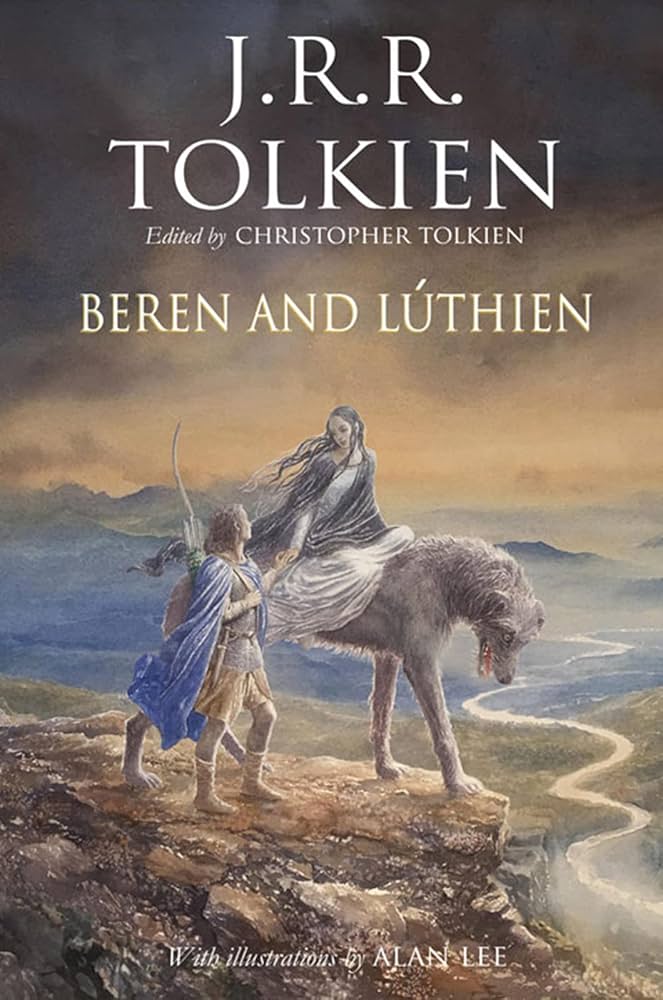
Tolkien's Great Romance: Beren and Luthien

I haven't watched Amazon's Rings of Power. I may some day. But even a brief review of the episode synopses makes me tired. It sounds like Elvish soap opera and doesn't cover the history of Middle Earth that I would now prefer to see. (Is a rehash of Sauron and the rings really necessary?) 

Rings of Power takes place in Middle Earth's Second Age rather than its First, and maybe someone like Jackson is holding onto The Silmarillion (First Age) to do it justice (I can only hope). In a recent rereading of The Silmarillion, I was reminded how much great stuff is available in Tolkien, if people will go looking for it. I'm a huge fan of Jackson's trilogies. I just don't think honoring Tolkien has to begin and end there. 

One of the best and most complete of Tolkien's earlier "lore" is Beren and Luthien. It has all the drama and angst anyone could desire. And, most importantly, it has a strong narrative arc.

Muddy Colors
Beren is human. His father is slaughtered when one of his father's followers unwillingly betrays him to Sauron. Beren kills his father's orc murderer and then makes his way through Ungoliant's niche to the realm of Thingol. 

In that realm, he comes across Luthien, who is the child of Thingol, an elf, and Melian, a Maiar. Thingol doesn't care for Beren as a choice for his daughter, but Luthien loves him and defends him. Thingol sets Beren a task to complete. Much of the couple's arc focuses on that task. 

The two perform rescues, face down Sauron (before the rings), sacrifice for each other. And they have this big pet dog! (Okay, he's more than a pet but...)  

Great characters! Great internal and external conflicts! Lots of material without having to resort to throwing a wizard-elf-dwarf-human-hobbit-villain-bunch-of-rings into a bag and shaking them about.

Friday, January 24, 2025

Redemption in Romance: When It Works and When It Doesn't

Two books about redemption by the same author, Eliot Grayson, point to the problem of redemption and romance. 

In The Alpha's Gamble, Blake is a self-entitled playboy who once harmed Declan, hotel owner. Now, Declan is forcing Blake to a reckoning. And they fall in love--after a number of misunderstandings. 

In Lost and Bound, animal-shifter Jared once tried to take control of his pack by betraying and using various people. Trapped by someone who was using him, he ends up meeting Calder. They become lovers. Jared comes to a personal reckoning and eventually reunites with the people he betrayed, who forgive him. 

The difference has to do with experience. In The Alpha's Gamble, at one point, Blake tries to tell Declan that he is being watched, possibly stalked. Declan doesn't entirely believe him and later states, "It's like the boy who cries wolf..."

And here's the thing: Declan isn't wrong. He is wrong in this instance, but he isn't wrong to use past experience as a guide. 

Calder, however, doesn't have that baggage. Jared doesn't lie to Calder about what he did to other people, and Calder objectively assesses Jared's level of culpability. He doesn't have any personal reason to distrust Jared. 

Experience matters. Trusting one's past judgment matters. Being able to trust those instincts matters. 

Consequently, I don't entirely believe in the Blake-Declan relationship. I'm not saying forgiveness isn't possible. But, again, forgiveness doesn't automatically annihilate experience. Cesar Millan's willingness to go back into the "ring" with red-zone dogs isn't the product of naivety but a willingness to try again without holding the dog's state against the dog. 

Asking humans to do the same is an ideal--I'm not sure, however, that it makes for a comfortable relationship for either party.

That is, Blake can, in fact, redeem himself. Declan can, in fact, forgive him.  

That doesn't mean the relationship will work. It doesn't mean that Declan won't forever associate a particular set of memories and feelings--(Give me a break; you just make stuff up, you weasel)--with the person before him. Whether or not he should is a separate question from reality: we know what we know because of things that happen. Age and experience do matter. The "what" of our personalities--what we do, what we see, what we choose--does matter. 

Tuesday, October 31, 2023

Interview with the Translator: Hills of Silver Ruins, Zombies & Psychopaths

Kate: The Hinman who attack Risai and Gyousuu’s group in Hills of Silver Ruins seem like a cross between zombies and werewolves. 

Do the Japanese have an interest in zombie popular culture? To the same extent as Americans? And do they link their zombies to Voodoo? (American zombies aren't really linked to Voodoo, but everyone pretends they are.)

Eugene: Like Halloween (which has exploded in popularity over the past decade), Hollywood horror has inserted itself into contemporary culture while becoming influential on the home-grown Japanese genres. Consider that an episode of Fruits Basket includes a running joke about "Jason" from Friday the 13th.

Vampires and zombies are two examples. The Japanese versions often tweak the origins stories but otherwise import them in recognizable form, such as the vampires in Call of the Night (a well done teen vampire dramedy). Hellsing gives us both vampires and zombies.
 
Hellsing employs the now standard trope of a secret government demon hunting corps. Hellsing takes place in England, and the group is led by a descendant of  Abraham Van Helsing. Demon Slayer, Jujutsu Kaisen, and Chainsaw Man have all used the same-only-different formula.

Voodoo references can be replaced by similar Shinto concepts. The idea of cursing someone via a symbolic representation of that person (commonly a paper or straw doll) is a common one in Shinto-based horror and goes as far back as at least the 11th century and The Tale of Genji.

The demon slayers in Chainsaw Man hack their way through a whole army of zombies in the big climax, though the zombies are just collateral damage on the way to taking out the Big Bad, an overpowered "gun demon" from the other side of the Pacific. 

Kate: Even though Asen is a bad guy, his disposal of Ukou is a relief. In saner times, the man would be held for war crimes.

Do the Japanese have an opinion about war crimes, events like the Nuremberg Trials? Or is the preference to move on? After World War II, were any of the “old guard” left to put on trial or did they fade into the background?

Eugene: The Tokyo War Crimes Tribunal convened in 1946 and was intended to be a repeat of the Nuremberg Trials. It was a huge production, lasting twice as long as Nuremberg, but ultimately turned into little more than a show trial, with MacArthur leaning heavily on the scales to produce the outcomes he desired. The proposition that Tojo was analogous to Hitler was absurd, though if Tojo was guilty then so was Hirohito.

As John Dower notes, MacArthur's campaign to absolve Emperor Hirohito of responsibility "knew no bounds," rendering the whole business an exercise in selectively settling scores, not seeking justice.

As far as I'm concerned, Nuremberg is the exception that proves the rule that the whole concept of the "war crime" will inevitably succumb to "victor's justice." It falls into the same subjective witch hunt territory as "hate crimes," meaning all the stuff you did that I don't like. But taking the term at its face value, the purpose of a "trial" is to settle matters of justice and moral responsibility. So when the Tokyo Trials were over, the Japanese people by and large considered the matter resolved and put it behind them.

 In a 2006 survey conducted in Japan, "70 percent of those who were questioned were unaware of the details of the Tokyo Trials, a figure that rose to 90 percent among those who were in the 20–29 age group."

The "truth commission" approach is far superior. It is preferable in these circumstances to find out what happened and why than to affix blame. In a war, after all, every single person involved is "to blame."

An actual "war criminal" would be prosecuted according to the laws that governed his actions. A guy like Ukou would fall under the jurisdiction of the Imperial Army's Uniform Code of Military Justice and be court martialed accordingly. The problem is rarely a lack of laws on the books. Turkey's building codes aren't very different from Japan's. The difference in Japan is that they are enforced.

Thursday, September 21, 2023

Interview with the Translator: Hills of Silver Ruins, Shakepeare

Kate: Based on the conflicting belief systems of Asen’s good retainers in Hills of Silver Ruins, how do you think they would respond to Henry V’s speech the eve of the Battle of Agincourt?

Retainer’s Argument: But if the cause be not good, the King himself hath a heavy reckoning to make, when all those legs and arms and heads, chopped off in battle, shall join together at the latter day, and cry all “We died at such a place,” ...Now, if these men do not die well, it will be a black matter for the king that led them to it, who to disobey were against all proportion of subjection.

King Henry: So, if a son that is by his father sent about merchandise do sinfully miscarry upon the sea, the imputation of his wickedness, by your rule, should be imposed upon his father that sent him. Or if a servant, under his master’s command transporting a sum of money, be assailed by robbers and die in many irreconciled iniquities, you may call the business of the master the author of the servant’s damnation. But this is not so. The King is not bound to answer the particular endings of his soldiers, the father of his son, nor the master of his servant, for they purpose not their death when they purpose their services...Then, if they die unprovided, no more is the King guilty of their damnation than he was before guilty of those impieties for the which they are now visited. Every subject’s duty is the King’s, but every subject’s soul is his own.

Eugene: Henry V’s debate with one of his own soldiers on the eve of the Battle of Agincourt almost perfectly sums up the moral foundations, not just of a UCMJ (Uniform Code of Military Justice), but of the ideal code of conduct in any large organization. "Every subject's duty is the King's (or the CEO's), but every subject's soul is his own."

One realistic aspect of the Ono's world building in the Twelve Kingdoms is that guys like Rakushun are rare. Even high-ranking officials are not always clear about how the whole system works. The vast majority will have never met the emperor or the kirin. In that situation, situational rationalizations make the most sense: my guy is the right guy, especially if he's the guy in power.

The irony is that Shakespeare's Henry V is pretty much in the same position. In retrospect, it's hard to categorize the Hundred Year's War as a "good cause." It was ultimately one of those interminably stupid conflicts about where to draw the property lines. Likewise, Japan's Warring States period can be treated as a long Shakespearean drama because it didn't matter who won.

Of course, it mattered to them. But not like "City on the Edge of Forever" from the original Trek.

Given such a murky ethical environment, it's impressive that Keitou, for example, at last declares that his soul is indeed his own and allies himself with Taiki. Growing increasingly uncomfortable with being paired up with a nihilist like Ukou, Yuushou is headed in that direction too. Then again, Ukou even creeps out the Macbethian Asen.

Kate: In Chapter 33 of Book IV of Hills of SilverRuins, Risai's attitude reminds me of Hamlet at the end of the play, when he finally accepts his fate: 

"Not a whit, we defy augury. There’s a special providence in the fall of a sparrow. If it be now, ’tis not to come; if it be not to come, it will be now; if it be not now, yet it will come. The readiness is all."

Shakespeare is ubiquitous in manga and Asian live-action series/films! In a recent Thai live-action series, the two characters act out a scene from Romeo & Juliet. They begin to argue about which character is supposed to say, "Wherefore art thou...?" until one uses the line to get back at the other: "Wherefore art thou a jerk?" And I own a manga series in which an art gallery is titled “The Nutshell” as a deliberate reference to “though I am bound in a nutshell” from Hamlet. And when I was a teenager, I saw a fantastic version of Shogun MacBeth live.

Does Shakespeare strike a cord of high romance, related to knights, chivalry, and King Arthur's court? Is Shakespeare somewhat more "translatable" than the very Western, if popular, King Arthur and his knights? After all, King Arthur got turned into Camelot while Shakespeare retains that medieval bite--alongside the War of the Roses mess.  

Eugene: Thanks to men like Thomas Blake Glover, the enterprising Scotsman who armed the burgeoning rebellion against the disintegrating Tokugawa regime in the mid-19th century, the Meiji government closely aligned itself with Great Britain. The strictures of Victorian society certainly would have struck a familiar note at the time.

Well into the 20th century, many of Japan's political elites were full-blown Anglophiles, down to the clothes they wore. This may explain why the preferred formal western attire for Japanese men is the English morning coat.

It is not difficult to find events from the Sengoku period () and the earlier Genpei War () that match up with the kind of historical events that Shakespeare was mining for material. Akira Kurosawa adapted MacBeth in Throne of Blood and King Lear in Ran, both of which take place during the late Sengoku period.

The Heike Story, a recent adaptation of Heike Monogatari (the classic account of the Genpei War and the decline and fall of the Taira clan), has the feel of a grand Shakespearian tragedy.

Especially in Showa period dramas, it can seem that every girl's school in Japan has to put on a performance of Romeo and Juliet. In Hanako and Anne, an entire story arc is devoted to Hanako translating Romeo and Juliet for her BFF Renko to star in. (Though I've noticed of late that anime high school romcoms have taken a liking to fractured fairy tale versions of Cinderella.)

Friday, July 7, 2023

Rules Help: 609 Bedtime Story

I mention elsewhere that Thai dramas are generally far longer than they need to be--so much so in some cases, that the original premise gets lost. 

609 Bedtime Story at 11 episodes is an exception, and I postulate that one reason for the exception is that it utilizes fantasy rules.

The rules are ostensibly scientific, but the overall premise is more magic than science. Two young men share the same apartment in different universes. The universes only connect for an hour a night. And they operate in reverse order, so Mum visits Dew's universe at the end of their relationship--and sees him shot to death. He then visits Dew over a month until Dew meets him for the first time.

In the meantime, the time in each universe proceeds forward. 

It is less confusing than it sounds--unless one tries to make sense of the time factor, which I don't recommend. I would have to watch the series many more times to check if the writers were consistent. 

In any case, they make no glaring errors, and the attempt to stick to the rules--so (1) Mum and Dew know each other to a differing degree in each episode and (2) even though the end is in the beginning, Mum doesn't figure out the end--the murderer--until his time catches up to Dew's time--forced discipline onto the story. 

The episodes do not suddenly throw in crazy parents and an excess of minor rivals to keep the series going an extra four to five episodes. The episodes have to link up.

Truth is, 609 Bedtime Story isn't my favorite Thai paranormal series. That would be Dear Doctor. But 609 Bedtime Story has fewer story writing flaws than many other series. It also showcases some fairly impressive acting with strong character payoffs.

In regards to the writing, the rules helped.  

(I will address the problem of "cloning"--falling in love with a character who is not the character--at a later date.)

Tuesday, June 13, 2023

The Director Who Buys Me Dinner Explained

In a prior post comparing Dear Doctor to Something in My Room, I suggest that supernatural romances must overcome two issues: potentially incomprehensible rules; too much lecturing tell-no-show. 

In sum, with supernatural shows, there needs to be consistency and there need to be pay-offs. 

The (Weird) Director Who Buys Me Dinner (I've encountered both titles)--which impressively brings almost all the threads together at the end--suffers, oddly enough, from not enough lecture. The rules are reasonably comprehensible--they don't really need to be explained--but the reason for Denis's anger is never entirely addressed.  

And the reason for Denis's anger needs to be addressed. Otherwise, what will stop his obsession and rage from causing a death a second time? Is the couple always doomed? 

*Spoilers!*

The following explanation is based on the television series, which should be able to stand alone. 

My explanation: When Young Master Min gives the Child of God a name--Dongbaek--he commits an act that makes him responsible for the young man's future. He fails to live up to that obligation when a family retainer kills Dongbaek to prevent the lovers running off together. 

300 years later, Director Min Youdam encounters Dongbaek when the 27-year-old applies for a position on the production side of his company. He appropriates Dongbaek for his office; he knows, in a textbook way, that he needs to "fix" the relationship, but he doesn't entirely remember what went wrong. He has buried that knowledge behind an arrogant demeanor and attitude. There's more than a hint of "hey, I'm the victim of God's anger here," such as when he accuses Dongbaek of being God's "favorite" and when he protests that he is the cursed one. 

He isn't an evil man. Rather, like Supernatural's ghosts, Min's lingering mortality has pushed him into a closed-off, self-protective state. He runs the entertainment business as a way to network, to eventually attract Dongbaek's notice. However, his attitude when they do meet is more exasperated than romantic. It's about time! None of which is helped when Dongbaek doesn't remember their relationship. Great! Now, I have to do this whole relationship thing by myself

In return, Dongbaek is bewildered and also exasperated: I have to have dinner with this guy for the rest of my life? Does having dinner even count as a date? (The answer from the spirits is: Sort of.)

But sweetly--and believably--they begin to build a relationship, to fall in love again. For one, Dongbaek is no longer held back by the historical class distinction and can take more direct action.

However, the singer/celebrity/idol Denis--represented by Min's company, addicted to over-the-counter medications, and on the verge of a nervous breakdown--attacks Director Min and inadvertently fatally wounds Dongbaek, at which point Min must make a decision. He (finally) takes full responsibility for his failure to protect Dongbaek so many years in the past. 

Denis

I suggest that the connection here between Denis's rage, Director Min's actions, and Dongbaek's death is that Director Min's arrogance and closed-off heart have led him to take advantage of Denis and ignore obvious problems with Denis (much as he ignored obvious reactions to his relationship with Dongbaek in the past). Dongbaek's appearance complicates matters. Denis becomes an avenging angel/demon.

Dongbaek when possessed
That is, Denis's attitude and expressions correspond chillingly to the spirit that momentarily overtakes Dongbaek and accuses Director Min of failing Dongbaek 300 years earlier. They seem to be manifestations of a very angry body of spirits who want Director Min to get his act together...or else.

The final scenes imply, in passing, that Denis and Director Min are now working together without problems. In the meantime, Dongbaek has gotten the job he was supposed to have in the first place. This time, he approaches Director Min, who exhibits a softer demeanor overall. 

It's a Scrooge tale! Except Director Min doesn't change from a miser without human feelings to a good guy. He changes from an okay guy who thinks he is a victim to a good guy who has finally taken responsibility for and made peace with his past. 

The hints are there--a few more would be nice. 

Saturday, May 20, 2023

Dragons: Poking Fun at Established Tropes

On Votaries, I discuss how dragons tend to create "meta" fantasy--that is, dragons tend to create fiction that comments directly on fantasy tropes. 

Eliot Grayson's Deven and the Dragon is a case in point. Deven and Fiora meet in the Rose Garden. Fiora--little though powerful; beautiful but not in any typical way--is horribly self-conscious. So he wears a cloak and insists on trying to appear in faintly mysterious circumstances.

Big, handsome, faintly teasing and take-life-as-it-is Deven is confused. It's hot out: why wear a cloak? And what does it mean when someone claims his name means "born of darkness"? Whose parent would ever name their child that? And what's up with the claim that they are meeting in darkness anyway? It isn't so very dark. And not all that quiet either since the kitchen side-door was left open and the cook is yelling at people.

It's a hilarious encounter, which is made more hilarious by how effortlessly Grayson pokes holes in particular tropes by calling upon a familiarity with those tropes. As Fiora, the dragon, thinks to himself, "[Dragons] brooded in solitary and majestic dignity--and yes, occasionally while complaining to their stewards while hiding in a closet...[b]ut mostly when sitting atop a turret under a cloud-obscured moon, contemplating the futility and sorrow of life."

It reminded me of several scenes--from Angel, Psych, and Castle--where too cool-to-be-believed men try to slide effortlessly over the hood of a car--you know, like those guys from The Dukes of Hazard--only to find that it is actually WAY too much work.

And it reminded me of Tanith Lee's marvelous Dragon Hoard, which pokes fun at recognized tropes--while also appreciating them.  

To put this another way: Dragons never get dull. 

Tuesday, May 16, 2023

Interview with the Translator: Hills of Silver Ruins, Point of View

Kate: Fantasy depends, to a degree, on point of view. Tolkien’s Lord of the Rings depends on Saruman making a personal bid for the ring, which not only puts him in conflict with Sauron but also distracts Sauron’s attention from the divided Fellowship. No matter how evil and long-lived, Sauron only knows what he knows about the ring based on limited information.

Tolkien rather takes point-of-view for granted, so much so that the limitations of knowledge get lost a bit in the movies.

Hills of Silver Ruins, however, not only depends on the limitations of point-of-view, the text, even plot, is about characters overcoming those limitations. When Taiki announces that Asen is the new emperor of Tai, he doesn’t reveal his true intent until later. Others are left to deal with the announcement as best they can.

How important is point of view to fantasy writer? How does Japanese literature handle it generally?

Eugene: In Shadow of the Moon, Ono effectively uses a single, limited POV. In A Thousand Leagues of Wind, she has three POV characters. Hills of Silver Ruins follows the more common cinematic style, the POV shifting from character to character depending on the focus of the scene. But the narrative voice never knows more than what any one POV character knows.

I can't say much about Japanese literature in general, but I think the hard work of creating manga and anime naturally results in a disciplined focus on a small central cast with the POV following the main characters. In manga especially, the constant challenge is to keep the drama going while keeping the workload manageable. Limiting omniscience and the cast solves most narrative problems.

Both problems crop up to an annoying degree in Hollywood productions. In Buffy and especially in Angel, Whedon kept adding cast members until the only thing they could do together was save the world once again, which got boring. The seemingly paradoxical rule of essay writing applies to fiction as well. If you can't think of what to write about, tighten the focus, don't expand it.

Less is more. I think the physical and artistic constraints of television production in the 1960s made Roger Moore as The Saint a better Bond than Roger Moore actually playing James Bond in big-budget movies.

But just as bad, often much worse, is this compulsion by writers to tell the audience everything they know. You see this reflected in the obsession with backstories and origin stories. Not that manga and anime don't do origin stories. Demon Slayer is a great archetypal example. But it is probably more common for characters to be introduced in medias res and their origins revealed later if at all.

Hence the running joke in One Punch Man with Genos trying to find out Saitama's origin story and then being disappointed at how mundane it is.

On the other hand, you can't have characters conveniently forgetting what they should already know. But again, the solution is to maintain a tight narrative focus and POV. 

Watching "Kenobi vs Anakin: The Secret Reason Why It's Boring" by the Literature Devil got me thinking about the big fight scene at the end of the third season of Railgun. The climax of the conflict is not Misaka ("Railgun") defeating her foe (that occurs in the denouement) but figuring out what her motivations are.

As Literature Devil points out, a dramatic arc like this in a fight scene is much more interesting than twenty minutes of two guys hitting each other with swords. The Japanese superhero genre excels at telling a whole story within a single climactic fight scene. (The Literature Devil uses Rurouni Kenshin as an example.) This only works if the audience doesn't already know the whole story.

Demon Slayer turns so many of its extended fight scenes into mini Shakespearean tragedies for the villains that it becomes its own "sympathy for the devil" trope.

I'll also point out that manga and anime dramatists love what Tolkien termed eucatastrophe, "the sudden turn of events at the end of a story which ensures that the protagonist does not meet some terrible, impending, and very plausible doom." Perhaps a bit too much. But, boy, are they good at it, with Demon Slayer, to cite a recent example, constituting a master class on the subject.

I think the "Entertainment District" arc of Demon Slayer is better than the Mugen Train blockbuster movie, though that fight scene could be trimmed a tad here and there. But it certainly addresses the "not enough Nezuko" problem in Mugen Train, with plenty of Nezuko as the best bad-ass demon slayer since Buffy.

Tubi has the first two seasons of Railgun.

https://tubitv.com/series/2312/a-certain-scientific-railgun

Crunchyroll has the whole series.

https://beta.crunchyroll.com/series/G649J4XPY/

Wednesday, April 26, 2023

Dear Doctor and Something in My Room: Supernatural Romances, Their Successes & Their Problems

In Dear Doctor, I'm Coming for Soul and Something in My Room, the main character is "haunted" by the dead--in the first case, a soul reaper; in the second, a ghost. 

The two series have decent acting and production values. They have positives and negatives in terms of writing. In the end, Dear Doctor succeeds. Something in My Room does not. 

*Spoilers*

The Premise

The premise of Dear Doctor makes somewhat more sense than Something in My Room

In Dear Doctor, Sanya died as a young man nearly twenty years earlier. Young Prakan became the recipient of his donated heart. Sanya agreed to act as a soul reaper, in part to experience life vicariously through the boy who now carries his heart. 

Grown up Dr. Prakan can see Sanya, whom he names Tua (or Ticket--all episode titles refer to "Ticket," the way in which the potential dead's names are delivered). They form an immediate connection. However, Tua is constrained by the rules of the Underworld, rules that Prakan at least initially tries to override. The rules are presented early on as well as continually hinted at.

In Something in My Room, Phob retreats to his family home when he dies in a suicide/car accident. He needs help remembering his past, so he can move on. A living young man, Phat, helps him. However, several people, including the admittedly very cool house's guardian, refuse to give Phob answers because it isn't "time." 

There is some sense to Phob retreating to his home turf. In addition, Phat's ability to see him is allowed by romance and youth standards (plus Phat has to make an effort to get in contact with Phob, using the Buffy-like abilities of his good friend, Dream). 

But there really is no good reason for people to just not tell Phob things. And their refusal to do so is never really explained except by Galaxy Quest standards (the clock always stops at the last second!).

The Primary Plot

In Dear Doctor, Tua must eventually pay for the information he passes on to the doctor (and others). The show is replete with clues, right from the beginning, regarding Tua's options and choices. In fact, the writing relies to an impressive degree on un-explained hints, such as the number of warnings Tua receives, implying that he has been treading the line for some time, even before he tells Prakan about his father. Tua's punishment--his separation from the doctor--leads directly to how they handle their relationship at the end of the series.

The primary plot of Something is that Phob needs to come to terms with bad events in his previous life, to meet and reconcile with various people before he moves on. I found the "Ben" subplot quite interesting--and the Ben character notable in his own right. The parental plot was less interesting but still appropriate to the premise. 

Except Phob never answers for his own behavior/choices, as Korn must in Until We Meet Again--and as Tua does when he pays for helping Prakan--and as Prakan must when he reconciles with his rival, another surgeon. Phob is presented almost entirely as someone who suffered at the hands of others. Some people adore this plot. It bores me only slightly less than mafia and drug storylines. I want to see the main character grow and adapt, not accept others' groveling or get buried under an avalanche of inevitable badness. 

The Subplots

The subplots in Dear Doctor are standard hospital fare: rivalry and politics. See every hospital drama ever! In some places, the subplots falter, but they pay off in a decent fashion (and far more positively than in many similar dramas). 

The primary subplot in Something in My Room is the nutty next door neighbor and it completely falls apart at the end. The next door neighbor, Nuan, is chillingly and convincingly suspicious--until it turns out that nothing was really her fault either and oh, she's going home now. 

Really? What a let down! I thought the actress deserved a scene-chewing "I'm taking you all down!" complex-antagonist's moment at the end. 

She didn't get it. 

The Sub Romances

Most Thai series have one to two other romances, mostly--I would guess--to fill in the episodes. 

I don't usually mind these romances, but other than Dr. Metha and the bold Dr. Nuch in Dear Doctor, I found the other romances in both series somewhat disturbing. 

In Dear Doctor, Kheeta bothered me since his "confession" seemed to take priority, in his mind, over all else, including Dr. Prakan's recovery.

In Something, Luck's behavior was actually illegal. Besides which, I do not favor the idea that stupid actions should be excused because they came about due to great passion. 

The Themes 

Dear Doctor is about the doctor coming to terms with all aspects of being a doctor. He doesn't accept death in the sense that he stops fighting it--but he does ultimately accept it as something he must address and handle. 

Consequently, his arguments/confrontations with Tua indicate growth. During the first major confrontation, he tries to banish Tua. With the second, he is angry at the timing of his mother's death but continues to interact with Tua. The third time, he asks for space yet acquiesces when Tua insists on a conversation. 

He accepts his own near-death experience. At the end of his life, he accepts his death--and the taking of his soul at Tua's hand--with gentle gravity. 

Reconciliation seems (maybe, perhaps, sort of) to be the theme of Something, but, as I mention above, Phob never really has to answer for his part in the process. Everybody else does. But not Phob.

"Everything is so unfair" unfortunately permeates the second series. See below.

The Primary Romance

I love the Hawaiian shirt--
I also love the gardening discussion.
Prakan and Tua/Sanya's relationship is cute, gentle, and deeply romantic. They determine at the end that they will remain together for Prakan's lifetime, yet Tua retreats from trying to interact with humans and be a soul reaper. Many of his rule violations arose because he was trying to do both at once. He has to choose--as all good Elvin/supernatural/fantasy characters must--and he chooses doing what will enable him to stay with the doctor. 

The final scene of the series implies that Tua will continue to operate, perhaps for several more generations, until he and the doctor can be reincarnated at the same time. 

The relationship in Something is more Romeo & Juliet (without the irony). The romance is believable and quite sweet but a moral lecture begins to creep into the final episodes, namely, it is unfair that Phob and Phat will be separated just as it is unfair that gay people cannot marry. 

The analogy is not without its merits: Phat's inability to acknowledge his "ghost" boyfriend is compared to a living boyfriend being "ghosted" by society. 

And I was fully prepared for Phob to be only symbolically dead. 

Only he was actually dead. And being actually dead in a supernatural show means that the character is...actually dead

Consequently, the end of the second series comes across as nearly nihilistic.

In Dear Doctor, Dr. Prakan continues to be a hard-working doctor who lives for his job and his family's hospital. His lover works invisibly at the same hospital, continuing to reap souls. They reserve their private relationship for home. Tua steps back from being friends with Prakan's friends. Life isn't perfect yet the lovers are happy and satisfied with their choices. 

In contrast, Phat becomes a sad man who married, then got divorced, doesn't appear to have had kids, and lived with a mother who was never happy. He treads water until his life ends. 

Again, some people may like the "Queen Victoria never puts off black clothing" act, but I've always been grateful that Monk, for one, kept doing the job he was good at, no matter how deeply he mourned his dead wife. He added positive actions to the world.  

"He's always around."
I felt less sympathy, ultimately, for the Something characters than I felt for Prakan and Tua/Sanya. With Dear Doctor, I mourned what Sanya had lost and nourished hope for both characters in the future. With Something, I was forced to conclude that Phob actually did ruin Phat's life, even if he does come for him at the end. Vampire-like, he fixated Phat on the unattainable dead rather than the complicated and potentially lovable living.

Since Phob is a decent character, I blame the writers (for a lot of stuff) more than the character. 

In sum...

The differences point to the difficulty of creating supernatural plots that rely on comprehensible rules that work organically throughout the story and avoid, however tempting, thematic analogies that potentially overwhelm and derail the story. I will address these issues in future posts.