Showing posts with label Books to Movies. Show all posts

Saturday, September 13, 2025

Lovers of Verne--And Each Other

As mentioned on Votaries, Verne did not invest all that much in character change/growth. His books are travelogues. Characters learn things, but they don't usually alter their fundamental beliefs or habits. 

Even Phineas Fogg, in Around the World in 80 Days, doesn't alter his fundamental nature. He gains a wife by rescuing one. 

Film versions tend to give Fogg a moment of epiphany or an alteration in goals. However, even film versions of Around the World tend to be mostly visual extravaganzas that focus on location, location, location. 

One exception is not from Verne but about Verne: Doc and Clara Clayton in Back to the Future III. 

Doc and Clara are the original geeks or otaku, the original Dungeons & Dragons masters, the original cosplay, anime, manga, Lord of the Rings fans on their way to the next convention. Their romance is adorable since it involves that delighted recognition between the two that they share an interest...

A love of Verne.

Sunday, June 29, 2025

Great Laid Back Action Hero: Hugh Beringer

On Votaries, I have reached characters from "P" authors. Since Ellis Peters is one of those authors, I naturally started thinking about the Cadfael mysteries.

Hugh Beringar is a great character, and I realized, much to my delight, that he falls into the category of laid-back hero (see list below). He is the sheriff of Shrewsbury and the surrounding area for most of the Cadfael series. He is spry and lean with dark hair and eyes. He marries early on. Consequently, his life and family parallel Cadfael's--including their pleasure in meeting their sons (new born in Hugh's case; full-grown in Cadfael's case). He remains Cadfael's ally and friend through all the books. 

He is also quite laid-back. Cadfael does not know at first what to make of Hugh, who is observant, calm, and capable of playing a long game. Cadfael begins to trust him and is relieved to have that trust affirmed when Beringar is amused--rather than angry--at being out-maneuvered in One Corpse Too Many. 

In the first season of the series, Beringar is played by Sean Pertwee. The look is absolutely right. Pertwee plays Beringar's character as a tad more uptight--I suppose two entirely sanguine-y characters onscreen would be too much--but he captures the easy push and pull with Cadfael. And Pertwee has this marvelous low-pitched baritone which captures the character's contemplative side.

Other Laid-Back Heroes


Wednesday, June 25, 2025

Tolkien's Great Romance: Beren and Luthien

I haven't watched Amazon's Rings of Power. I may some day. But even a brief review of the episode synopses makes me tired. It sounds like Elvish soap opera and doesn't cover the history of Middle Earth that I would now prefer to see. (Is a rehash of Sauron and the rings really necessary?) 

Rings of Power takes place in Middle Earth's Second Age rather than its First, and maybe someone like Jackson is holding onto The Silmarillion (First Age) to do it justice (I can only hope). In a recent rereading of The Silmarillion, I was reminded how much great stuff is available in Tolkien, if people will go looking for it. I'm a huge fan of Jackson's trilogies. I just don't think honoring Tolkien has to begin and end there. 

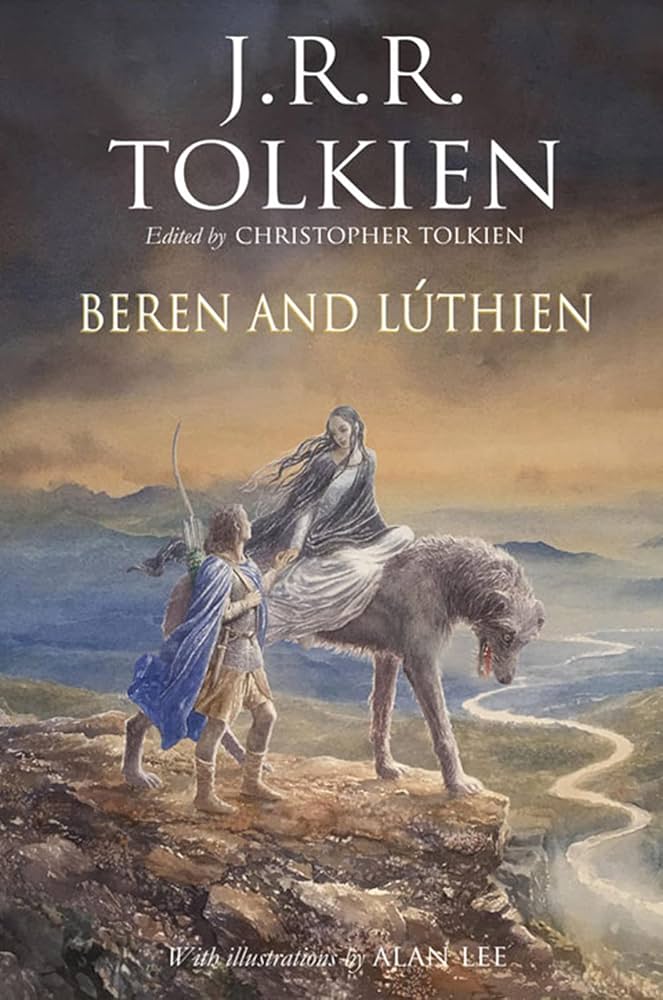
One of the best and most complete of Tolkien's earlier "lore" is Beren and Luthien. It has all the drama and angst anyone could desire. And, most importantly, it has a strong narrative arc.

Muddy Colors
Beren is human. His father is slaughtered when one of his father's followers unwillingly betrays him to Sauron. Beren kills his father's orc murderer and then makes his way through Ungoliant's niche to the realm of Thingol. 

In that realm, he comes across Luthien, who is the child of Thingol, an elf, and Melian, a Maiar. Thingol doesn't care for Beren as a choice for his daughter, but Luthien loves him and defends him. Thingol sets Beren a task to complete. Much of the couple's arc focuses on that task. 

The two perform rescues, face down Sauron (before the rings), sacrifice for each other. And they have this big pet dog! (Okay, he's more than a pet but...)  

Great characters! Great internal and external conflicts! Lots of material without having to resort to throwing a wizard-elf-dwarf-human-hobbit-villain-bunch-of-rings into a bag and shaking them about.

Monday, June 9, 2025

Character Transformation in Romance: When It Works

I point out in several posts that one reason I will walk away from an author/series is the abandonment of the character. That is, the author starts using a character for an often completely unrelated agenda by giving the character attitudes and behavior inconsistent with the character's earlier attitudes and behavior. 

The issue here is complicated by the fact that people do change. 

They change in terms of age. They change in terms of focus (what they care about, what they have time for). They even change by improving: shedding bad habits; acquiring good habits; treating others' better; treating themselves better. 

In Niffenegger's Time Traveler's Wife, the wife is at first somewhat disappointed when she meets her husband in chronological time. He isn't the older, wiser, gentle, mature guy she has grown up knowing. She knows what is coming, however, and waits for him to become that guy. 

Generally speaking, I do not advocate marriages built on "in the future, she/he might...."  In this case, what Clare knows about the man is something of a given. She still takes a leap of faith. But she isn't signing up for a complete unknowable. 

And, from a writing point of view, Henry doesn't instantly become somebody else. He is THAT guy, simply younger.

What keeps a character a character, even while that character matures? 

In my review of "Humbug," a Scrooge-tribute, I wrote that the novella succeeds because the author, Joanna Chambers, doesn't abandon the (thirty-odd) Scrooge's base personality: 

Chambers characterizes her thirty-something Scrooge, Quin, as inherently obsessive. That is, his personality is such that no matter what he does, he has to go at it to the nth degree. He gets into the consulting game by accident but once he is there, of course, he's going to be the best consultant ever whose team is also the "best". He's on the fast-track to becoming a manager.

Problem: the gig isn't totally in line with his personality, so he becomes--as characters in the story repeatedly tell him--a "dick." He later tells Rob, the Bob Crachit character, "I think [this job] brings out the worst in me."  Instead of becoming the kind of leader whose team is the best because they admire him and feel appreciated, he becomes (is becoming) the kind of leader who wrings work out of people through unreasonable demands and sheer sarky irritation. He is acting in accordance with what he believes to be the "role" of manager--and he does it well, but it makes him absolutely unpleasant to be around.

After his epiphany, he returns to his first plan to be a math teacher. And here is where Joanna Chambers really knocks the characterization out of the park: because of course, Quin has to be the BEST teacher. Only this time, what he wants and what he brings to the table are in line. He'll get in his students' faces ("They'll love you," Rob says, "because you're sarky"). He'll get in their parents' faces. He'll tick off the school board but still win. The aggressive energy that makes him unlikable in one field (that he doesn't feel at home in) will make him an excellent advocate in another.

That is, the triumph (and difficulty) of the character who changes is that the character remains the character, only better. 

A spouse can get better--but not because the spouse turns into someone else. The spouse is THAT PERSON improved, not "what I really wished I'd married instead."

Wednesday, January 29, 2025

Bromances in Lord of the Rings

Frodo and Sam; Pippin and Merry are classic bromance characters. They borrow upon English male relationships, which are quite effectively captured in the movie Tolkien.

When the LOTR trilogy came out, the question "Do you think they are gay?" was naturally posed. It's a ridiculous question that even at the time backed actors into a corner. What were they supposed to say? When George Takei said "No" to the same question about Sulu, pointing to Roddenberry's original vision, he was more or less shouted down. The ability to talk about art as a set of forms constructed for the sake of the story gets more and more of a beating these days.

The insistence on a label robs the relationships of depth. In Tolkien, the real life character Geoffrey Bache Smith, with whom real life Tolkien was good friends and who died in World War I, is given a possible crush on Tolkien, which crush remains unstated and unreciprocated. The same movie gives Tolkien a batman named Sam (likely invented). The other friends are combative and supportive and daring. Labeling them wouldn't make them more real or vibrant or individualistic. It wouldn't make their relationships with Tolkien and each other any more layered. People can be more than one thing and more than one thing with each other at the same time.

Sam and Frodo are entirely reliant on each other in their tiny band of brothers (unlike in the movie, they never separate in the book). Merry and Pippin are so close that Merry feels bereft when he is left alone with the Rohirrim--the movie perfectly captures this moment in Return of the King when Merry dashes to the outlook tower to watch Pippin ride away with Gandalf.

It seems to me that paying attention to the label rather than to the emotions keeps readers and viewers from noticing the actual reality of the relationships--which would be a pity with such great well-rounded characters. 


Wednesday, January 1, 2025

What is Tauriel Heading Towards? Beorn, Possibly--or Bard

I mention on Votaries that Jackson really needed to pay off Tauriel in The Hobbit trilogy. The issue isn't about romance. It's about storytelling. 

Set something up--pay something off.

I suggested a few pay-offs (I took keeping Kili alive off the table, though that was certainly a possible pay-off!):
  • She goes to Moria with Balin to honor Kili's memory. 
  • She takes Kili's stone back to his mum. 
  • She carries Kili's stone with her to the Undying Lands.
  • She marries Beorn. 
  • She marries Bard since they have both lost someone and she gets along with his kids. She becomes the de facto queen of Dale.
I go back and forth between Tauriel marrying Bard (hey, she's a great role model for his kids!) and Tauriel marrying Beorn, the latter in part because the novels never explain where all his Beornings came from. 

The Beornings are mentioned quite often in The Lord of the Rings novels. They are either a group that gathered around Beorn or they are his descendants. They are largely responsible for keeping passes open between East Middle Earth and West Middle Earth. Bilbo's ability (in the books) to visit the Lonely Mountain before he settles in Rivendell is due to the Beornings. 

And yet, in The Hobbit, the book, Beorn's wife is unmentioned. In Jackson's movies, she is dead.

Why not Tauriel as the co-founder of a dynasty? She's fierce!

And she's looking for something. As John Howe states about Kili and Tauriel:
 
The relationship between Tauriel and Kili is like one of those love stories where people think they are falling in love when, in fact, they are actually falling out of love with everything else around them, and the only sympathetic face is someone who they would never choose in any other circumstances...
 
Thranduil's sudden about-face at the end of the trilogy--his statement to Tauriel, "[It hurts so much] because it was real"--is not only not enough of a pay-off, it utterly misses the point. 

Tauriel and Kili's relationship was never about whether they REALLY loved each other or, for that matter, about family support. It was about the answers they found in each other that were lacking in their own cultures. "Love" was about what the other person had to offer (in a positive sense, not in a "you have to make up for my deficiencies" sense). 

Tauriel is looking for a purpose. "I'm going to save him" is an epiphany moment for her, a realization that she can expand beyond her slated role. 

I think Beorn is about as outside what she is used to as a person can get. He is powerful in his own right. An protector of the human dwellers in his area. A wilderness supporter (give the guy a state park!). A wise man. Fair in his dealings. A shapeshifter. A man with a yearning for family. 

I think Tauriel would find a home and a purpose with him. 

She could also help keep Sauron's forces at bay alongside Bard's grandson in The Lord of the Rings. 

Lots of possibilities!


Thursday, December 12, 2024

Shakespeare's Couples: Orlando & Rosalind are Kinda Boring

I'll discuss girls-dress-as-boys (or, speaking historically, boys-dressed-as-girls-dressed-as-boys-who-dress-as-girls-again) more when I reach Twelfth Night. 

For now...I'll confess, I don't think As You Like It is all that funny. 

I did when I was younger, likely because I saw a cut version of the play in the park and enjoyed it. But after trying multiple versions this past summer, I determined, "Nah. I don't know what Shakespeare was doing here, but it's not comedy..." 

The play drags as The Royal Shakespeare Company filmed version proves. The many, many, many conversations feel like clever people exchanging in-jokes while the rest of us look on. Shakespeare honestly doesn't have to feel that way. 
 
Branagh's version starts out better than the others because he cuts it ruthlessly. However, I have to agree with various critics who don't understand the purpose of the Japanese setting. I liked it for its own sake but it doesn't contribute to the movie one way or the other.
 
His leads do have great chemistry! Bryce Dallas Howard doesn't look remotely male, not even enough for us to pretend. Still--the premise calls for a great deal of belief and disbelief being suspended.
 
Olivier and Elisabeth Bergner (image above) also have great chemistry. Granted, it's hard to believe that Olivier hiked into the forest to find the exiled duke (good heavens, he looks healthy for a starving man!). But once the two lovers meet, he has supposedly recovered. And she's adorable. 
 
But I decided that the biggest problem with the couple is that the play is more Sleepless in Seattle than You've Got Mail--that is, the play is mostly about the leads when they are NOT together rather than ongoing interactions between the leads. 
 
Not even Helen Mirren changed
my mind about the play.
Much Ado About Nothing and Taming of the Shrew depend more on ongoing interactions. Twelfth Night is somewhere in the middle. As You Like It: not so much.
 
Granted, As You Like It has more interactions than Sleepless. But it takes a surprisingly long time for the couple to have anything approaching an actual conversation. 
 
Maybe the play is a decent drama or an okay comedy about peasants. But as a comedy about a couple...frankly, I think it falls flat.


Monday, June 3, 2024

Shakespeare's Couples: The Unlikable Pair from All's Well That Ends Well

Most critics agree: the Countess
Rousillon character is fantastic.
Yup, that's Judi Dench!

On Votaries, I am examining the process of turning books into other mediums. A-Z List 8 examines certain books made into films by the author's last name. I am also examining Peter Jackson's Tolkien trilogies chapter by chapter.

On Romance & Manga, I decided to examine the filmed versions of Shakespeare's romantic couples.

Going in alphabetical order, the first couple comes from All's Well That Ends Well and there simply aren't that many versions of the play-as-movie to compare and contrast. The play has been made into a movie as part of The Complete Dramatic Works of William Shakespeare--though those televised versions are often presented as plays.

The story involves a woman who sleeps with a man who didn't want to marry her--and tries to get away after he is forced to marry her. She follows him, takes the place of another woman, and sleeps with him. It's a variation on the Trope of the Forced Relationship and brings with it all the problems of the forced relationship. It is also paired with unrequited love--though Helena comes across as far more with-it than Eponine from Les Miserables. She's decided, "This is the guy I want," and she makes it happen.

And yet, still--

There's an extremely funny scene in a Sarah Caudwell book regarding the play. Julia takes Cantrip's Uncle Hereward to see All's Well That Ends Well. The elderly gentleman conflates the actors with the characters. He stands up in the theater and cries, "Shame, sir, shame, you're a scoundrel," directing his comments at Bertram. After getting thrown out of the theater, he and Julia move on to a restaurant where the Colonel "was anxious to believe that in spite of having been perfectly beastly to Helena through five acts Roussillon was really deeply in love with her, and would thereafter make her an ardent and devoted husband." Julia tries to pacify him by explaining that she thinks the title is ironic. At this point, the cast enters the restaurant and the Colonel gets into a shouting match with the actor who plays Bertram, resulting in the older man tossing spaghetti at the younger.

The couple does in fact provoke extreme reactions: critics who despise Helena. Critics, like the Colonel, who don't see WHY she loves Bertram. 

Not a great many fans of the couple as a couple.

The Complete Dramatic Works of William Shakespeare does offer one interesting interpretation--at least of the play's setting. The play uses Dutch costuming and houses, which is a captivating change from the (usually) Elizabethean look of "historical" Shakespeare plays. 

Shakespeare lived into the Jacobean Era, till 1616. The play is one of his early seventeenth-century problem plays. "Problem" is a term invented by Frederick S. Boas to group all of Shakespeare's plays he didn't like. 

One can see why All's Well That Ends Well ended up on that list.