Showing posts with label Humor. Show all posts

Wednesday, August 11, 2021

Conversations with a Translator: Humor in Manga

Although the Japanese reputedly don't 'get' irony, they deliver something that is awfully close. One of my favorite scenes from The Way of the Househusband occurs when one of Tatsu's friends makes and delivers a chocolate cake to his yakuza boss on Valentine's Day. The boss's nonplussed face (I don't get it) treads the line of irony.

Of course, irony is difficult to define--hence the website: Is It Ironic?

From my perspective as a teacher of literature, the scene would be definitively ironic if the yakuza boss actually loved chocolate (upending the readers' expectations) or was allergic (upending the character's expectations).

So what is the humor here?

I asked the Translator.

Eugene: My theory is that the comedy arises out of a juxtaposition of roles and expectations, a clash of context-based social values that are valid in one setting but not another. 
 
This exchange from Only the Ring Finger 
Knows is practically incomprehensible--til
one realizes that Wataru left off the honorific
(unfortunately, most honorifics aren't used
in the translation) with upperclassman Kazuki.
Because roles and expectations are so determined by social context in Japan, and are seemingly obvious to the objective onlooker (the audience), it's easy to upset expectations by creating situations where the roles (and the accompanying rules) don't match or trespass from one setting into another. 
 
Probably the easiest form of this kind of comedy simply has a character not using the correct honorifics, like referring to a senpai by name only (yobisute). Here's a good explanation with a relevant example.  
 
In The Way of the Househusband, the neighborhood housewives treat Tatsu like one of their own, so that's the role he assumes. But the yakuza treat him like one of their own too (as do the police). So you end up with collisions of wildly different expectations when the roles don't change to fit the setting. 


Friday, February 10, 2017

Japanese Slapstick

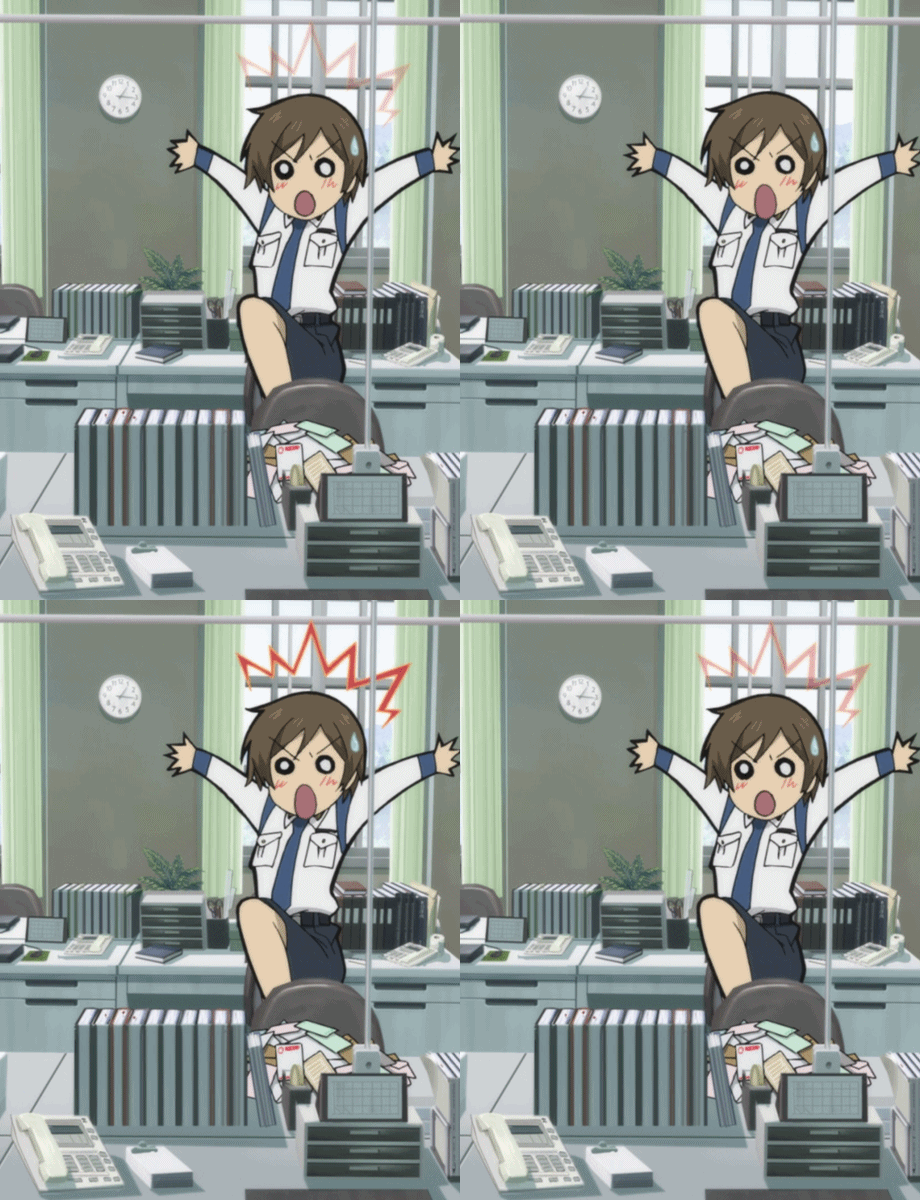
Image result for library wars Kasahara animeI remember the moment I realized that the Japanese are not all math-oriented, serious geeks (note: I see nothing wrong with being a math-oriented, serious geek).

Prior to that moment, if anyone had said to me, "But people are people. Why can't the Japanese be as silly and raunchy as everyone else?" I would have agreed. I wasn't intellectually surprised to find out I was wrong.

But, cultural assumptions being what they are, I was surprised:
So . . . I'm watching a clip of Japanese television. What's on is some type of game show or reality show where the hosts wake people up in the morning--you know, with the bed head and sleepy voice, etc. etc. This is, apparently, hilarious.

And the host makes a fart joke.

I'm not kidding!
This was my initial introduction to what cultural critics often still misunderstand: the Japanese are fans of all kinds of bodily humor, including slapstick.

I am not, which may be why I didn't notice it for so long. But the Three Stooges leave me cold. (I was the kind of kid who felt sorry for the Coyote in The Road Runner--seriously: I hated the Road Runner.)

I don't especially mind (illustrated) slapstick in manga, mostly because it is less violent than farcical--less Three Stooges, more Mr. Bean--and--perhaps mistakenly--because I read it as almost entirely representational.

Sometimes the slapstick is obviously representational, such as the manga and anime scenes in Library Wars where Kasahara "freaks out" in her head about something someone has said (see above). However, often, the physical humor is exactly what it appears to be: people are giving each other headbutts and noogies and wrestling each other to the ground. Which can be cute but often make me glad I'm not watching the encounters live.

And sometimes, the physical humor is utterly amusing, such as the omake (a possible non-canon ending invented by the mangaka herself) of Wild Rock in which the hero, instead of rescuing the main protagonist from a lion, is eaten!

"So now a moment of silence," writes Kazusa Takashima in her notes, "for that poor, pathetic, but brave man who lost his life for love."